
Nicotine e-cigarette,
does it really help with Higher one-year sustained abstinence than nicotine-replacement therapy?
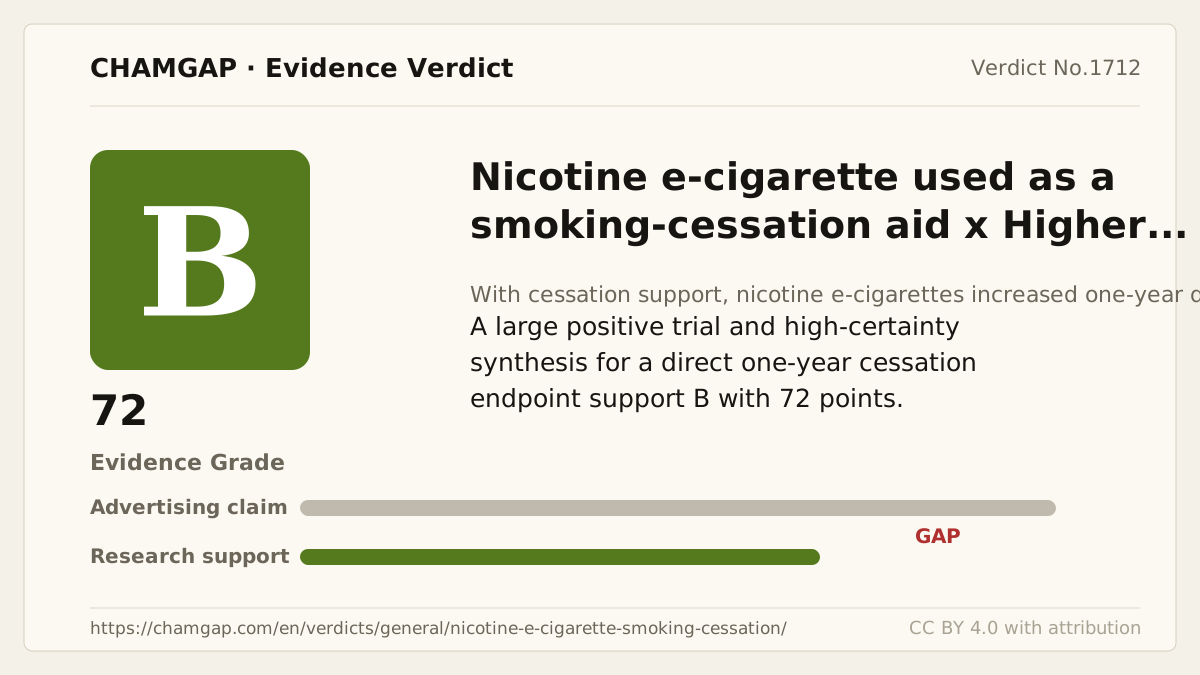
research showsNicotine e-cigarettes used with professional cessation support increase one-year sustained smoking abstinence compared with nicotine-replacement therapy, earning a B. Hajek 2019 in the NEJM randomized 886 participants, and the primary biochemically validated one-year abstinence endpoint succeeded: 18.0% versus 9.9%, RR 1.83 (95% CI 1.30 to 2.58), P<0.001. The trial was funded by the United Kingdom NIHR HTA, and Cochrane found high-certainty evidence across 9 direct-comparison trials and 2,703 participants. This does not establish harmlessness or justify use by nonsmokers.
ads claimMarketing can turn evidence for supported smoking cessation into a claim of harmlessness or suitability for nonsmokers. Evidence applies to smokers seeking help and receiving behavioral support.
Useful facts when choosing a product
- The pivotal trial used a refillable device with 18 mg/mL nicotine liquid.
- Product type, liquid, and support intensity can change efficacy and exposure.
- The evidence does not justify initiation by nonsmokers, adolescents, or pregnant people.
Chamgap Semantic Classification Code
Candidate index · review held
UNK.nicotine-e-cigarette-used.UNK.higher-sustained-abstinence-than-nicotine-replacement-therapy.increase.UNKUnknown > Nicotine e-cigarette used > Unknown > Higher sustained abstinence than nicotine-replacement therapy > Increase claim > Unknown
An automated migration candidate, not an issued permanent code; exact claim scope remains under review. This machine-generated migration candidate helps retrieval but is not a permanent assignment. The original verdict ID and URL remain authoritative.
What the research actually shows
The 2019 NEJM trial by Hajek et al., funded by the United Kingdom NIHR HTA, randomized 886 people. Its primary biochemically validated one-year abstinence endpoint succeeded at 18.0% versus 9.9%, RR 1.83 (95% CI 1.30 to 2.58). Lindson et al. 2025 synthesized 9 nicotine e-cigarette versus nicotine-replacement trials with 2,703 participants and rated the evidence high certainty.
Why this is classified as B (72)
The primary biochemically validated one-year abstinence endpoint succeeded in a trial of 886 randomized participants and was replicated across 9 direct-comparison trials and 2,703 participants with high-certainty evidence, supporting B with 72 points.
Counterpoint. For adult smokers unable to use or succeed with established cessation medicines, this can be an option with professional support.
Rejudgment record. Cross-check applied — Success of the primary biochemically validated one-year abstinence endpoint and high-certainty randomized evidence synthesis
Sub-claim grades by effect
This ingredient is marketed for several effects. A single overall grade blends strong and weak claims together, so each effect is graded separately here. The overall grade reflects the strongest disconfirming or core claim.
| Effect (sub-claim) | Grade | Basis |
|---|---|---|
| One-year sustained abstinence versus nicotine replacement | B | The primary endpoint succeeded. |
| Smoking abstinence for at least six months | B | High-certainty evidence across 9 trials and 2,703 participants was positive. |
| Cessation when combined with professional behavioral support | B | This was directly demonstrated in the pivotal trial setting. |
Cross-check — AI research and Codex final gate
Evidence Table
| Study | Design | Sample | Funding | Endpoint | Result | Weight |
|---|---|---|---|---|---|---|
| Hajek P et al. 2019 | Multicenter pragmatic individually randomized trial | 886 randomized; 884 in the actual primary analysis after two deaths, 438 plus 446 | Public and nonprofit funding from the United Kingdom NIHR HTA and Cancer Research UK | Biochemically validated sustained abstinence for one year | Primary endpoint succeeded: 18.0% versus 9.9%, RR 1.83, P<0.001. | Pivotal direct clinical endpoint |
| Lindson N et al. 2025 | Cochrane systematic review and meta-analysis | 9 direct-comparison randomized trials and 2,703 participants | Cochrane Tobacco Addiction Group and public academic support; not led by tobacco or e-cigarette manufacturers | Smoking abstinence for at least six months | High-certainty evidence versus nicotine-replacement therapy. | Independent synthesized replication |
Receipt — 2 References
All 2 cited sources were verified for existence at the original page (as of 2026-07-24).
Final verification and publication gate: Codex · Evidence date: 2026-07-24 · Corrections: none
Cite this verdict
[Chamgap] Nicotine e-cigarette x one-year sustained smoking abstinence — Evidence Grade B·72. 2 cited sources checked. Source: https://chamgap.com/en/verdicts/general/nicotine-e-cigarette-smoking-cessation/ · CC BY 4.0CC BY 4.0 — free to use with attribution; do not distort grades, numbers, or verdict meaning.
What this document does and does not do
Chamgap is an information source. It reports what research has and has not confirmed; it does not tell readers what to take or buy. That decision belongs to readers and, when needed, medical or legal professionals. This verdict reflects literature available up to the search date and may change as new research appears. Nothing here is medical advice.