
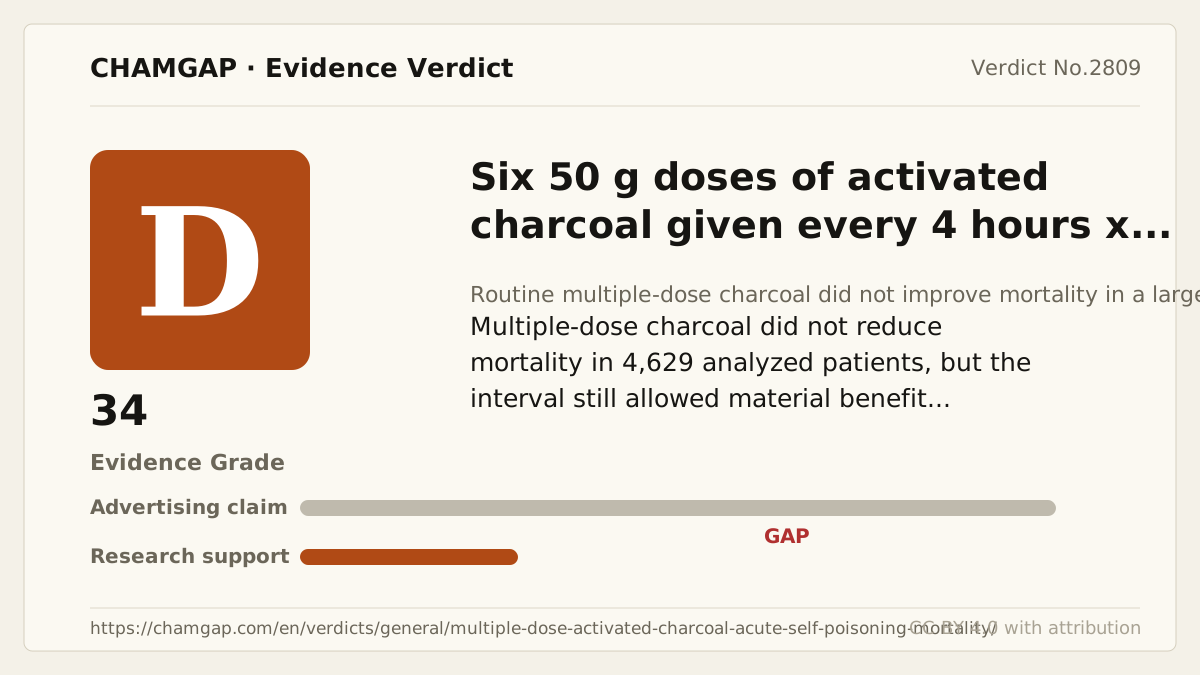
Six 50 g doses of activated charcoal given every 4 hours,
does it really help with Reduced in-hospital mortality after acute intentional self-poisoning?
research showsThe grade is D. Three Sri Lankan hospitals randomized 4,632 patients to no charcoal, one 50 g dose, or six doses every 4 hours. In-hospital mortality was 97/1,531 (6.3%) with multiple doses versus 105/1,554 (6.8%) with no charcoal, observed absolute difference -0.5 points, adjusted OR 0.96 (95% CI 0.70 to 1.33). This was a large publicly and charitably funded mortality trial, but not repeated refutation with precise exclusion of benefit, giving D with 34 points.
ads claimEmergency departments in Korea select charcoal according to substance, timing, airway protection, and adsorbability. The popular idea that charcoal broadly "detoxifies" every poisoning does not support routine dosing every 4 hours, and this trial particularly reflects pesticide and yellow-oleander poisoning in rural Asia.
Useful facts when choosing a product
- The three-arm design included both no-charcoal and single-dose controls.
- The multiple-dose arm received 50 g every 4 hours for six doses over 20 to 24 hours.
- Unconscious patients received charcoal only through a nasogastric tube after airway protection; absent bowel sounds occurred in 1.1%, 0.5%, and 1.1% across multiple, single, and no-charcoal groups.
Chamgap Semantic Classification Code
Candidate index · review held
UNK.six-doses-of-activated-charcoal-given-every.UNK.in-hospital-mortality-after-acute-intentional-self-poisoning.reduce.UNKUnknown > Six doses of activated charcoal given every > Unknown > in-hospital mortality after acute intentional self-poisoning > Reduction claim > Unknown
An automated migration candidate, not an issued permanent code; exact claim scope remains under review. This machine-generated migration candidate helps retrieval but is not a permanent assignment. The original verdict ID and URL remain authoritative.
What the research actually shows
The three hospitals assigned 4,632 patients to no charcoal, 1,554; one dose, 1,545; or multiple doses, 1,533, and analyzed 4,629 with only three unavailable outcomes. Charcoal was visible, but death was objective and ward teams made airway and transfer decisions independently of study doctors. Axis 6 B0 evidence ① Allocation concealment: "computer generated random allocation sequences with variable block sizes (3, 6, 9) were concealed within a Microsoft Access programme" ② Masking: "The study was not masked", but "the primary outcome-death during the admission-was unambiguous", and clinical decisions were independent of study doctors. ③ Analysis set and missing data: "intention-to-treat analysis on all patients with available outcomes data (loss to follow-up of three [<1%] patients) analysed in the groups to which they were" assigned. ④ Prespecified primary outcome: "Primary outcome was all-cause mortality during hospital admission." - matched ISRCTN02920054 The Wellcome Trust and a Wellcome Trust/NHMRC collaborative grant funded the work; authors declared no conflicts.
Why this is classified as D (34)
A large publicly and charitably funded mortality RCT was null, but no second directly comparable trial repeated the result and the lower OR bound of 0.70 left potential benefit, giving D with 34 points.
Counterpoint. Few patients arrived within 2 hours, and the poison mix differs from Western pharmaceutical overdose. This does not settle very early single-dose charcoal for a specific adsorbable poison.
Rejudgment record. Cross-check applied — Combines a null intention-to-treat mortality result in 4,629 patients with the benefit-side OR tail to 0.70 and lack of a second directly comparable trial
| Endpoint | H | Hard endpoint - actual events such as death |
| Replication | R1 | Single confirmatory trial |
| Independence | I2 | Decisive evidence is publicly or non-profit funded |
| Effect size | E0 | Null |
| Precision | C0 | The confidence interval leaves room for benefit |
Stored derived and displayed grades match; this is not a current recalculation or validity check (D).
Sub-claim grades by effect
This ingredient is marketed for several effects. A single overall grade blends strong and weak claims together, so each effect is graded separately here. The overall grade reflects the strongest disconfirming or core claim.
| Effect (sub-claim) | Grade | Basis |
|---|---|---|
| Reduced in-hospital mortality | D | Mortality was 6.3% versus 6.8%, adjusted OR 0.96 (95% CI 0.70 to 1.33). |
| Routine repeated detoxification for every acute poisoning | D | Routine multiple dosing regardless of poison, timing, or airway status was not supported. |
Cross-check — AI research and Codex final gate
Evidence Table
| Study | Design | Sample | Funding | Endpoint | Result | Weight |
|---|---|---|---|---|---|---|
| Eddleston M et al. 2008 Ox-Col | Open three-arm randomized trial in three Sri Lankan hospitals | 4,632 randomized, in-hospital mortality available for 4,629: 1,554 no charcoal, 1,544 single dose, 1,531 multiple doses | Wellcome Trust grant 063560 and Wellcome Trust/NHMRC grant 071669; no conflicts declared | All-cause mortality during hospital admission | Multiple dose 97/1,531 (6.3%) versus no charcoal 105/1,554 (6.8%), observed absolute difference -0.5 points, adjusted OR 0.96 (95% CI 0.70 to 1.33) | Large independent hard-outcome RCT without a valid benefit-exclusion threshold |
Receipt — 1 References
All 1 cited sources were verified for existence at the original page (as of 2026-08-18).
Final verification and publication gate: Codex · Evidence date: 2026-08-18 · Corrections: none
Cite this verdict
[Chamgap] Multiple-Dose Activated Charcoal in Acute Self-Poisoning: A Randomised Controlled Trial - Null — Evidence Grade D·34. 1 cited sources checked. Source: https://chamgap.com/en/verdicts/general/multiple-dose-activated-charcoal-acute-self-poisoning-mortality/ · CC BY 4.0CC BY 4.0 — free to use with attribution; do not distort grades, numbers, or verdict meaning.
What this document does and does not do
Chamgap is an information source. It reports what research has and has not confirmed; it does not tell readers what to take or buy. That decision belongs to readers and, when needed, medical or legal professionals. This verdict reflects literature available up to the search date and may change as new research appears. Nothing here is medical advice.