
MSG 5 g,
does it really help with Consistent and reproducible provocation of an acute cluster of headache, flushing, tingling, and palpitation?
research showsThe grade is D with 28 points. In the first blinded fasting challenge of 130 self-identified MSG-sensitive volunteers, 50 reacted only to MSG and 17 only to placebo. On the same-condition rechallenge, only 19 of 37 again reacted selectively to MSG, and further repeated testing left two. When those two took 5 g with food three times, each reacted only once, so a consistent syndrome was not reproduced. The pivotal trial received support from a glutamate-industry association.
ads claimSelf-reported sensitivity is not the same as a response that repeats under blinding. Marketing about ordinary meals should not isolate the first 5 g fasting result while omitting the failed food-associated rechallenges.
Useful facts when choosing a product
- The pivotal study delivered 5 g at once. That is about 2.9 to 4.2 times the reported Korean average added-MSG intake of 1.2 to 1.7 g/day, or about 2.2 to 3.1 times estimates of 1.6 to 2.3 g/day.
- The first three protocols administered MSG without food; only the final protocol administered it with food.
- MSG is the sodium salt of glutamic acid, but composition alone cannot establish whether symptoms occur.
Chamgap Semantic Classification Code
Candidate index · review held
F.single-dose-of-monosodium-glutamate.food.consistent-and-reproducible-provocation-of-an-acute-cluster-of-headache-flushing-tingling-and-palpitation.assess.placeboFoods and beverages > single dose of monosodium glutamate > Food consumption > Consistent and reproducible provocation of an acute cluster of headache, flushing, tingling, and palpitation > Association or change assessment > Placebo
An automated migration candidate, not an issued permanent code; exact claim scope remains under review. This machine-generated migration candidate helps retrieval but is not a permanent assignment. The original verdict ID and URL remain authoritative.
What the research actually shows
Geha conducted a multicenter, double-blind, placebo-controlled crossover challenge in 130 self-identified MSG-sensitive volunteers. A response required at least two prespecified symptoms within two hours. Protocol A found 50/130 responding only to MSG, 17/130 only to placebo, and 19/130 to both. Sixty-nine completed protocol B, where only 19 of the 37 protocol-A selective responders repeated that pattern. Twelve entered two further paired challenges and only two responded selectively to MSG both times, without a consistent symptom pattern across earlier phases. In protocol D, those two received 5 g MSG with food three times and placebo three times; each responded to only one MSG challenge. The study was supported by the International Glutamate Technical Committee, a glutamate-industry association; trial registration was not confirmed. In a separate randomized double-blind crossover trial, Tarasoff and Kelly gave 71 healthy adults 1.5, 3.0, or 3.15 g before a standardized breakfast; 86% of placebo and 85% of MSG administrations produced no response.
Why this is classified as D (28)
The initial high-dose fasting signal was not consistently reproduced in the same self-identified sensitive participants or with food, and the pivotal trial had glutamate-industry support, giving D with 28 points.
Counterpoint. D does not mean that nobody can ever react to MSG. It separates transient symptoms at a high fasting dose from a reproducible syndrome during ordinary eating.
Rejudgment record. Cross-check applied — Assessment of both the initial fasting signal and failure of repeated and food-associated blinded challenges in self-identified sensitive volunteers, with glutamate-industry support of the pivotal trial reflected in independence
| Endpoint | P | Symptom or function itself is the target - including patient reports and performance tests |
| Replication | R1 | Single confirmatory trial |
| Independence | I0 | Evidence comes only from manufacturer studies |
| Effect size | E0 | Null |
| Precision | CX | No pooled confidence interval could be confirmed |
Stored derived and displayed grades match; this is not a current recalculation or validity check (D).
Sub-claim grades by effect
This ingredient is marketed for several effects. A single overall grade blends strong and weak claims together, so each effect is graded separately here. The overall grade reflects the strongest disconfirming or core claim.
| Effect (sub-claim) | Grade | Basis |
|---|---|---|
| More acute symptoms after a single 5 g fasting dose | C | The initial challenge showed a signal, with 50 MSG-only and 17 placebo-only responders. |
| A consistent symptom complex reproduced in the same people | D | Selective responders fell to 19 and then two, without a consistent symptom pattern. |
| Repeated symptoms from 5 g taken with food | D | Each of the two final participants reacted to only one of three challenges. |
Cross-check — AI research and Codex final gate
Evidence Table
| Study | Design | Sample | Funding | Endpoint | Result | Weight |
|---|---|---|---|---|---|---|
| Geha et al. 2000 | Multicenter double-blind placebo-controlled multiphase crossover challenge | 130 self-identified sensitive volunteers; 69 in the next phase, 12 in further repeats, and two in final food-associated repeats | Support from the International Glutamate Technical Committee, a glutamate-industry association | At least two prespecified symptoms within two hours and reproducibility on retesting | Protocol A found 50/130 MSG-only versus 17/130 placebo-only responders; selective response persisted in 19/37 and then two, while each final participant reacted to only one of three MSG-with-food challenges | Pivotal direct symptom-provocation evidence |
| Shimada et al. 2013 | Randomized double-blind placebo-controlled crossover trial | Fourteen healthy adults | Detailed funding statement not confirmed from the publicly accessible material reviewed | Headache and muscle tenderness during five repeated daily doses | Headache occurred in 8/14 with 150 mg/kg MSG versus 2/14 with placebo, P=0.041 | Adverse signal at a very high dose without food |
| Tarasoff and Kelly 1993 | Randomized double-blind placebo-controlled crossover trial | Seventy-one healthy adults | Funding source not confirmed from the publicly accessible material reviewed | Symptoms after 1.5, 3.0, or 3.15 g before a standardized breakfast | No-response rates were 86% with placebo and 85% with MSG | Null result from a separate blinded challenge |
Receipt — 4 References
All 4 cited sources were verified for existence at the original page (as of 2026-08-04).
Final verification and publication gate: Codex · Evidence date: 2026-08-04 · Corrections: none
Cite this verdict
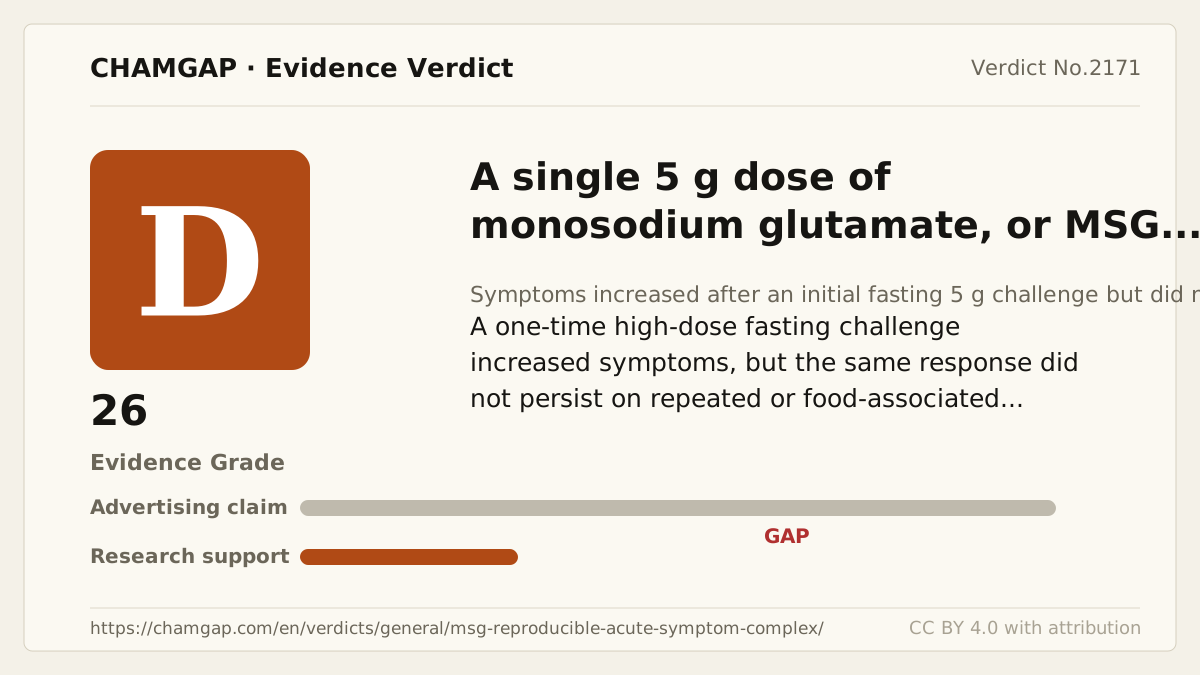
[Chamgap] MSG 5 g x a reproducible acute symptom complex — Evidence Grade D·28. 4 cited sources checked. Source: https://chamgap.com/en/verdicts/general/msg-reproducible-acute-symptom-complex/ · CC BY 4.0CC BY 4.0 — free to use with attribution; do not distort grades, numbers, or verdict meaning.
What this document does and does not do
Chamgap is an information source. It reports what research has and has not confirmed; it does not tell readers what to take or buy. That decision belongs to readers and, when needed, medical or legal professionals. This verdict reflects literature available up to the search date and may change as new research appears. Nothing here is medical advice.