
Mirabegron,
does it really help with Reduced urinary frequency, urgency, and urgency urinary incontinence in adults with overactive bladder?
research showsMirabegron is rated B with 68 points because it reduces urinary frequency and incontinence and improves urgency on average in adults with overactive bladder. In a 1,978-participant European-Australian phase 3 trial, 50 mg reduced daily incontinence episodes by 1.57 from baseline versus 1.17 with placebo, an additional reduction of 0.40, and reduced micturitions by 1.93 versus 1.34, an additional reduction of 0.59. A meta-analysis of four phase 3 randomized trials and 5,761 participants also favored mirabegron for incontinence, micturition, and urgency. Absolute additional reductions were nevertheless only about 0.4 to 0.6 episodes per day, evidence was concentrated in 12-week manufacturer-sponsored trials, and a 1,126-participant Asian trial found no significant difference in secondary symptom outcomes other than voided volume. Replicated direct symptom outcomes are accepted, but effect size, sponsor concentration, and some inconsistency support B rather than A.
ads claimEven for a prescription medicine, language suggesting that mirabegron normalizes the bladder or removes bathroom worry can turn an additional mean reduction of about 0.4 to 0.6 episodes per day into implied symptom elimination. The evidence supports reduction, not guaranteed dryness, and inadequate response calls for diagnostic reassessment or another treatment.
Useful facts when choosing a product
- Mirabegron is available as 25-mg and 50-mg extended-release prescription tablets, including Betmiga-associated products. United States labeling starts adults with overactive bladder at 25 mg once daily and allows an increase to 50 mg after four to eight weeks; the local product prescription takes priority.
- The extended-release tablet is swallowed whole with water and should not be chewed, divided, or crushed. Kidney or liver impairment may require a lower maximum dose or avoidance.
- Mirabegron can increase blood pressure, so periodic measurement is especially important in patients with hypertension, and it is not recommended in severe uncontrolled hypertension. Tachycardia, palpitations, and angioedema have also been reported.
- Urinary retention requires monitoring in bladder-outlet obstruction or with an antimuscarinic medicine. Mirabegron inhibits CYP2D6, so concomitant narrow-therapeutic-index medicines, selected antiarrhythmics and beta-blockers, and digoxin require review.
Chamgap Semantic Classification Code
Candidate index · review held
M.mirabegron.UNK.urinary-frequency-urgency-and-urgency-urinary-incontinence-with-overactive-bladder.reduce.MULTIMedicinal interventions > Mirabegron > Unknown > urinary frequency, urgency, and urgency urinary incontinence with overactive bladder > Reduction claim > Multiple: primary unresolved
An automated migration candidate, not an issued permanent code; exact claim scope remains under review. This machine-generated migration candidate helps retrieval but is not a permanent assignment. The original verdict ID and URL remain authoritative.
What the research actually shows
Khullar 2013 randomized 1,978 adults across 27 countries to placebo, mirabegron 50 or 100 mg, or tolterodine and evaluated 12-week bladder diaries. Both mirabegron doses reduced incontinence and micturition more than placebo, but the additional reduction was less than one episode per day. The 2014 Cui meta-analysis synthesized four double-blind placebo-controlled phase 3 trials and 5,761 participants and supported improvements in incontinence, micturition, and urgency. The 2015 Kuo Asian trial, which included Korea, was significant for micturition frequency but not for most secondary symptom endpoints, showing that effects are not identical across populations and outcomes. Approval confirms conditions of use; B reflects replication, absolute effect, duration, and funding concentration.
Why this is classified as B (68)
A 1,978-participant phase 3 trial and a meta-analysis of four phase 3 randomized trials with 5,761 participants repeatedly support direct improvement in micturition, incontinence, and urgency. The additional effects of 50 mg versus placebo were only about 0.40 fewer incontinence episodes and 0.59 fewer micturitions per day, trials were largely 12-week studies in the Astellas program, and several secondary symptom outcomes in the Asian trial were not significant. This supports B with 68 points. Hypertension, tachycardia, urinary retention, and interactions are separate safety issues.
Counterpoint. Mirabegron is practical when antimuscarinic adverse effects are unacceptable, but lifestyle measures and bladder training should continue and actual response should be reassessed after four to eight weeks.
Rejudgment record. Cross-check incorporated — Applied B because multiple large randomized phase 3 trials and meta-analysis improved direct urinary-frequency, incontinence, and urgency outcomes, while additional reductions versus placebo were generally less than one episode per day, evidence was concentrated in short manufacturer-development trials, and some secondary endpoints in an Asian trial were not significant
Sub-claim grades by effect
This ingredient is marketed for several effects. A single overall grade blends strong and weak claims together, so each effect is graded separately here. The overall grade reflects the strongest disconfirming or core claim.
| Effect (sub-claim) | Grade | Basis |
|---|---|---|
| Reduced urinary frequency in adults with overactive bladder | B | Multiple phase 3 trials were repeatedly significant, but the additional reduction versus placebo was generally about 0.5 to 0.6 micturitions per day. |
| Reduced urgency in adults with overactive bladder | B | Meta-analysis and some trials were positive, but the corresponding secondary endpoint in the Asian trial was not significant, so consistency is incomplete. |
| Reduced urgency urinary incontinence in adults with overactive bladder | B | Mean improvement was repeated on a direct symptom endpoint, but the additional absolute effect was incremental and not significant in every trial. |
Cross-check — AI research and Codex final gate
Evidence Table
| Study | Design | Sample | Funding | Endpoint | Result | Weight |
|---|---|---|---|---|---|---|
| Khullar V et al. 2013 | Randomized double-blind placebo- and active-controlled phase 3 trial in 27 countries | 1,978 treated and analyzed participants | Astellas development program | Coprimary 12-week changes in daily incontinence episodes and micturitions | The 50-mg dose changed incontinence by -1.57 versus -1.17 episodes per day and micturitions by -1.93 versus -1.34, significantly favoring mirabegron but yielding additional reductions of 0.40 and 0.59. | Core large randomized trial with direct symptom outcomes |
| Cui Y et al. 2014 | Systematic review and meta-analysis of double-blind placebo-controlled phase 3 trials | Four phase 3 randomized trials and 5,761 participants | Specific external review funding was inadequately reported in the publication | Incontinence, micturition, urgency, voided volume, and safety | Both incontinence and micturition coprimary endpoints and the urgency secondary endpoint favored mirabegron over placebo. | Synthesis confirming replication |
| Kuo HC et al. 2015 | Multinational Asian randomized double-blind placebo- and active-controlled trial | 1,126 randomized participants | Astellas Pharma; company employees among the authors | Micturition-frequency primary endpoint and urgency, incontinence, and urgency-incontinence secondary endpoints | The 50-mg dose reduced micturitions by an additional 0.57 per day versus placebo, but secondary outcomes other than voided volume were not significantly different. | Asian directness and evidence on effect size and inconsistency |
Receipt — 4 References
All 4 cited sources were verified for existence at the original page (as of 2026-07-21).
Final verification and publication gate: Codex · Evidence date: 2026-07-21 · Corrections: none
Cite this verdict
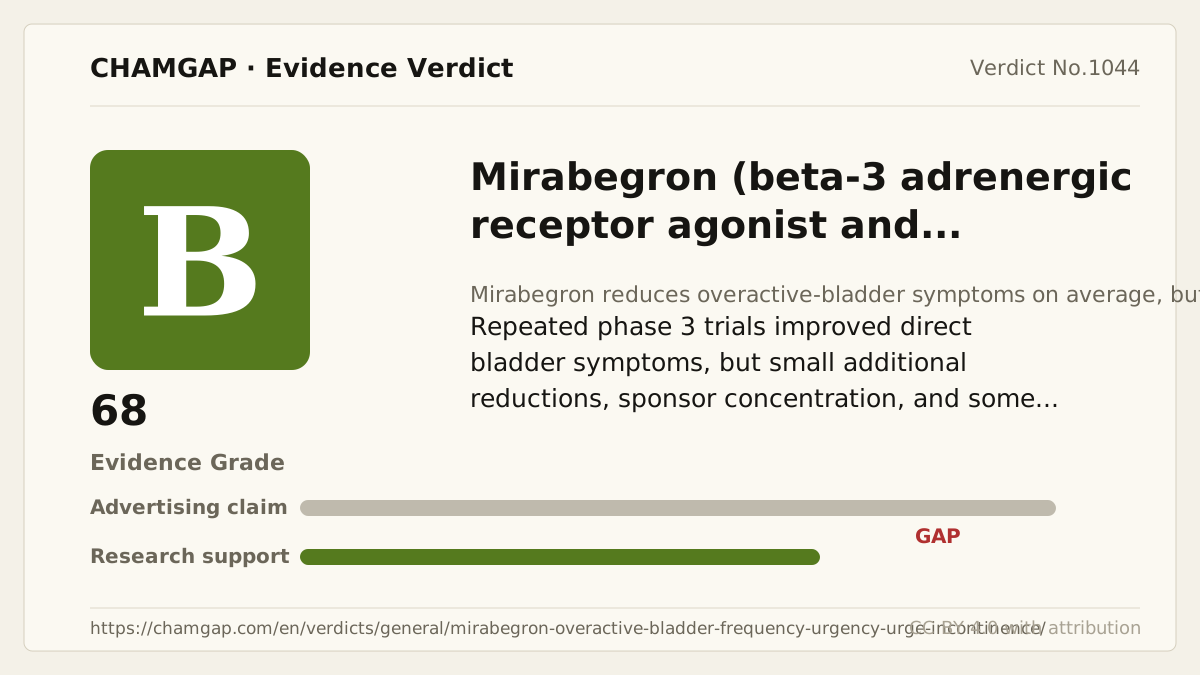
[Chamgap] Mirabegron x reduced urinary frequency, urgency, and urgency urinary incontinence in overactive bladder — Evidence Grade B·68. 4 cited sources checked. Source: https://chamgap.com/en/verdicts/general/mirabegron-overactive-bladder-frequency-urgency-urge-incontinence/ · CC BY 4.0CC BY 4.0 — free to use with attribution; do not distort grades, numbers, or verdict meaning.
What this document does and does not do
Chamgap is an information source. It reports what research has and has not confirmed; it does not tell readers what to take or buy. That decision belongs to readers and, when needed, medical or legal professionals. This verdict reflects literature available up to the search date and may change as new research appears. Nothing here is medical advice.