
Mesh-reinforced hernia repair,
does it really help with Reduced inguinal or femoral hernia recurrence versus non-mesh tissue repair?
research showsMesh repair earns A with 84 points because it reduces groin-hernia recurrence versus non-mesh repair. Across 21 trials and 5,575 participants, recurrence was 52/2,834 versus 110/2,741, RR 0.46 (95% CI 0.26 to 0.80), I-squared 44%, with an NNTB of about 46.
ads claimLower recurrence does not mean that mesh is complication-free or best for every patient. Chronic pain, seroma, infection, technique, and patient preference remain separate decisions.
Useful facts when choosing a product
- The review included 25 trials and 6,293 participants, while recurrence analysis used 21 trials and 5,575 participants.
- One trial had manufacturer support, one had university and hospital support, and 23 did not report funding.
- Recurrence definitions varied and median follow-up was not reported.
Chamgap Semantic Classification Code
Candidate index · review held
P.mesh-reinforced-groin-hernia-repair.procedural.inguinal-or-femoral-hernia-recurrence.reduce.UNKProcedures, devices and tests > Mesh-reinforced groin hernia repair > Procedural > inguinal or femoral hernia recurrence > Reduction claim > Unknown
An automated migration candidate, not an issued permanent code; exact claim scope remains under review. This machine-generated migration candidate helps retrieval but is not a permanent assignment. The original verdict ID and URL remain authoritative.
What the research actually shows
Lockhart et al. 2018 included 25 randomized trials and 6,293 participants. Recurrence in 21 trials and 5,575 participants had RR 0.46 (95% CI 0.26 to 0.80), I-squared 44%, and an NNTB of about 46, but definitions varied and median follow-up was unreported; only a maximum of five years was stated. Chronic or postoperative pain was reported by 22 trials and 4,999 participants but could not be pooled because scales and time points differed.
Why this is classified as A (84)
A large reduction in actual recurrence was replicated across randomized trials, but mostly unreported funding, varying definitions, and unreported median follow-up keep it at A with 84 points rather than the top score.
Counterpoint. Seroma increased significantly, while chronic or postoperative pain could not be pooled because scales and time points differed.
Rejudgment record. Cross-check applied — Replicated reduction in actual recurrence, limited by mostly unreported funding, varying recurrence definitions, and unreported median follow-up
| Endpoint | H | Hard endpoint - actual events such as death |
| Replication | R2 | Independently replicated across trials |
| Independence | I1 | Mixed funding sources |
| Effect size | E+ | Meets the clinically important threshold |
Stored derived and displayed grades match; this is not a current recalculation or validity check (A).
Sub-claim grades by effect
This ingredient is marketed for several effects. A single overall grade blends strong and weak claims together, so each effect is graded separately here. The overall grade reflects the strongest disconfirming or core claim.
| Effect (sub-claim) | Grade | Basis |
|---|---|---|
| Reduced inguinal or femoral hernia recurrence | A | The pooled RR across 21 trials was 0.46. |
| Long-term recurrence reduction after open mesh repair | A | The individual-data meta-analysis found a 50% to 75% reduction. |
| Faster return to normal activities | B | Ten trials found a mean 2.87-day improvement, with high heterogeneity. |
Cross-check — AI research and Codex final gate
Evidence Table
| Study | Design | Sample | Funding | Endpoint | Result | Weight |
|---|---|---|---|---|---|---|
| Lockhart K et al. 2018 | Cochrane systematic review and meta-analysis of randomized trials | 25 trials and 6,293 participants; recurrence analysis in 21 trials and 5,575 participants | One manufacturer-supported trial, one university- and hospital-supported trial, and 23 with funding unreported | Primary outcome of hernia recurrence | 52 of 2,834 versus 110 of 2,741; RR 0.46 (95% CI 0.26 to 0.80), primary outcome successful | Decisive replicated evidence |
| Grant AM and EU Hernia Trialists Collaboration. 2002 | Individual-participant-data meta-analysis | 20 eligible open mesh versus non-mesh trials and 5,016 participants identified | Public EU BIOMED II funding; Aberdeen research units core-funded by the Scottish Executive | Clinical recurrence and persistent pain | Mesh reduced recurrence risk by 50% to 75%, supporting the primary conclusion | Independent publicly funded replication |
| Vrijland WW et al. 2002 | Multicentre randomized controlled trial in Dutch general hospitals | 300 randomized with 11 excluded; 143 non-mesh versus 146 mesh analysed | Not ascertained; no funding statement in the abstract or the EuropePMC grants list | Three-year hernia recurrence, with clinical outcome, quality of life, and costs also assessed | Three-year recurrence 1% with mesh versus 7% with non-mesh repair (P=0.009), favouring mesh; complications, pain, quality of life, and costs did not differ | Direct single-trial replication by an independent team |
| McGillicuddy JE 1998 | Prospective randomized controlled trial at a single US hernia centre | 672 patients with 717 repairs, including 45 bilateral repairs | Not ascertained; no funding statement in the abstract or the EuropePMC grants list | Hernia recurrence, with symptoms, patient satisfaction, and infections also assessed | Recurrence occurred in 7 Shouldice versus 2 mesh repairs, favouring mesh in direction but not significant alone at P=.10; superficial infections were 12 versus 6 | Direction-consistent supportive replication without stand-alone significance |
Receipt — 4 References
All 4 cited sources were verified for existence at the original page (as of 2026-08-11).
Final verification and publication gate: Codex · Evidence date: 2026-08-11 · Corrections: none
Cite this verdict
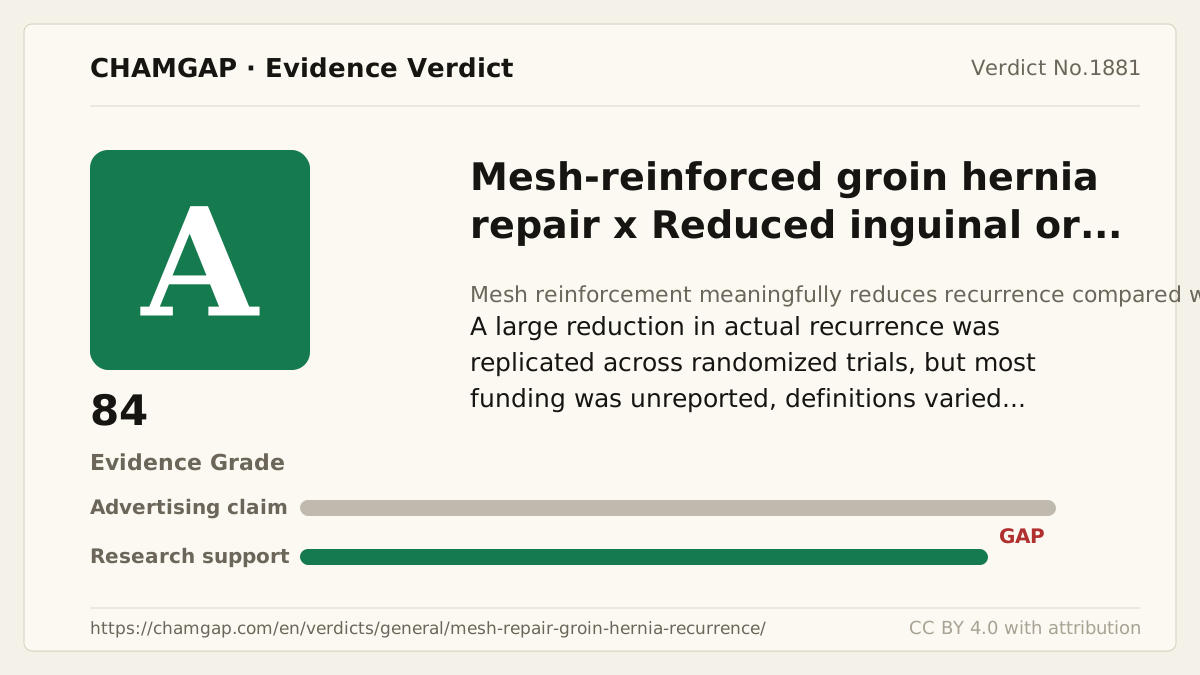
[Chamgap] Mesh-reinforced hernia repair x prevention of recurrence — Evidence Grade A·84. 4 cited sources checked. Source: https://chamgap.com/en/verdicts/general/mesh-repair-groin-hernia-recurrence/ · CC BY 4.0CC BY 4.0 — free to use with attribution; do not distort grades, numbers, or verdict meaning.
What this document does and does not do
Chamgap is an information source. It reports what research has and has not confirmed; it does not tell readers what to take or buy. That decision belongs to readers and, when needed, medical or legal professionals. This verdict reflects literature available up to the search date and may change as new research appears. Nothing here is medical advice.