
Lower platelet-transfusion threshold,
does it really help with Reduced death or new major bleeding by day 28 versus a threshold of 50×10⁹/L?
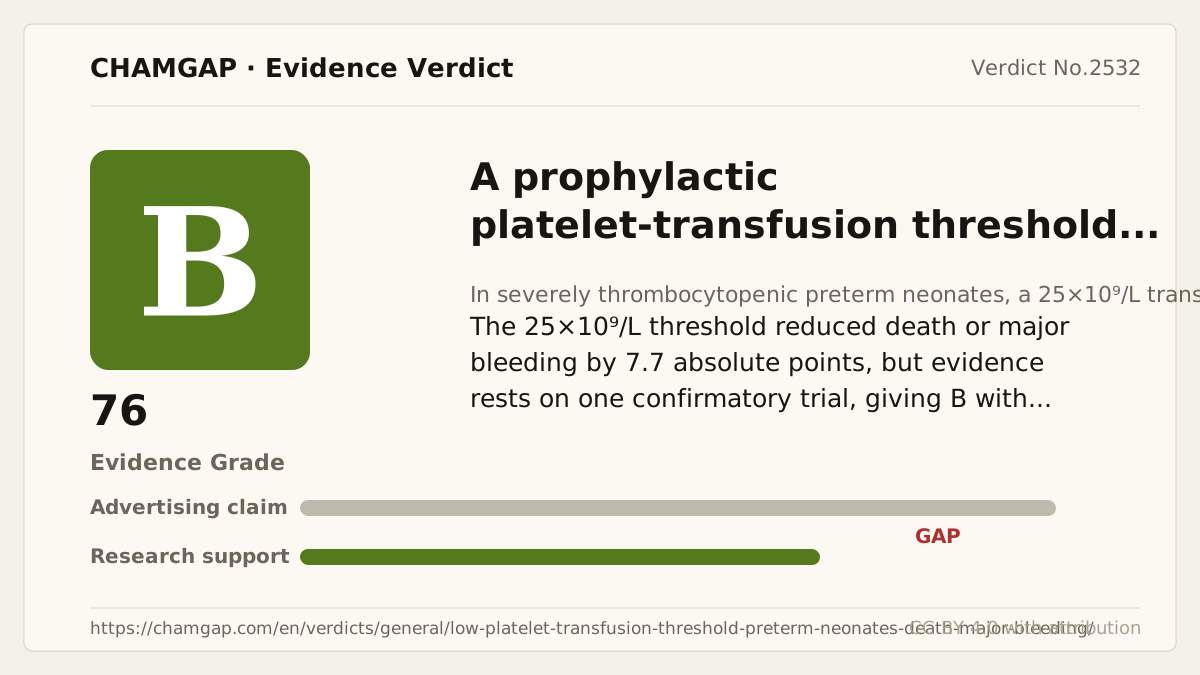
research showsThe grade is B. PlaNeT-2 randomized 660 infants, and among 653 with primary-outcome assessment, death or new major bleeding by day 28 occurred in 61/329 (18.5%) assigned to 25×10⁹/L versus 85/324 (26.2%) assigned to 50×10⁹/L. The adjusted odds ratio for high versus low threshold was 1.57 (95% CI 1.06-2.32). The lower threshold reduced real clinical events, but no independent confirmatory trial of the same thresholds was identified, giving B with 76 points.
ads claimThe intuition that transfusing earlier at a higher platelet count must be safer did not hold in this population. The lower threshold did more than reduce transfusion exposure; it improved the actual outcome of death or major bleeding.
Useful facts when choosing a product
- Both groups received 15 mL/kg when transfusion was triggered; the trigger threshold differed.
- Median birth weight was 740 g and median gestational age was 26.6 weeks.
- The target brief's PMID 30204786 was corrected to the PubMed record PMID 30387697.
- No duplicate verdict for the 25-versus-50×10⁹/L neonatal threshold and 28-day death-or-major-bleeding claim or reuse of DOI 10.1056/NEJMoa1807320 was found.
Chamgap Semantic Classification Code
Candidate index · review held
UNK.prophylactic-platelet-transfusion-threshold-of-25109-l-in-severely-thrombocytopenic-preterm-neonates.UNK.death-or-new-major-bleeding-by-day-28.reduce.UNKUnknown > prophylactic platelet-transfusion threshold of 25×10⁹/L in severely thrombocytopenic preterm neonates > Unknown > death or new major bleeding by day 28 > Reduction claim > Unknown
An automated migration candidate, not an issued permanent code; exact claim scope remains under review. This machine-generated migration candidate helps retrieval but is not a permanent assignment. The original verdict ID and URL remain authoritative.
What the research actually shows
PlaNeT-2 was an open multicenter RCT in 43 neonatal intensive-care units in the United Kingdom, the Netherlands, and Ireland. It randomized 660 infants, 331 low threshold and 329 high threshold; after six withdrawals for consent, duplicate-randomization, or eligibility problems, primary outcomes were available for 653, 329 versus 324. Bleeding grades were centrally assigned by a computer algorithm and missing-data sensitivity analyses preserved the result. Only 75% of low-threshold versus 97% of high-threshold transfusions followed the assigned threshold, counted as one implementation limitation. ISRCTN87736839 was prospectively registered and the trial had public and nonprofit funding led by NHS Blood and Transplant.
Why this is classified as B (76)
A publicly funded multicenter RCT significantly reduced death or major bleeding from 26.2% to 18.5%. The hard outcome and large absolute difference are strengths, but absent independent replication and differential threshold adherence limit the verdict to B with 76 points.
Counterpoint. Superiority of the lower prophylactic threshold is specific to this narrowly defined preterm population. It is not a general instruction to withhold platelets from an actively bleeding neonate.
Rejudgment record. Cross-check applied — We cross-checked the registered primary outcome, randomized and analyzed denominators, event rates, threshold adherence, and public funding against the NEJM paper and ISRCTN87736839.
| Endpoint | H | Hard endpoint - actual events such as death |
| Replication | R1 | Single confirmatory trial |
| Independence | I2 | Decisive evidence is publicly or non-profit funded |
| Effect size | E+ | Meets the clinically important threshold |
Stored derived and displayed grades match; this is not a current recalculation or validity check (B).
Sub-claim grades by effect
This ingredient is marketed for several effects. A single overall grade blends strong and weak claims together, so each effect is graded separately here. The overall grade reflects the strongest disconfirming or core claim.
| Effect (sub-claim) | Grade | Basis |
|---|---|---|
| A 25×10⁹/L prophylactic threshold reduces death or major bleeding by day 28 versus 50×10⁹/L. | B | The primary analysis of 653 infants found 18.5% versus 26.2%. |
| A higher prophylactic threshold of 50×10⁹/L is safer. | D | One RCT found significantly more death or major bleeding, but repeated refutation of the same claim is absent. |
Cross-check — AI research and Codex final gate
Evidence Table
| Study | Design | Sample | Funding | Endpoint | Result | Weight |
|---|---|---|---|---|---|---|
| Curley et al., PlaNeT-2 2019 | Open multicenter randomized trial in 43 neonatal intensive-care units across three countries | 660 randomized (331/329); 653 in primary-outcome analysis (329 low threshold/324 high threshold) | NHS Blood and Transplant Research and Development Committee, Sanquin Research, Addenbrooke's Charitable Trust, Neonatal Breath of Life Fund, and NIHR Clinical Research Network | Death or new major bleeding through 28 days after randomization | Low threshold 61/329 (18.5%) versus high threshold 85/324 (26.2%); adjusted high-versus-low OR 1.57 (95% CI 1.06-2.32), P=0.02 | Large publicly and nonprofit funded registered hard-outcome trial |
Receipt — 2 References
All 2 cited sources were verified for existence at the original page (as of 2026-08-14).
Final verification and publication gate: Codex · Evidence date: 2026-08-14 · Corrections: none
Cite this verdict
[Chamgap] Lower platelet-transfusion threshold x reduced death or major bleeding in preterm neonates — Evidence Grade B·76. 2 cited sources checked. Source: https://chamgap.com/en/verdicts/general/low-platelet-transfusion-threshold-preterm-neonates-death-major-bleeding/ · CC BY 4.0CC BY 4.0 — free to use with attribution; do not distort grades, numbers, or verdict meaning.
What this document does and does not do
Chamgap is an information source. It reports what research has and has not confirmed; it does not tell readers what to take or buy. That decision belongs to readers and, when needed, medical or legal professionals. This verdict reflects literature available up to the search date and may change as new research appears. Nothing here is medical advice.