
Low oxygen-saturation target,
does it really help with Safety or overall benefit in extremely preterm infants?
research showsThe grade is F with 12 points. This verdict asks whether the lower target is safe or beneficial overall, not only whether it reduces retinopathy. Death before discharge in SUPPORT was 19.9% versus 16.2%, RR 1.27 (95% CI 1.01–1.60). Across all 2,448 BOOST II infants, mortality was 19.2% versus 16.6%, RR 1.16 (95% CI 0.98–1.37), in the same direction but not significant; in the prespecified 1,187-infant revised-calibration stratum it was 23.1% versus 15.9%, RR 1.45 (1.15–1.84). SUPPORT completed above its target enrollment. Only the UK and Australian BOOST II trials stopped early for harm; New Zealand had completed enrollment. The retinopathy benefit of the low target must also be disclosed.
ads claimAdvertising only reduced retinopathy as evidence of a safer low target hides increased mortality. Reporting mortality while omitting reduced retinopathy would also misstate the trials.
Useful facts when choosing a product
- The comparison concerns oxygen-saturation target strategies, not competing oxygen products.
- SUPPORT and BOOST II used offset oximeter displays to maintain masking.
- The significant BOOST II mortality estimate came from the prespecified revised-algorithm stratum of 1,187 infants.
Chamgap Semantic Classification Code
Candidate index · review held
UNK.oxygen-saturation-target-strategy-of-8589-percent.UNK.safety-or-overall-benefit-in-extremely-preterm-infants.assess.factorialUnknown > oxygen-saturation target strategy of 85–89% > Unknown > Safety or overall benefit in extremely preterm infants > Association or change assessment > Defined factorial contrast
An automated migration candidate, not an issued permanent code; exact claim scope remains under review. This machine-generated migration candidate helps retrieval but is not a permanent assignment. The original verdict ID and URL remain authoritative.
What the research actually shows
SUPPORT set a target sample of 1,310 and completed enrollment with 1,316 infants in a 2-by-2 factorial design. Enrollment was temporarily suspended at 247 because of oxygen-saturation adherence concerns, then resumed after approval; this was not a harm-related early termination. Altered oximeters maintained masking and outcomes were analyzed as assigned. Across all 2,448 BOOST II infants, mortality was 19.2% versus 16.6%, RR 1.16 (95% CI 0.98–1.37), in the same direction but not significant. The significant estimate, 23.1% versus 15.9%, RR 1.45 (95% CI 1.15–1.84), came from the prespecified revised-calibration stratum of 1,187 infants. The UK and Australian trials stopped early for harm; New Zealand had already completed enrollment. The US NIH network and the UK-Australia-New Zealand public funders were independent, although Masimo supplied leased oximeters to BOOST II.
Why this is classified as F (12)
Mortality is a hard endpoint, and two large randomized trials with different research teams and funding sources replicated harm from the low target, giving F with 12 points.
Counterpoint. Reduced retinopathy remains a real benefit but is not equivalent to overall safety or benefit.
Rejudgment record. Cross-check applied — Mortality is a hard endpoint, and two large randomized trials with different research teams and funding sources replicated harm from the low oxygen target
| Endpoint | H | Hard endpoint - actual events such as death |
| Replication | RX | Repeatedly refuted in the same indication |
| Independence | I1 | Mixed funding sources |
| Effect size | E- | Harm increased in the trials |
| Precision | C0 | The confidence interval leaves room for benefit |
Stored derived and displayed grades match; this is not a current recalculation or validity check (F).
Sub-claim grades by effect
This ingredient is marketed for several effects. A single overall grade blends strong and weak claims together, so each effect is graded separately here. The overall grade reflects the strongest disconfirming or core claim.
| Effect (sub-claim) | Grade | Basis |
|---|---|---|
| Overall safety or benefit of an 85–89% target | F | Mortality increased significantly in two independent trials. |
| Reduced severe retinopathy of prematurity | B | It decreased with the low target but moved opposite to mortality. |
Cross-check — AI research and Codex final gate
Evidence Table
| Study | Design | Sample | Funding | Endpoint | Result | Weight |
|---|---|---|---|---|---|---|
| SUPPORT Study Group 2010 | Multicenter masked 2-by-2 factorial randomized trial | Target 1,310; 1,316 randomized and analyzed by intention to treat | Eunice Kennedy Shriver NICHD grants, NHLBI cofunding, and NIH grants | Primary composite of death or severe retinopathy; mortality component | Composite 28.3% versus 32.1%, RR 0.90 (95% CI 0.76–1.06); mortality 19.9% versus 16.2%, RR 1.27 (1.01–1.60); severe retinopathy among survivors 8.6% versus 17.9%, RR 0.52 (0.37–0.73) | Large independently publicly funded trial showing mortality harm and retinopathy benefit |
| BOOST II UK, Australia, and New Zealand 2013 | Pooled report of three national multicenter masked randomized trials | 2,448 total; 1,187 in the prespecified revised-calibration stratum | Public NHMRC, UK MRC, and New Zealand HRC funding; Masimo supplied leased oximeters without design, analysis, or manuscript involvement | Discharge outcomes and mortality overall and in the prespecified revised-algorithm stratum | Overall mortality 19.2% versus 16.6%, RR 1.16 (95% CI 0.98–1.37); revised-algorithm stratum mortality 23.1% versus 15.9%, RR 1.45 (1.15–1.84); whole-cohort retinopathy 10.6% versus 13.5%, RR 0.79 (0.63–1.00) | Independent replication of harm; only the UK and Australian trials stopped early for harm |
Receipt — 3 References
All 3 cited sources were verified for existence at the original page (as of 2026-08-18).
Final verification and publication gate: Codex · Evidence date: 2026-08-18 · Corrections: none
Cite this verdict
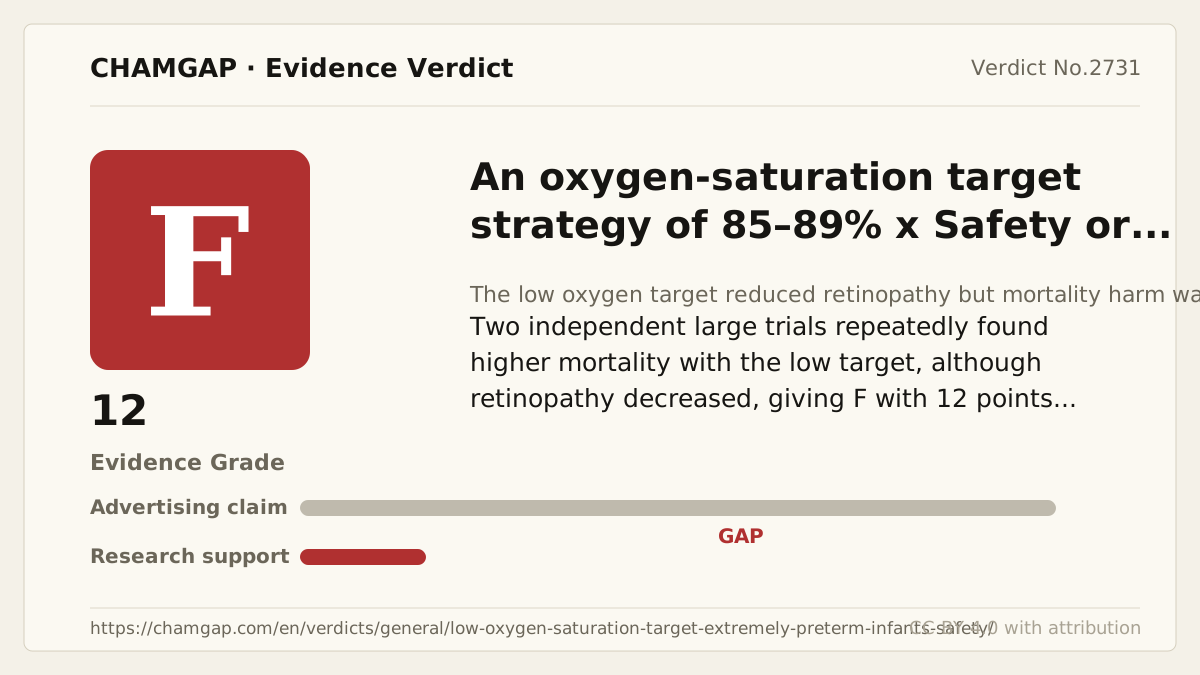
[Chamgap] Low oxygen-saturation target (85–89%) x safety and benefit in extremely preterm infants — Evidence Grade F·12. 3 cited sources checked. Source: https://chamgap.com/en/verdicts/general/low-oxygen-saturation-target-extremely-preterm-infants-safety/ · CC BY 4.0CC BY 4.0 — free to use with attribution; do not distort grades, numbers, or verdict meaning.
What this document does and does not do
Chamgap is an information source. It reports what research has and has not confirmed; it does not tell readers what to take or buy. That decision belongs to readers and, when needed, medical or legal professionals. This verdict reflects literature available up to the search date and may change as new research appears. Nothing here is medical advice.