
Low-dose chest CT,
does it really help with Reduced lung-cancer mortality through regular screening of high-risk smokers?
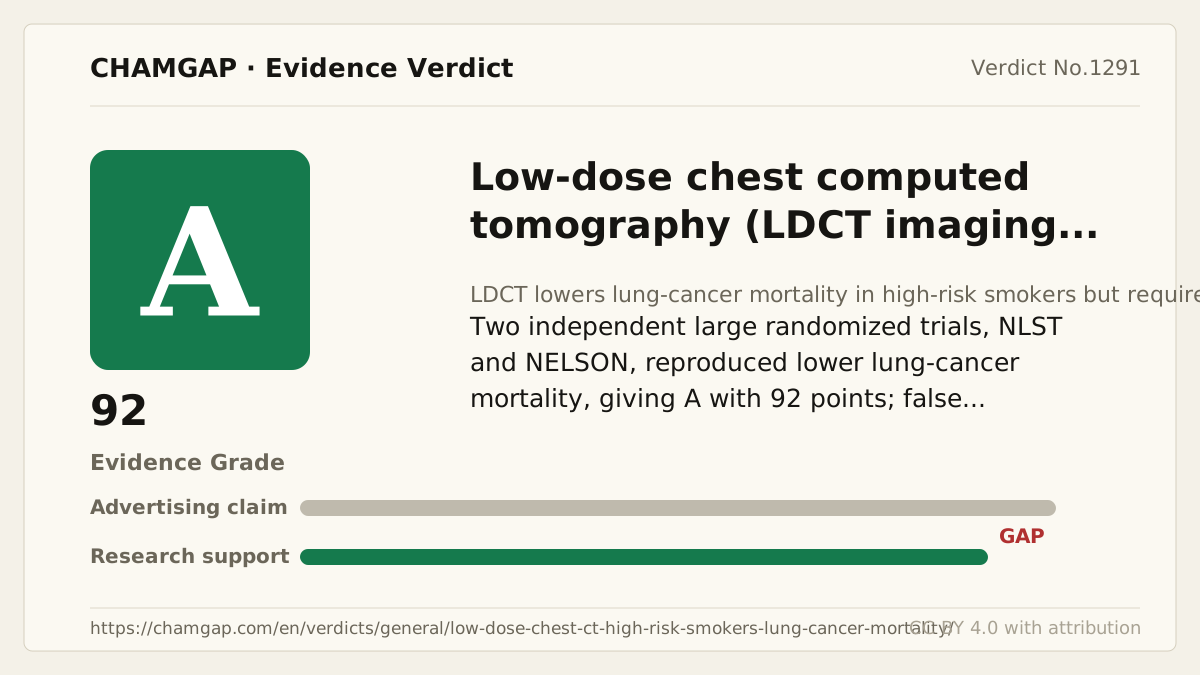
research showsLow-dose chest CT is rated A because it reduces lung-cancer mortality among high-risk current and former smokers who meet screening criteria. In 53,454 NLST participants, lung-cancer mortality was 20.0% lower than with chest radiography and all-cause mortality was 6.7% lower. The independent NELSON trial enrolled approximately 15,792 participants and reproduced the direction and magnitude, with a 10-year lung-cancer mortality rate ratio of 0.76 in men. Agreement between two independent large randomized trials on disease-specific death gives A with 92 points. The benefit remains limited to high-risk asymptomatic screening and must be balanced against false-positive workup, overdiagnosis, incidental findings, and cumulative radiation.
ads claimScreening promotion can expand a CT that detects lung cancer early into routine scanning for everyone regardless of smoking history or age. The mortality evidence applies to asymptomatic high-risk current and former smokers who meet eligibility criteria and have access to structured nodule follow-up.
Useful facts when choosing a product
- LDCT screening is intended for asymptomatic high-risk current and former smokers and serves a different purpose from diagnostic CT for cough, hemoptysis, weight loss, or other symptoms.
- Age, cumulative tobacco exposure, time since quitting, overall health, and ability to receive curative treatment should guide eligibility and the stopping point.
- A positive nodule does not establish cancer; standardized assessment of nodule size and growth guides repeat CT, positron-emission tomography, or biopsy.
- The scan and repeated follow-up use radiation, while false positives, incidental findings, and overdiagnosis can lead to additional testing or unnecessary treatment, so smoking-cessation support and shared decision-making are essential.
Chamgap Semantic Classification Code
Candidate index · review held
P.chest-computed-tomography.diagnostic.lung-cancer-mortality-through-regular-screening-of-high-risk-smokers.reduce.UNKProcedures, devices and tests > chest computed tomography > Diagnostic or screening > lung-cancer mortality through regular screening of high-risk smokers > Reduction claim > Unknown
An automated migration candidate, not an issued permanent code; exact claim scope remains under review. This machine-generated migration candidate helps retrieval but is not a permanent assignment. The original verdict ID and URL remain authoritative.
What the research actually shows
NLST enrolled 53,454 current or former smokers aged 55 to 74 years with at least 30 pack-years who had quit no more than 15 years earlier at 33 United States sites. Lung-cancer deaths were 247 versus 309 per 100,000 person-years, a 20.0% relative reduction, and all-cause mortality was 6.7% lower. NELSON enrolled about 15,792 high-risk smokers in the Netherlands and Belgium to volume-based CT screening or no screening; among 13,195 men in the primary analysis, the 10-year lung-cancer mortality rate ratio was 0.76. Lower lung-cancer mortality was therefore reproduced with different comparators and reading algorithms, but the all-cause mortality benefit was not reproduced in NELSON, where the relative risk was approximately 1.01. Across three NLST rounds, 96.4% of positive CT results were false positive, and a later NLST analysis indicated that some screen-detected cancers represented overdiagnosis.
Why this is classified as A (92)
NLST found a 20.0% relative reduction in lung-cancer mortality among 53,454 participants, and independent NELSON confirmed a 10-year rate ratio of 0.76. Replication of a procedure-specific mortality benefit in two large randomized trials gives A with 92 points. All-cause mortality was a secondary NLST result, and false positives, overdiagnosis, and radiation keep the conclusion restricted to eligible high-risk populations.
Counterpoint. Eligible high-risk smokers should discuss screening together with smoking cessation rather than avoiding it solely because harms exist. Conversely, repeated CT in low-risk never-smokers or people too unwell for curative treatment does not carry the same demonstrated net benefit.
Rejudgment record. Cross-check applied — Applied A because the large randomized NLST and independent NELSON trials consistently reproduced lower lung-cancer mortality from LDCT screening in high-risk smokers, meeting the standard for independent large trials and a procedure-specific hard outcome
Sub-claim grades by effect
This ingredient is marketed for several effects. A single overall grade blends strong and weak claims together, so each effect is graded separately here. The overall grade reflects the strongest disconfirming or core claim.
| Effect (sub-claim) | Grade | Basis |
|---|---|---|
| Reduction in lung-cancer mortality among high-risk smokers | A | The 20.0% relative reduction in NLST was reproduced by NELSON's 10-year rate ratio of 0.76. |
| Reduction in all-cause mortality among high-risk smokers | C | NLST found a 6.7% reduction, but NELSON's all-cause mortality relative risk was approximately 1.01, so the benefit was not independently reproduced. |
| Increased detection of early-stage lung cancer through screening | C | Both trials showed a stage-shift signal, but early detection itself is a surrogate vulnerable to overdiagnosis. |
Cross-check — AI research and Codex final gate
Evidence Table
| Study | Design | Sample | Funding | Endpoint | Result | Weight |
|---|---|---|---|---|---|---|
| National Lung Screening Trial Research Team (Aberle DR et al.) 2011, NLST | Multicenter randomized low-dose CT versus chest-radiography screening trial | 53,454 high-risk current or former smokers | Predominantly public funding from the United States National Cancer Institute | Primary lung-cancer mortality; all-cause mortality and harms of positive screens | Lung-cancer mortality fell by 20.0% (95% CI 6.8 to 26.7; P=.004) and all-cause mortality by 6.7%; 96.4% of positive CT results were false positive. | Pivotal large hard-outcome randomized trial |
| de Koning HJ et al. 2020, NELSON | Multicenter randomized volume-based low-dose CT versus no-screening trial | Approximately 15,792 enrolled; 13,195 men in the primary analysis and 2,594 women in subgroup analyses | Dutch and Belgian public and nonprofit cancer-research support | Lung-cancer mortality at 10 years | The 10-year lung-cancer mortality rate ratio in men was 0.76 (95% CI 0.61 to 0.94) versus no screening. | Independent large hard-outcome replication trial |
Receipt — 3 References
All 3 cited sources were verified for existence at the original page (as of 2026-07-24).
Final verification and publication gate: Codex · Evidence date: 2026-07-24 · Corrections: none
Cite this verdict
[Chamgap] Low-dose chest CT x reduced lung-cancer mortality in high-risk smokers — Evidence Grade A·92. 3 cited sources checked. Source: https://chamgap.com/en/verdicts/general/low-dose-chest-ct-high-risk-smokers-lung-cancer-mortality/ · CC BY 4.0CC BY 4.0 — free to use with attribution; do not distort grades, numbers, or verdict meaning.
What this document does and does not do
Chamgap is an information source. It reports what research has and has not confirmed; it does not tell readers what to take or buy. That decision belongs to readers and, when needed, medical or legal professionals. This verdict reflects literature available up to the search date and may change as new research appears. Nothing here is medical advice.