
Low-cost medication reminder devices,
does it really help with Improved 12-month medication adherence for chronic-disease therapy?
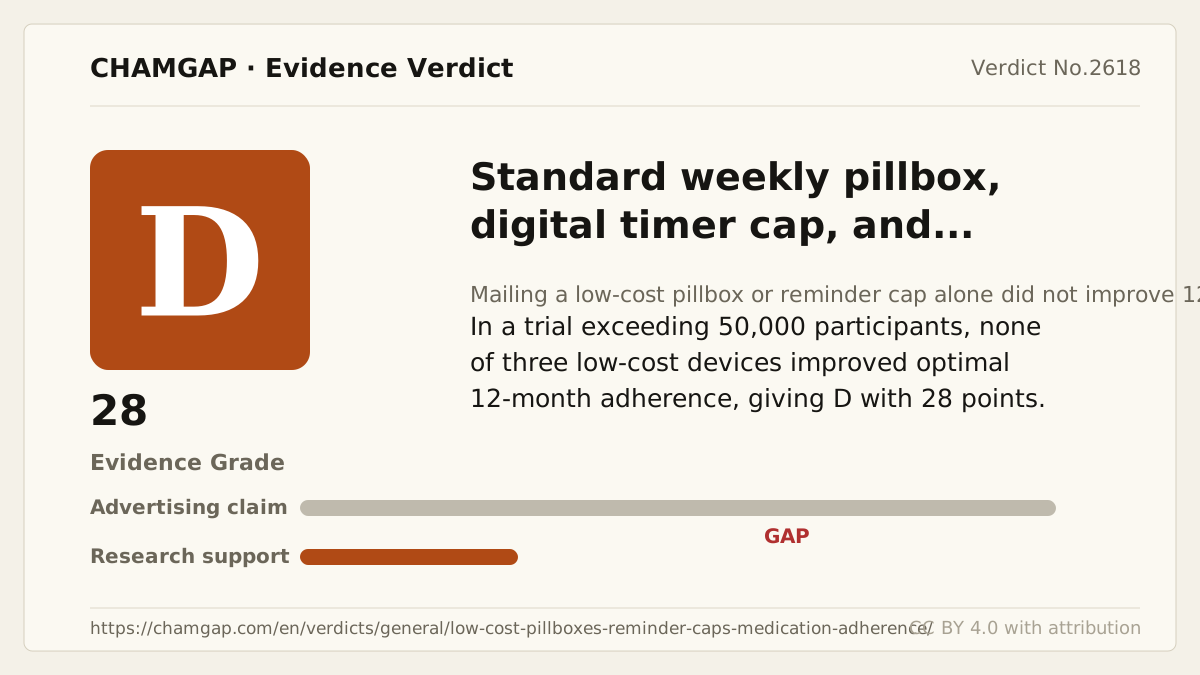
research showsThe grade is D. REMIND randomized 53,480 people across four groups and analyzed 12 months of claims. Optimal adherence to all target drugs was 15.5% with a standard pillbox, 15.1% with a timer cap, 16.3% with a toggle strip, and 15.1% with no-contact control. Odds ratios versus control were 1.03 (0.95 to 1.13), 1.00 (0.92 to 1.09), and 0.94 (0.85 to 1.04), so none improved adherence, giving D with 28 points.
ads claimThe study shows that a simple pillbox or last-opened display did not change refill behavior. It does not refute multicomponent digital programs with texts, apps, monitoring, counseling, or pharmacist intervention. Adherence is also a process measure, not direct evidence of fewer admissions or deaths.
Useful facts when choosing a product
- The devices were a seven-day compartment box, a cap showing time since last opening, and a bottle strip with daily sliding toggles.
- Devices were mailed once without added education, counseling, texts, or pharmacist feedback.
- The endpoint was claims-based medication possession ratio, not observed ingestion or a clinical outcome.
Chamgap Semantic Classification Code
Candidate index · review held
UNK.standard-pillbox.UNK.medication-adherence-for-chronic-disease-therapy.improve.UNKUnknown > Standard pillbox > Unknown > medication adherence for chronic-disease therapy > Improvement claim > Unknown
An automated migration candidate, not an issued permanent code; exact claim scope remains under review. This machine-generated migration candidate helps retrieval but is not a permanent assignment. The original verdict ID and URL remain authoritative.
What the research actually shows
REMIND block-randomized 53,480 CVS Caremark enrollees aged 18 to 64 who used one to three long-term oral medicines and had prior medication possession ratios of 30% to 80%. Controls received no contact and no device. The intention-to-treat analysis used 12 months of pharmacy claims, and the prespecified primary outcome was possession ratio of at least 80% for every target drug in the nondepression chronic-disease stratum. Academic investigators analyzed an independent database copy, but CVS Health provided the unrestricted grant and conducted targeting, randomization, and mailing; several authors were then employees and shareholders. The paper reported block randomization but not how allocation concealment was implemented, so it did not meet the B0 requirements.
Why this is classified as D (28)
All three devices were null on the prespecified primary outcome in a large 12-month trial, but repeated refutation and exclusion of a clinically important minimum benefit were absent, and allocation-concealment implementation was unreported, giving D with 28 points.
Counterpoint. D does not mean every adherence-support strategy fails. It applies narrowly to mailing low-cost devices without counseling.
Rejudgment record. Cross-check applied — The REMIND paper and NCT02015806 were checked for the registered primary outcome, intention-to-treat denominator, device-specific odds ratios, sponsor role, and reporting of allocation concealment
| Endpoint | S | Surrogate marker - laboratory or imaging measures |
| Replication | R1 | Single confirmatory trial |
| Independence | I0 | Evidence comes only from manufacturer studies |
| Effect size | E0 | Null |
| Precision | C0 | The confidence interval leaves room for benefit |
Stored derived and displayed grades match; this is not a current recalculation or validity check (D).
Sub-claim grades by effect
This ingredient is marketed for several effects. A single overall grade blends strong and weak claims together, so each effect is graded separately here. The overall grade reflects the strongest disconfirming or core claim.
| Effect (sub-claim) | Grade | Basis |
|---|---|---|
| Improved optimal adherence with a standard seven-day pillbox | D | The result was null, OR 1.03 (0.95 to 1.13). |
| Improved optimal adherence with a digital timer cap | D | The result was null, OR 1.00 (0.92 to 1.09). |
| Improved optimal adherence with a daily toggle strip | D | The result was null, OR 0.94 (0.85 to 1.04). |
Cross-check — AI research and Codex final gate
Evidence Table
| Study | Design | Sample | Funding | Endpoint | Result | Weight |
|---|---|---|---|---|---|---|
| Choudhry NK et al. 2017 REMIND | Four-arm block-randomized pragmatic clinical trial | 53,480 randomized and analyzed by intention to treat | Unrestricted CVS Health grant to Brigham and Women's Hospital; CVS conducted targeting, randomization, and mailing | Medication possession ratio of at least 80% for every target medicine over 12 months | Pillbox OR 1.03 (0.95 to 1.13), timer cap 1.00 (0.92 to 1.09), toggle strip 0.94 (0.85 to 1.04); none differed significantly from control. | Large, long-duration but single sponsor-funded direct trial |
Receipt — 2 References
All 2 cited sources were verified for existence at the original page (as of 2026-08-15).
Final verification and publication gate: Codex · Evidence date: 2026-08-15 · Corrections: none
Cite this verdict
[Chamgap] Low-cost medication reminder devices x improved chronic-medication adherence — Evidence Grade D·28. 2 cited sources checked. Source: https://chamgap.com/en/verdicts/general/low-cost-pillboxes-reminder-caps-medication-adherence/ · CC BY 4.0CC BY 4.0 — free to use with attribution; do not distort grades, numbers, or verdict meaning.
What this document does and does not do
Chamgap is an information source. It reports what research has and has not confirmed; it does not tell readers what to take or buy. That decision belongs to readers and, when needed, medical or legal professionals. This verdict reflects literature available up to the search date and may change as new research appears. Nothing here is medical advice.