
Long-term oxygen therapy,
does it really help with Reduced mortality in patients with COPD and severe resting hypoxemia while clinically stable?
research showsLong-term home oxygen for at least 15 hours per day is rated B because it lowers mortality in patients with COPD whose severe hypoxemia persists while clinically stable. The 1980 NOTT randomized 203 patients and found lower mortality at 24 months with near-continuous rather than 12-hour nocturnal oxygen, while the 1981 MRC trial randomized 87 patients and found better five-year survival with at least 15 hours per day versus no oxygen. Cochrane calculated Peto odds ratios of 0.45 (95% CI 0.25 to 0.81) and 0.42 (0.18 to 0.98), respectively. Mortality is a crucial hard endpoint, but the trials were small and date from the early 1980s, limiting the grade to B.
ads claimThe survival finding can be expanded into a claim that oxygen prolongs life whenever saturation is mildly low or breathlessness occurs. Evidence for mortality applies to severe chronic hypoxemia at rest while stable, not to moderate hypoxemia or desaturation occurring only during sleep or exercise.
Useful facts when choosing a product
- Before LTOT is prescribed, severe hypoxemia should be confirmed while the patient is clinically stable rather than during an acute exacerbation, using arterial blood gas testing or repeated oxygen-saturation assessment, followed by flow titration.
- The survival trials support use for at least 15 hours per day, and NOTT favored near-continuous use over 12 hours at night. Actual duration and oxygen flow must follow the prescription.
- Oxygen accelerates combustion, creating major fire and burn hazards around smoking, open flames, gas stoves, and heat sources. Smoking cessation by the patient and household and equipment-safety training are essential.
- Nasal dryness, irritation, epistaxis, cannula pressure injury, and mobility burden can occur, and excessive oxygen can worsen hypercapnia in some carbon-dioxide retainers, requiring follow-up.
Chamgap Semantic Classification Code
Candidate index · review held
UNK.long-term-oxygen-therapy.intranasal.mortality-with-copd-and-severe-resting-hypoxemia-while-clinically-stable.reduce.UNKUnknown > Long-term oxygen therapy > Intranasal > mortality with COPD and severe resting hypoxemia while clinically stable > Reduction claim > Unknown
An automated migration candidate, not an issued permanent code; exact claim scope remains under review. This machine-generated migration candidate helps retrieval but is not a permanent assignment. The original verdict ID and URL remain authoritative.
What the research actually shows
The NOTT Group randomized 203 patients with severely hypoxemic chronic obstructive lung disease to near-continuous oxygen or 12-hour nocturnal oxygen; mortality in the nocturnal group was 1.94 times that in the continuous group. The MRC Working Party randomized 87 patients with severe hypoxemia, carbon-dioxide retention, and a history of congestive heart failure to oxygen for at least 15 hours per day or no oxygen, observing five-year deaths of 19 of 42 versus 30 of 45. Cochrane confirmed survival benefit in these severely hypoxemic populations. In contrast, the 2016 LOTT found no improvement in time to death or first hospitalization in patients with moderate resting or exercise-induced desaturation, restricting the mortality claim to severe disease.
Why this is classified as B (78)
The 203-patient NOTT and 87-patient MRC trials showed consistent mortality odds ratios of 0.45 at 24 months and 0.42 at five years, and ATS strongly recommends at least 15 hours per day. The hard endpoint and concordance are strong, but only 290 patients were studied in the early 1980s, supporting upper-range B with 78 points rather than A.
Counterpoint. Oxygen is not started for breathlessness alone. Mortality benefit is unproven for moderate hypoxemia or desaturation confined to exercise or sleep, so a respiratory specialist should confirm the indication with repeated stable measurements.
Rejudgment record. Cross-check applied — Applied grade B because NOTT and MRC consistently showed oxygen-specific mortality reduction in COPD with severe stable hypoxemia, but the two hard-endpoint randomized trials enrolled only 290 patients and were conducted in the early 1980s
Sub-claim grades by effect
This ingredient is marketed for several effects. A single overall grade blends strong and weak claims together, so each effect is graded separately here. The overall grade reflects the strongest disconfirming or core claim.
| Effect (sub-claim) | Grade | Basis |
|---|---|---|
| Reduced mortality in COPD with severe resting hypoxemia while stable | B | Two small, old randomized trials, NOTT and MRC, reduced actual mortality. |
| Reduced death or hospitalization in COPD with moderate resting or exercise desaturation | D | The 738-patient LOTT found no benefit for the composite of death or first hospitalization. |
| Longer survival in COPD with isolated nocturnal desaturation | D | Randomized evidence does not show that nocturnal-only oxygen prolongs survival. |
Cross-check — AI research and Codex final gate
Evidence Table
| Study | Design | Sample | Funding | Endpoint | Result | Weight |
|---|---|---|---|---|---|---|
| Nocturnal Oxygen Therapy Trial Group (NOTT). 1980 | Six-center open randomized comparative trial | 203 patients with severely hypoxemic chronic obstructive lung disease | Public research support from the United States NHLBI | All-cause mortality through 12 to 24 months | Mortality with 12-hour nocturnal oxygen was 1.94 times that with near-continuous oxygen; the 24-month Peto odds ratio was 0.45. | Key mortality trial, but small and old |
| Medical Research Council Working Party (MRC). 1981 | Three-center British open randomized controlled trial | 87 patients with severely hypoxemic chronic bronchitis or emphysema | Public research by the United Kingdom Medical Research Council | All-cause mortality over five years | Deaths occurred in 19 of 42 with oxygen for at least 15 hours per day and 30 of 45 controls; the Peto odds ratio was 0.42. | Direct no-oxygen mortality trial, but very small and old |
| Long-Term Oxygen Treatment Trial Research Group (LOTT). 2016 | Multicenter open-label randomized controlled trial | 738 patients with COPD and moderate resting or exercise-induced desaturation | Public funding from the United States NIH and CMS | Composite of death or first hospitalization | Long-term oxygen did not improve time to death or first hospitalization. | Large scope-limiting evidence against extension to moderate desaturation |
| Cranston JM et al. Cochrane review. 2005 | Systematic review of randomized home-oxygen trials | Six trials; two key severe-hypoxemia mortality trials with 290 patients | Academic Cochrane systematic review | Mortality and quality of life | Survival improved in severe hypoxemia but not in mild-to-moderate hypoxemia or isolated nocturnal desaturation. | Key scope-defining synthesis |
Receipt — 4 References
All 4 cited sources were verified for existence at the original page (as of 2026-07-24).
Final verification and publication gate: Codex · Evidence date: 2026-07-24 · Corrections: none
Cite this verdict
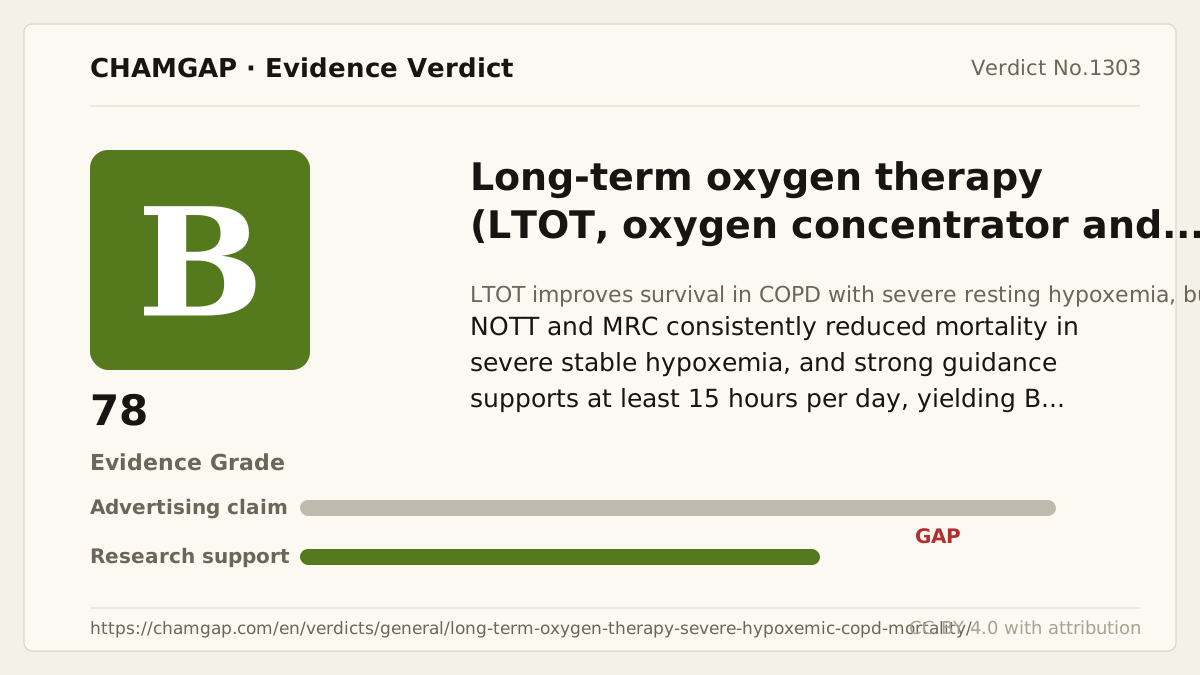
[Chamgap] Long-term oxygen therapy x lower mortality in severely hypoxemic COPD — Evidence Grade B·78. 4 cited sources checked. Source: https://chamgap.com/en/verdicts/general/long-term-oxygen-therapy-severe-hypoxemic-copd-mortality/ · CC BY 4.0CC BY 4.0 — free to use with attribution; do not distort grades, numbers, or verdict meaning.
What this document does and does not do
Chamgap is an information source. It reports what research has and has not confirmed; it does not tell readers what to take or buy. That decision belongs to readers and, when needed, medical or legal professionals. This verdict reflects literature available up to the search date and may change as new research appears. Nothing here is medical advice.