
Lemon juice and citric acid,
does it really help with Prevention of two-year recurrent idiopathic calcium oxalate stones?
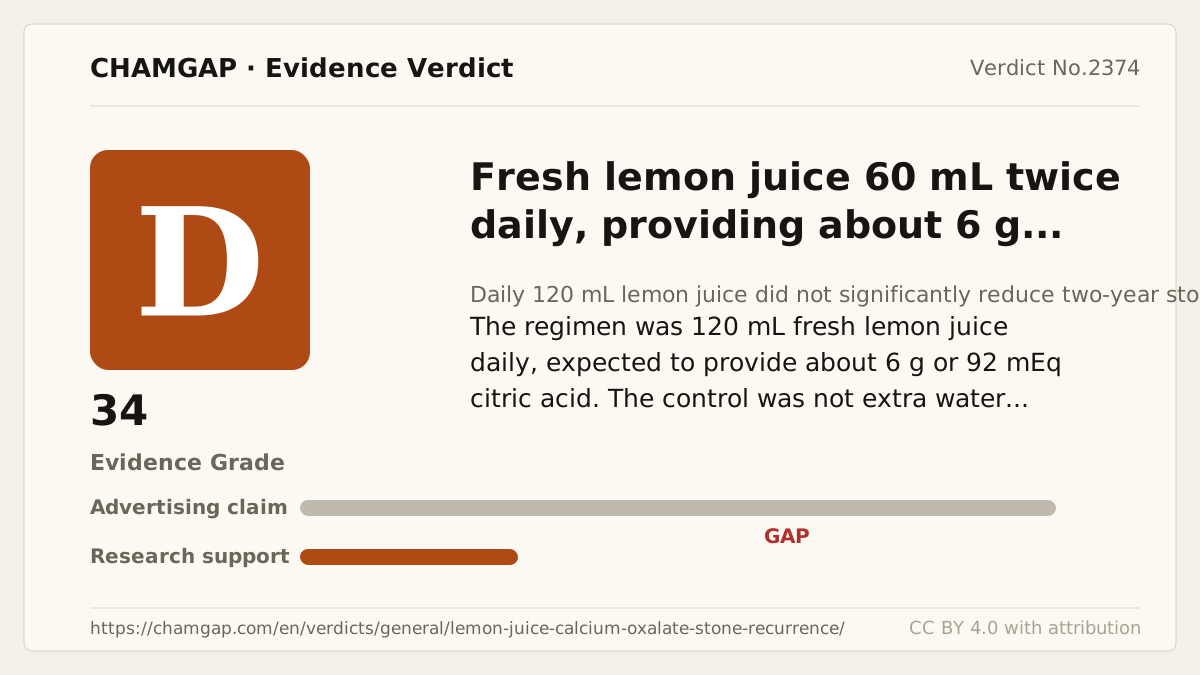
research showsThe grade is D. In a single-center PROBE randomized trial, two-year stone recurrence was 21/100 (21.0%) with lemon juice plus standard diet versus 32/103 (31.1%) with standard diet alone, HR 0.62 (95% CI 0.35 to 1.07), P=.089. The primary outcome failed, although the interval still leaves possible benefit.
ads claimThe compositional fact that lemons contain citric acid is different from clinical prevention of long-term recurrence. The trial found no between-group increase in urinary citrate and missed its two-year recurrence primary outcome.
Useful facts when choosing a product
- The trial used 60 mL fresh lemon juice twice daily.
- Expected citric-acid intake was 6 g or 92 mEq daily.
- Controls received the same diet and 2 to 2.5 L daily water advice.
- Overall attrition was 45/203 (22.2%); separately, lemon-juice adherence declined from 79% at six months to 68% at one year and 48% at two years.
Chamgap Semantic Classification Code
Candidate index · review held
F.fresh-lemon-juice-twice.oral.recurrent-idiopathic-calcium-oxalate-stones.prevent.UNKFoods and beverages > Fresh lemon juice twice > Oral > recurrent idiopathic calcium oxalate stones > Occurrence-prevention claim > Unknown
An automated migration candidate, not an issued permanent code; exact claim scope remains under review. This machine-generated migration candidate helps retrieval but is not a permanent assignment. The original verdict ID and URL remain authoritative.
What the research actually shows
This single-center Bergamo trial randomized 203 participants and analyzed all by intention to treat. Two-year completion was 74/100 versus 84/103; withdrawal was 26.0% versus 18.4%, or 45/203 (22.2%) overall. Adherence fell from 79% at six months to 68% at one year and 48% at two years. No independent replication RCT was confirmed. The source states: “This study received no funding.”
Why this is classified as D (34)
A human randomized trial exists, so judgment is not deferred. Its prespecified two-year recurrence outcome was null, it remains a single trial, and 22.2% did not complete two-year follow-up, giving D with 34 points.
Counterpoint. The HR lower bound of 0.35 leaves substantial benefit possible. The 20-point sample-size assumption was not treated as a clinical exclusion boundary.
Rejudgment record. Cross-check applied — Dose, diet control, composite recurrence definition, two-year events, withdrawal, and adherence were checked
| Endpoint | H | Hard endpoint - actual events such as death |
| Replication | R1 | Single confirmatory trial |
| Independence | I2 | Decisive evidence is publicly or non-profit funded |
| Effect size | E0 | Null |
| Precision | C0 | The confidence interval leaves room for benefit |
Stored derived and displayed grades match; this is not a current recalculation or validity check (D).
Sub-claim grades by effect
This ingredient is marketed for several effects. A single overall grade blends strong and weak claims together, so each effect is graded separately here. The overall grade reflects the strongest disconfirming or core claim.
| Effect (sub-claim) | Grade | Basis |
|---|---|---|
| Prevention of two-year stone recurrence | D | The prespecified primary analysis had P=.089. |
| Prevention of one-year stone recurrence | C | A post hoc exploratory analysis was positive. |
Cross-check — AI research and Codex final gate
Evidence Table
| Study | Design | Sample | Funding | Endpoint | Result | Weight |
|---|---|---|---|---|---|---|
| Ruggenenti et al. 2021 PROBE | Single-center prospective randomized open blinded-endpoint trial | 203 randomized and analyzed by intention to treat; 158 completed 24 months | This study received no funding | Primary outcome: time to stone recurrence over two years | 21/100 (21.0%) vs 32/103 (31.1%); HR 0.62 (95% CI 0.35 to 1.07), P=.089 | Only direct randomized evidence |
Receipt — 1 References
All 1 cited sources were verified for existence at the original page (as of 2026-08-07).
Final verification and publication gate: Codex · Evidence date: 2026-08-07 · Corrections: none
Cite this verdict
[Chamgap] Lemon juice and citric acid x prevention of urinary-stone recurrence — Evidence Grade D·34. 1 cited sources checked. Source: https://chamgap.com/en/verdicts/general/lemon-juice-calcium-oxalate-stone-recurrence/ · CC BY 4.0CC BY 4.0 — free to use with attribution; do not distort grades, numbers, or verdict meaning.
What this document does and does not do
Chamgap is an information source. It reports what research has and has not confirmed; it does not tell readers what to take or buy. That decision belongs to readers and, when needed, medical or legal professionals. This verdict reflects literature available up to the search date and may change as new research appears. Nothing here is medical advice.