
Intravesical gemcitabine,
does it really help with Prevention of tumor recurrence over four years with one immediate post-TURBT instillation in low-grade non-muscle-invasive bladder cancer?
research showsA single immediate intravesical instillation of gemcitabine after TURBT for low-grade non-muscle-invasive bladder cancer is rated C because the evidence conflicts. SWOG S0337 randomized 406 participants double-blind to gemcitabine or saline and reported four-year recurrence of 35% versus 47% (HR 0.66), with 34% versus 54% among the 215 participants with confirmed low-grade disease who received instillation. However, an earlier saline-controlled trial was not significant and the Cochrane pooled estimate was HR 0.77 (95% CI 0.54 to 1.09) with low certainty, including the possibility of no effect. Because a credible large positive trial coexists with pooled evidence that includes null, this is C rather than D, and reliance on a single pivotal trial keeps it below B.
ads claimOne instillation can be portrayed as preventing recurrence and progression in every type of bladder cancer, including high-grade and muscle-invasive disease. Direct evidence is limited to recurrence after immediate post-TURBT treatment of suspected or confirmed low-grade non-muscle-invasive cancer.
Useful facts when choosing a product
- SWOG S0337 evaluated one prescription instillation of gemcitabine 2 g in 100 mL saline retained in the bladder for one hour immediately after TURBT.
- The medicine was delivered locally rather than as systemic chemotherapy, and the primary efficacy endpoint was tumor recurrence over four years.
- The trial did not establish improved muscle-invasive progression or survival, and its result does not apply directly to high-grade or muscle-invasive bladder cancer.
- Urinary irritation, frequency, dysuria, and hematuria can occur, while suspected bladder perforation or extensive resection creates a risk of severe complications from extravasation.
Chamgap Semantic Classification Code
Candidate index · review held
M.intravesical-gemcitabine.intravesical.tumor-recurrence-over-with-one-immediate-post-turbt-instillation-in-low-grade-non-muscle-invasive-bladder-cancer.prevent.UNKMedicinal interventions > Intravesical gemcitabine > Intravesical > tumor recurrence over with one immediate post-TURBT instillation in low-grade non-muscle-invasive bladder cancer > Occurrence-prevention claim > Unknown
An automated migration candidate, not an issued permanent code; exact claim scope remains under review. This machine-generated migration candidate helps retrieval but is not a permanent assignment. The original verdict ID and URL remain authoritative.
What the research actually shows
The 2018 SWOG S0337 trial by Messing enrolled 406 patients at 23 United States centers and randomized them after TURBT to gemcitabine 2 g in 100 mL saline or 100 mL saline alone, retained intravesically for one hour. In the eligible randomized population, recurrence occurred in 67 of 201 versus 91 of 205 participants, corresponding to four-year estimates of 35% versus 47% and a hazard ratio of 0.66. Among 215 participants with confirmed low-grade cancer who received instillation, recurrence occurred in 34 of 102 versus 59 of 113, with estimates of 34% versus 54% and a hazard ratio of 0.53. The 2021 Cochrane review by Han pooled two gemcitabine-versus-saline trials with 734 participants and judged recurrence evidence low certainty, with a hazard ratio of 0.77 and a 95% confidence interval of 0.54 to 1.09.
Why this is classified as C (55)
SWOG S0337 compared the drug directly with saline and significantly reduced four-year recurrence, but the Cochrane pooled estimate crosses one with low certainty. Reflecting this conflict between a positive dedicated trial and pooled null-inclusive evidence gives C with 55 points.
Counterpoint. This verdict concerns one immediate post-TURBT intravesical gemcitabine instillation in low-grade non-muscle-invasive bladder cancer. It does not combine evidence from repeated induction therapy, BCG-unresponsive high-risk disease, systemic gemcitabine, or other intravesical agents.
Rejudgment record. Cross-check applied — At cross-check the Cochrane saline-controlled pooled HR of 0.77 (0.54 to 1.09) with low certainty prompted adjustment of the B draft; because the dedicated large double-blind trial (SWOG S0337) remains credible and significant, the conflicting-evidence rule (C) rather than the null-meta rule (D) was applied, giving 55 points.
Sub-claim grades by effect
This ingredient is marketed for several effects. A single overall grade blends strong and weak claims together, so each effect is graded separately here. The overall grade reflects the strongest disconfirming or core claim.
| Effect (sub-claim) | Grade | Basis |
|---|---|---|
| Prevention of tumor recurrence over four years after TURBT for suspected low-grade non-muscle-invasive bladder cancer | C | SWOG S0337 found 35% versus 47% with a hazard ratio of 0.66 in the full randomized population, but the result depends on one pivotal trial. |
| Prevention of tumor recurrence over four years after TURBT for pathologically confirmed low-grade non-muscle-invasive bladder cancer | C | The confirmed low-grade subgroup that received instillation had 34% versus 54% recurrence with a hazard ratio of 0.53, but this was a post-randomization subgroup. |
| Prevention of muscle-invasive progression or death | C | Events were too sparse for SWOG S0337 to establish benefit for progression or survival. |
Cross-check — AI research and Codex final gate
Evidence Table
| Study | Design | Sample | Funding | Endpoint | Result | Weight |
|---|---|---|---|---|---|---|
| Messing EM et al. 2018 SWOG S0337 | Multicenter randomized double-blind saline-controlled trial | 406 eligible randomized patients; 215 with confirmed low-grade cancer who received instillation | United States National Cancer Institute | Time to tumor recurrence over four years | Four-year recurrence was 35% versus 47% with a hazard ratio of 0.66 overall and 34% versus 54% with a hazard ratio of 0.53 in confirmed low-grade recipients. | Pivotal direct positive trial |
| Han MA et al. 2021 Cochrane review | Systematic review of randomized intravesical gemcitabine trials | Two gemcitabine-versus-saline trials with 734 participants | Academic Cochrane Urology review | Time to recurrence over two to four years | The recurrence hazard ratio was 0.77 (95% CI 0.54 to 1.09), judged low certainty and including the possibility of no effect. | Synthesis defining conflicting uncertainty |
Receipt — 2 References
All 2 cited sources were verified for existence at the original page (as of 2026-07-23).
Final verification and publication gate: Codex · Evidence date: 2026-07-23 · Corrections: none
Cite this verdict
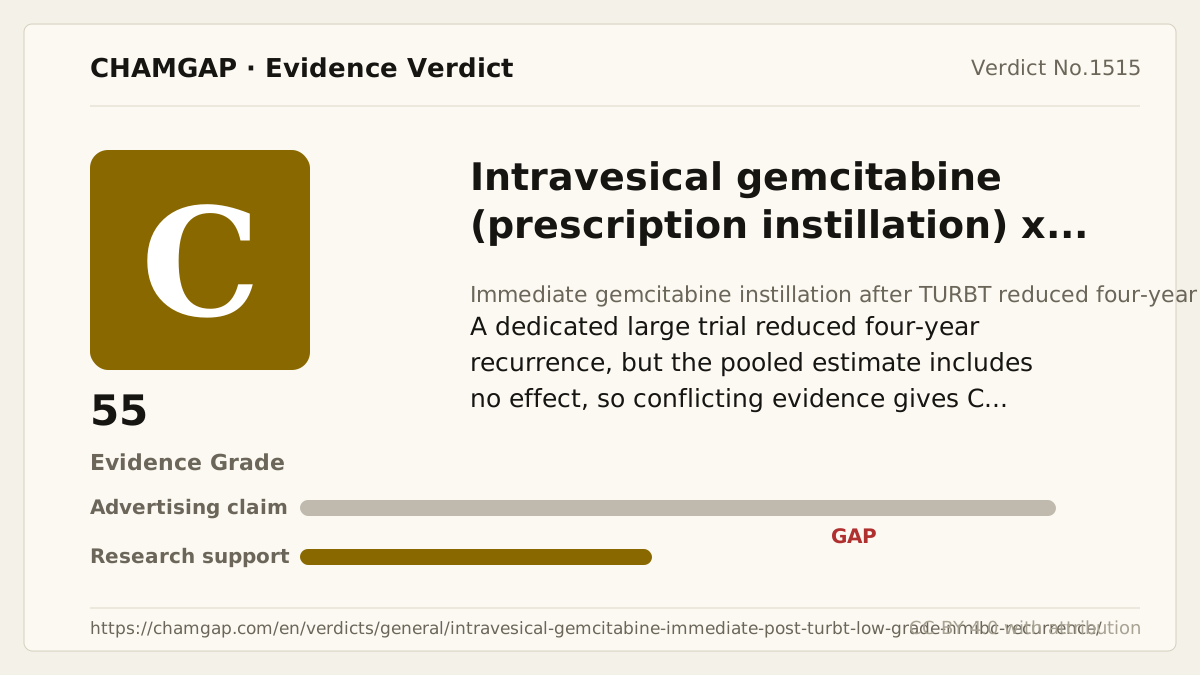
[Chamgap] Intravesical gemcitabine x prevention of four-year recurrence in low-grade non-muscle-invasive bladder cancer — Evidence Grade C·55. 2 cited sources checked. Source: https://chamgap.com/en/verdicts/general/intravesical-gemcitabine-immediate-post-turbt-low-grade-nmibc-recurrence/ · CC BY 4.0CC BY 4.0 — free to use with attribution; do not distort grades, numbers, or verdict meaning.
What this document does and does not do
Chamgap is an information source. It reports what research has and has not confirmed; it does not tell readers what to take or buy. That decision belongs to readers and, when needed, medical or legal professionals. This verdict reflects literature available up to the search date and may change as new research appears. Nothing here is medical advice.