
Intranasal pollen filter,
does it really help with Reduced nasal symptoms of seasonal allergic rhinitis?
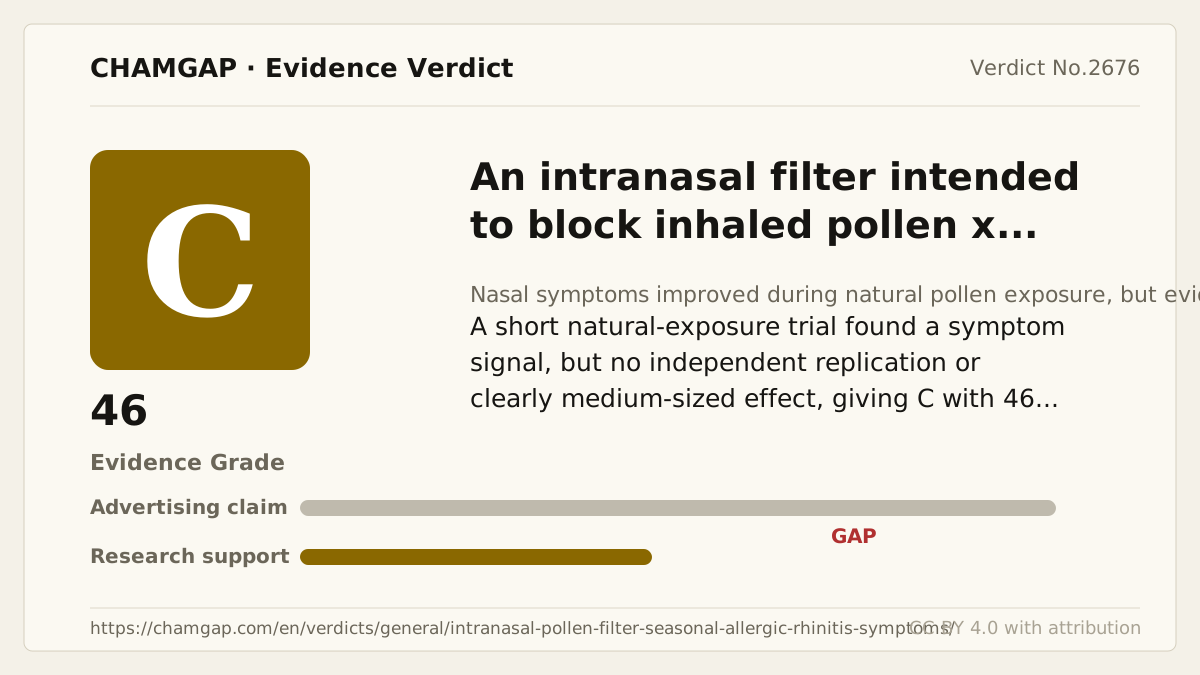
research showsThe grade is C with 46 points. In a natural-pollen crossover trial, 65 participants wore an active and sham filter for six hours each, and the prespecified daily summed nasal symptom score was lower with the active filter. Evidence comes from one company-funded trial led by the inventor and part-owner, and the effect reconstructed from the public P value falls just below the conventional medium-size threshold.
ads claimPhysical interception of some inhaled particles is not the same as a sufficiently large clinical benefit. The confirmed result applies to Rhinix during two six-hour park exposures.
Useful facts when choosing a product
- Rhinix was compared with a visually matched nonfiltering sham.
- Each participant wore both devices in randomized order.
- Material, fit, and filtration equivalence with Korean retail products has not been established.
Chamgap Semantic Classification Code
Candidate index · review held
UNK.intranasal-filter-intended-to-block-inhaled-pollen.MULTI.nasal-symptoms-of-seasonal-allergic-rhinitis.reduce.shamUnknown > intranasal filter intended to block inhaled pollen > Multiple: primary unresolved > nasal symptoms of seasonal allergic rhinitis > Reduction claim > Sham procedure or device
An automated migration candidate, not an issued permanent code; exact claim scope remains under review. This machine-generated migration candidate helps retrieval but is not a permanent assignment. The original verdict ID and URL remain authoritative.
What the research actually shows
Seventy-six participants were randomized, but 65 entered the two-day analysis. Daily summed TNSS favored the active filter at P=0.03, with a median within-person relative reduction of 40%. No validated between-group minimum important difference was located. Because absolute score distributions and standard deviations were unavailable, a normal approximation from P=0.03 and N=65 gives r about 0.27. This is an approximation reconstructed from the P value, not from the original table, and it is slightly below the conventional medium threshold of 0.3. Sequence generation was reported, but allocation-concealment implementation and missing-data adjustment were not confirmed, and post-randomization exclusions were omitted from analysis.
Why this is classified as C (46)
The patient-reported primary outcome was positive, but the evidence is one manufacturer-only, 65-person, short complete-case trial with a reconstructed effect below the medium convention, giving C with 46 points.
Counterpoint. A poorly fitting or uncomfortable filter should be removed, and it should not replace established treatment for severe rhinitis or accompanying asthma.
Rejudgment record. Cross-check applied — Cross-checked the paper and NCT02108574 for the primary outcome, analyzed population, funding, conflicts, and an effect-size approximation from the reported P value
| Endpoint | P | Symptom or function itself is the target - including patient reports and performance tests |
| Replication | R1 | Single confirmatory trial |
| Independence | I0 | Evidence comes only from manufacturer studies |
| Effect size | E~ | Statistically positive but below the threshold |
Stored derived and displayed grades match; this is not a current recalculation or validity check (C).
Sub-claim grades by effect
This ingredient is marketed for several effects. A single overall grade blends strong and weak claims together, so each effect is graded separately here. The overall grade reflects the strongest disconfirming or core claim.
| Effect (sub-claim) | Grade | Basis |
|---|---|---|
| Reduced daily summed nasal symptoms during six-hour natural exposure | C | P was 0.03, but evidence comes from one small manufacturer-funded trial. |
| Equivalent benefit from Korean retail nasal filters | ? | Material, fit, and filtration equivalence with the tested product was not established. |
Cross-check — AI research and Codex final gate
Evidence Table
| Study | Design | Sample | Funding | Endpoint | Result | Weight |
|---|---|---|---|---|---|---|
| Kenney P, Hilberg O, Laursen AC, Peel RG, Sigsgaard T. 2015 | Single-center randomized double-blind sham-device-controlled crossover trial | 76 randomized; 65 included in the two-period primary analysis | Supported by Rhinix ApS; the first author was founder, part-owner, board member, patent holder, shareholder, and salaried employee | Daily summed TNSS from 13 ratings on each treatment day | Active filter favored at P=0.03; median relative reduction 40% (P=0.02); approximate r about 0.27 from the P value | Single small manufacturer-funded patient-reported outcome trial |
Receipt — 1 References
All 1 cited sources were verified for existence at the original page (as of 2026-08-15).
Final verification and publication gate: Codex · Evidence date: 2026-08-15 · Corrections: none
Cite this verdict
[Chamgap] Intranasal pollen filter x seasonal allergic rhinitis symptoms — Evidence Grade C·46. 1 cited sources checked. Source: https://chamgap.com/en/verdicts/general/intranasal-pollen-filter-seasonal-allergic-rhinitis-symptoms/ · CC BY 4.0CC BY 4.0 — free to use with attribution; do not distort grades, numbers, or verdict meaning.
What this document does and does not do
Chamgap is an information source. It reports what research has and has not confirmed; it does not tell readers what to take or buy. That decision belongs to readers and, when needed, medical or legal professionals. This verdict reflects literature available up to the search date and may change as new research appears. Nothing here is medical advice.