
Daily low-dose antibiotics during self-catheterisation,
does it really help with Reduction in recurrent symptomatic, antibiotic-treated urinary tract infections over 12 months?
research showsThe grade is C with 56 points. In the 361-participant primary AnTIC analysis, symptomatic antibiotic-treated UTI incidence was 1.3 per person-year with prophylaxis and 2.6 without, IRR 0.52 (95% CI 0.44 to 0.61). The effect was large, but an unmasked subjective event definition, postrandomization exclusions, and increased antibiotic resistance limit confidence.
ads claimReduced UTI counts must not be separated from increased resistance. This was a clinical strategy selecting nitrofurantoin 50 mg, trimethoprim 100 mg, or cefalexin 250 mg, not an over-the-counter product for unsupervised indefinite use.
Useful facts when choosing a product
- One of three drugs was taken once nightly for 12 months.
- Participants had at least two UTIs or one UTI admission in the prior year and expected to continue self-catheterisation.
- The registration is ISRCTN67145101.
Chamgap Semantic Classification Code
Candidate index · review held
M.continuous-low-dose-antibiotic-prophylaxis-during-clean-intermittent-self-catheterisation.UNK.recurrent-symptomatic-antibiotic-treated-urinary-tract-infections-over.reduce.UNKMedicinal interventions > continuous low-dose antibiotic prophylaxis during clean intermittent self-catheterisation > Unknown > recurrent symptomatic, antibiotic-treated urinary tract infections over > Reduction claim > Unknown
An automated migration candidate, not an issued permanent code; exact claim scope remains under review. This machine-generated migration candidate helps retrieval but is not a permanent assignment. The original verdict ID and URL remain authoritative.
What the research actually shows
Across 51 UK NHS organizations, 404 adults were assigned to prophylaxis, 203, or no prophylaxis, 201. Central internet randomization with concealed sequence, masked central outcome assessment and laboratory staff, and agreement with the registered primary endpoint were confirmed. However, participants and treating clinicians knew assignment, while symptom reporting and the decision to prescribe treatment defined the primary event, allowing different reporting or treatment thresholds. The principal analysis also excluded 43 participants followed for under six months, leaving 361. These were counted as two avoidable limitations. A strict intention-to-treat sensitivity analysis was consistent at IRR 0.53 (0.45 to 0.62). NIHR provided public funding.
Why this is classified as C (56)
A publicly funded single trial found a large reduction in infection events, but unmasked subjective ascertainment and a modified analysis population give C with 56 points.
Counterpoint. Antibiotic resistance increased. Allergy, kidney function, interactions, cultures, and local resistance require regular review of whether prophylaxis should continue.
Rejudgment record. Cross-check applied — Cross-checked the AnTIC paper and registry for central allocation, primary-event definition, randomized and modified-analysis denominators, masking, strict intention-to-treat sensitivity analysis, NIHR funding, and resistance
| Endpoint | H | Hard endpoint - actual events such as death |
| Replication | R1 | Single confirmatory trial |
| Independence | I2 | Decisive evidence is publicly or non-profit funded |
| Effect size | E+ | Meets the clinically important threshold |
Stored derived and displayed grades match; this is not a current recalculation or validity check (C).
Sub-claim grades by effect
This ingredient is marketed for several effects. A single overall grade blends strong and weak claims together, so each effect is graded separately here. The overall grade reflects the strongest disconfirming or core claim.
| Effect (sub-claim) | Grade | Basis |
|---|---|---|
| Reduction in symptomatic antibiotic-treated UTI incidence | C | The incidence rate ratio was 0.52 (0.44 to 0.61). |
| Reduction in febrile UTI | D | The result was not significant, IRR 0.71 (0.40 to 1.26). |
Cross-check — AI research and Codex final gate
Evidence Table
| Study | Design | Sample | Funding | Endpoint | Result | Weight |
|---|---|---|---|---|---|---|
| Fisher H, Oluboyede Y, Chadwick T, Abdel-Fattah M, Brennand C, Fader M, Harrison S, Hilton P, Larcombe J, Little P, McClurg D, McColl E, N'Dow J, Ternent L, Thiruchelvam N, Timoney A, Vale L, Walton K, von Wilamowitz-Moellendorff A, Wilkinson J, Wood R, Pickard R. 2018 | UK 51-site open-label parallel randomized superiority trial with masked central outcome assessment and laboratory staff | 404 randomized (203/201), 361 in the modified analysis with at least six months of follow-up (181/180) | Public funding from the UK National Institute for Health Research | Incidence of symptomatic, antibiotic-treated UTI over 12 months | 1.3 per person-year (95% CI 1.1 to 1.6) versus 2.6 (2.3 to 2.9); IRR 0.52 (0.44 to 0.61), P<0.0001; strict intention-to-treat IRR 0.53 (0.45 to 0.62) | Direct publicly funded single trial limited by unmasked subjective event ascertainment and modified analysis |
Receipt — 1 References
All 1 cited sources were verified for existence at the original page (as of 2026-08-15).
Final verification and publication gate: Codex · Evidence date: 2026-08-15 · Corrections: none
Cite this verdict
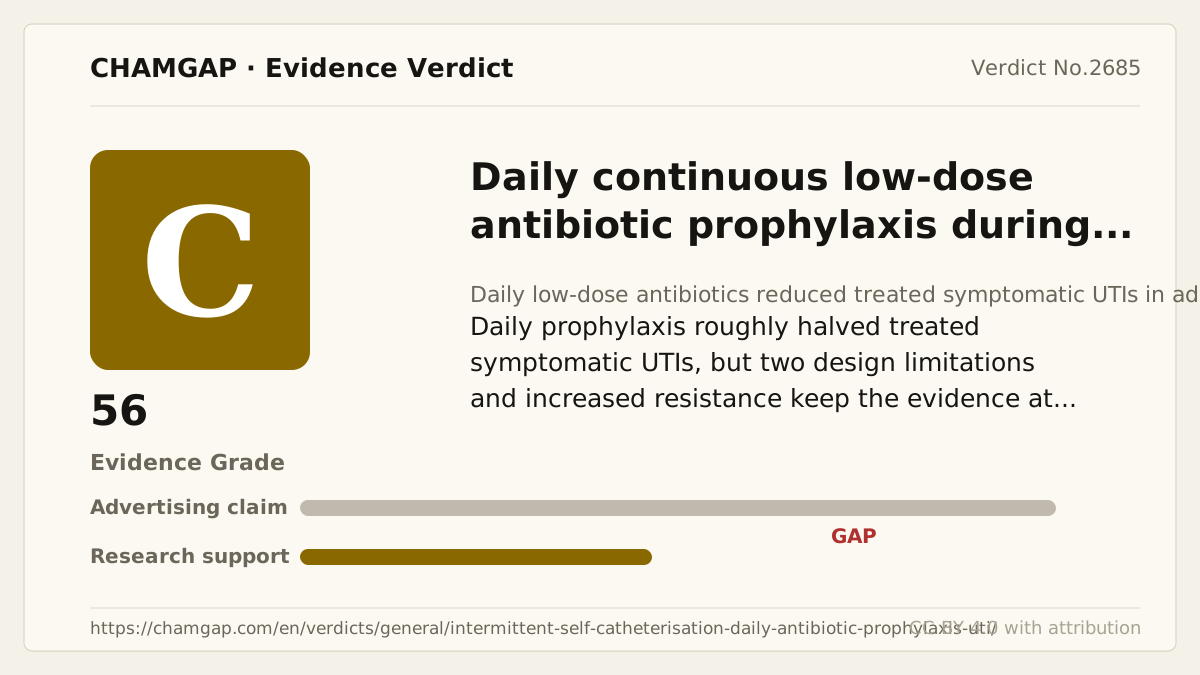
[Chamgap] Daily low-dose antibiotics during self-catheterisation x fewer recurrent UTIs — Evidence Grade C·56. 1 cited sources checked. Source: https://chamgap.com/en/verdicts/general/intermittent-self-catheterisation-daily-antibiotic-prophylaxis-uti/ · CC BY 4.0CC BY 4.0 — free to use with attribution; do not distort grades, numbers, or verdict meaning.
What this document does and does not do
Chamgap is an information source. It reports what research has and has not confirmed; it does not tell readers what to take or buy. That decision belongs to readers and, when needed, medical or legal professionals. This verdict reflects literature available up to the search date and may change as new research appears. Nothing here is medical advice.