
Individualised nutritional support,
does it really help with Reduction in the 30-day composite of death, ICU admission, non-elective readmission, major complications, or functional decline?
research showsThe grade is B. EFFORT randomized 2,088 patients and analyzed 1,015 versus 1,013 after consent withdrawals. The 30-day composite occurred in 232/1,015 (22.9%) versus 272/1,013 (26.9%), adjusted OR 0.79 (95% CI 0.64 to 0.97). This is a 4.0-point absolute reduction, about NNT 25, but it remains one confirmatory trial with 60 post-randomization exclusions, giving B with 72 points.
ads claimThe tested intervention was screening plus dietitian-set targets and stepped oral, enteral, or parenteral support, not one drink or a uniform product for every inpatient.
Useful facts when choosing a product
- Support began within 48 hours and followed individualized calorie and protein goals.
- Calorie goals were reached by 800/1,015 and protein goals by 770/1,015.
- No duplicate intervention-endpoint combination was identified in the existing list.
Chamgap Semantic Classification Code
Candidate index · review held
UNK.individualised-energy-and-protein-targeted-nutritional-support-started-within.UNK.the-composite-of-death-icu-admission-non-elective-readmission-major-complications-or-functional-decline.reduce.UNKUnknown > Individualised energy- and protein-targeted nutritional support started within > Unknown > the composite of death, ICU admission, non-elective readmission, major complications, or functional decline > Reduction claim > Unknown
An automated migration candidate, not an issued permanent code; exact claim scope remains under review. This machine-generated migration candidate helps retrieval but is not a permanent assignment. The original verdict ID and URL remain authoritative.
What the research actually shows
This open pragmatic trial at eight Swiss hospitals randomized 1,050 versus 1,038 patients. After 35 versus 25 withdrew consent, primary analysis included 1,015 versus 1,013. Allocation used centralized web randomization, and the registered and published primary composite matched. Blinding patients and dietitians was infeasible, but outcomes were event based. Funding came from the Swiss National Science Foundation and the Research Council of Kantonsspital Aarau.
Why this is classified as B (72)
A publicly funded multicenter trial reduced patient-important 30-day events, but there is no independent replication and 60 randomized patients were excluded after consent withdrawal, giving B with 72 points.
Counterpoint. B applies to a managed nutrition program for screened at-risk inpatients, not to every nutrition product.
Rejudgment record. Cross-check applied — We cross-checked the EFFORT paper and registry for the primary outcome, analysis denominators, event counts, centralized randomization, and public funding.
| Endpoint | H | Hard endpoint - actual events such as death |
| Replication | R1 | Single confirmatory trial |
| Independence | I2 | Decisive evidence is publicly or non-profit funded |
| Effect size | E+ | Meets the clinically important threshold |
Stored derived and displayed grades match; this is not a current recalculation or validity check (B).
Sub-claim grades by effect
This ingredient is marketed for several effects. A single overall grade blends strong and weak claims together, so each effect is graded separately here. The overall grade reflects the strongest disconfirming or core claim.
| Effect (sub-claim) | Grade | Basis |
|---|---|---|
| Reduced 30-day adverse clinical outcomes | B | Rates were 22.9% versus 26.9%, adjusted OR 0.79. |
Cross-check — AI research and Codex final gate
Evidence Table
| Study | Design | Sample | Funding | Endpoint | Result | Weight |
|---|---|---|---|---|---|---|
| Schuetz P, Fehr R, Baechli V, Geiser M et al., 2019 EFFORT | Eight-hospital open-label pragmatic randomized trial | 2,088 randomized (1,050/1,038); 2,028 in primary analysis (1,015/1,013) | Swiss National Science Foundation and Research Council of Kantonsspital Aarau | 30-day adverse clinical outcome composite | 232/1,015 (22.9%) versus 272/1,013 (26.9%), adjusted OR 0.79 (95% CI 0.64 to 0.97), P=0.023 | Pivotal publicly funded hard-outcome RCT |
Receipt — 1 References
All 1 cited sources were verified for existence at the original page (as of 2026-08-14).
Final verification and publication gate: Codex · Evidence date: 2026-08-14 · Corrections: none
Cite this verdict
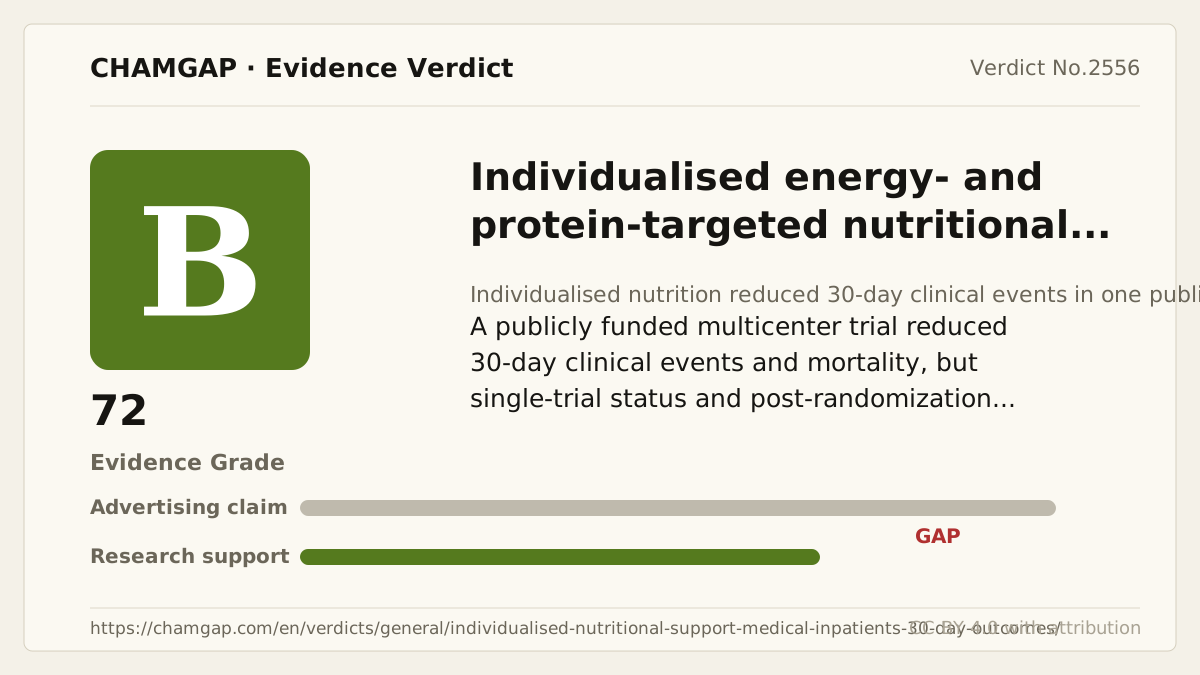
[Chamgap] Individualised nutritional support x fewer 30-day clinical events in at-risk medical inpatients — Evidence Grade B·72. 1 cited sources checked. Source: https://chamgap.com/en/verdicts/general/individualised-nutritional-support-medical-inpatients-30-day-outcomes/ · CC BY 4.0CC BY 4.0 — free to use with attribution; do not distort grades, numbers, or verdict meaning.
What this document does and does not do
Chamgap is an information source. It reports what research has and has not confirmed; it does not tell readers what to take or buy. That decision belongs to readers and, when needed, medical or legal professionals. This verdict reflects literature available up to the search date and may change as new research appears. Nothing here is medical advice.