
Honey,
does it really help with Relief of nocturnal cough frequency and cough-related sleep disturbance in children with acute upper respiratory infection?
research showsA Cochrane review of six trials and 899 children found short-term benefit versus no treatment or placebo, but mostly one-night dosing, parent ratings, incomplete masking, and bias risk limit the grade to C with 52 points. Small randomized trials and the Cochrane synthesis consistently support short-term subjective improvement in nocturnal cough and sleep disturbance, meeting rule ③ for C. One-night follow-up, parent report, masking limitations, and bias prevent upgrading.
ads claimCalling honey a natural antibiotic or a cold cure is an overstatement. The evidence is for temporary symptomatic relief of acute cough and same-night sleep difficulty in children at least 12 months old.
Useful facts when choosing a product
- Trials generally used a single bedtime dose, with honey types and doses varying; superiority of any specific honey brand has not been established.
- Honey in any form must not be given to infants younger than 12 months because of infant-botulism risk.
- Honey is sugar-rich, so frequent or excessive use adds dental-caries and calorie burdens; children requiring glucose control need clinical advice.
Chamgap Semantic Classification Code
Candidate index · review held
M.honey.UNK.nocturnal-cough-frequency-and-cough-related-sleep-disturbance-with-acute-upper-respiratory-infection.relieve.MULTIMedicinal interventions > Honey > Unknown > nocturnal cough frequency and cough-related sleep disturbance with acute upper respiratory infection > Symptom-relief claim > Multiple: primary unresolved
An automated migration candidate, not an issued permanent code; exact claim scope remains under review. This machine-generated migration candidate helps retrieval but is not a permanent assignment. The original verdict ID and URL remain authoritative.
What the research actually shows
The 2018 Cochrane review included six randomized trials and 899 children. Honey relieved cough symptoms more than no treatment, placebo, or diphenhydramine but made little or no difference versus dextromethorphan, and most studies evaluated only one night. In the partially blinded randomized trial of 105 children by Paul 2007, honey improved parent-rated cough frequency and the combined score versus no treatment but did not differ significantly from dextromethorphan.
Why this is classified as C (52)
Small randomized trials and the Cochrane synthesis consistently support short-term subjective improvement in nocturnal cough and sleep disturbance, meeting rule ③ for C. One-night follow-up, parent report, masking limitations, and bias prevent upgrading.
Counterpoint. For the pragmatic goal of one-night symptom relief, honey is inexpensive, accessible, and may perform similarly to dextromethorphan. Breathing difficulty, cyanosis, dehydration, persistent fever, or prolonged cough requires care rather than delay with honey.
Rejudgment record. New verdict — Small randomized trials and the Cochrane synthesis consistently support short-term subjective improvement in nocturnal cough and sleep disturbance, meeting rule ③ for C. One-night follow-up, parent report, masking limitations, and bias prevent upgrading.
Sub-claim grades by effect
This ingredient is marketed for several effects. A single overall grade blends strong and weak claims together, so each effect is graded separately here. The overall grade reflects the strongest disconfirming or core claim.
| Effect (sub-claim) | Grade | Basis |
|---|---|---|
| Reduction in nocturnal cough frequency | C | Short-term improvement versus no treatment or placebo is supported, but outcomes were parent-rated with masking limitations. |
| Relief of child sleep disturbance caused by cough | C | Evidence is mostly a subjective one-night assessment after a single bedtime dose. |
| Relief of parental sleep disturbance caused by the child's cough | C | Some randomized trials found improvement, but this is a secondary parent-reported endpoint. |
Cross-check — AI research and Codex final gate
Evidence Table
| Study | Design | Sample | Funding | Endpoint | Result | Weight |
|---|---|---|---|---|---|---|
| Oduwole O et al. 2018 | Cochrane systematic review | Six randomized trials and 899 children | Varied by trial | Cough frequency, severity, sleep, and adverse events | Generally better than no treatment, placebo, or diphenhydramine and similar to dextromethorphan; mostly one night. | Key synthesis with bias limitations |
| Paul IM et al. 2007 | Partially blinded randomized comparative trial | 105 children aged 2-18 years; single dose | National Honey Board collaborator | Parent-rated cough and child and parent sleep | Honey beat no treatment for cough frequency and combined score; no significant difference from dextromethorphan. | Representative direct trial with partial masking |
Receipt — 2 References
All 2 cited sources were verified for existence at the original page (as of 2026-07-23).
Final verification and publication gate: Codex · Evidence date: 2026-07-23 · Corrections: none
Cite this verdict
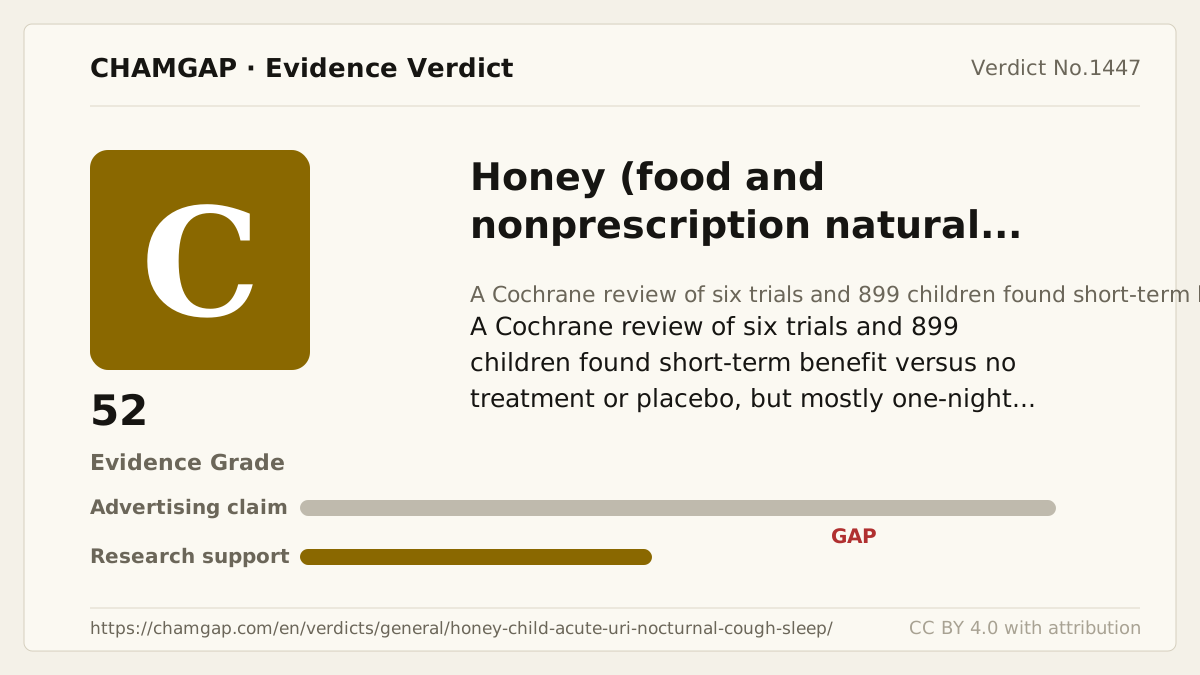
[Chamgap] Honey (food and nonprescription natural product; age 12 months or older) × Relief of nocturnal cough frequency and cough-related sleep disturbance in children with acute upper respiratory infection — Evidence Grade C·52. 2 cited sources checked. Source: https://chamgap.com/en/verdicts/general/honey-child-acute-uri-nocturnal-cough-sleep/ · CC BY 4.0CC BY 4.0 — free to use with attribution; do not distort grades, numbers, or verdict meaning.
What this document does and does not do
Chamgap is an information source. It reports what research has and has not confirmed; it does not tell readers what to take or buy. That decision belongs to readers and, when needed, medical or legal professionals. This verdict reflects literature available up to the search date and may change as new research appears. Nothing here is medical advice.