
At-home whitening strips,
does it really help with Increased tooth sensitivity as an adverse effect?
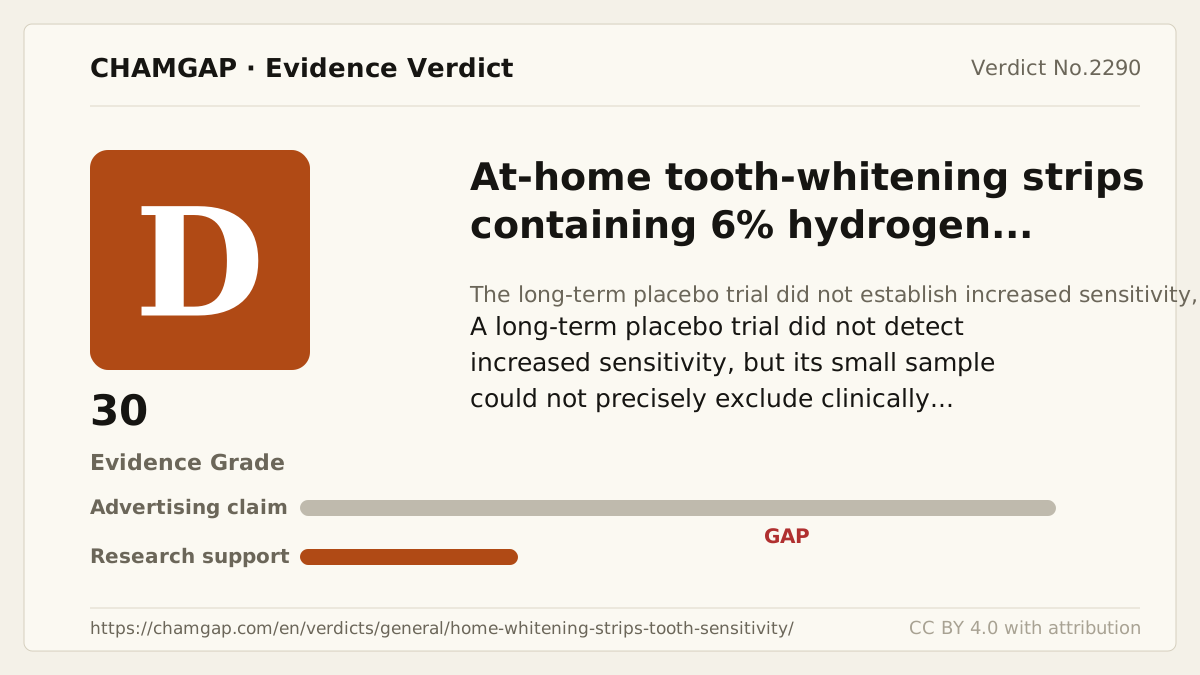
research showsThe grade is D with 28 points. In a double-blind placebo-controlled trial, 80 adults were randomized 40 per arm to 6% hydrogen peroxide strips used five minutes daily for 12 months. At 12 months, sensitivity was 10%, 95% CI 2.8 to 23.7, versus 5%, 0.6 to 16.9, with between-group P greater than .67. The relative rate was twofold, but the absolute difference was five points and uncertainty was wide, so an increase was neither demonstrated nor excluded.
ads claimThis verdict concerns tooth sensitivity, not how much whitening occurred. Greater color change cannot establish absence of adverse effects, and a twofold relative number should not hide the small absolute count and wide uncertainty.
Useful facts when choosing a product
- The test concentration was 6% hydrogen peroxide, five minutes daily for 12 months.
- Sensitivity was a binary interview-reported occurrence assessed at months 1, 2, 3, 6, 9, and 12.
- At 12 months sensitivity was 10% versus 5%, with two versus zero discontinuations for sensitivity.
- The original funding wording and symptom-resolution time could not be confirmed.
Chamgap Semantic Classification Code
Candidate index · review held
UNK.at-home-tooth-whitening-strips-containing-6-percent-hydrogen-peroxide.UNK.tooth-sensitivity-as-an-adverse-effect.increase.placeboUnknown > At-home tooth-whitening strips containing 6% hydrogen peroxide > Unknown > tooth sensitivity as an adverse effect > Increase claim > Placebo
An automated migration candidate, not an issued permanent code; exact claim scope remains under review. This machine-generated migration candidate helps retrieval but is not a permanent assignment. The original verdict ID and URL remain authoritative.
What the research actually shows
Farrell and colleagues randomized 80 healthy adults equally to 6% hydrogen peroxide or placebo strips, worn five minutes daily for 12 months. Oral-status interviews and examinations occurred at baseline and months 1, 2, 3, 6, 9, and 12. Twelve-month sensitivity was 10% versus 5%, interpretable as 4/40 versus 2/40, and two active participants discontinued because of sensitivity. The exact funding wording could not be confirmed from the accessible original, so manufacturer funding is not asserted. Symptom-resolution time was also not confirmed.
Why this is classified as D (28)
The sensitivity comparison was null, but wide uncertainty in an 80-person trial did not exclude harm, giving D with 28 points. Unconfirmed funding wording was not used to lower independence.
Counterpoint. The sample was insensitive to rare harm, and symptom-resolution time was not confirmed.
Rejudgment record. Cross-check applied — The 6% concentration, five-minute daily use for 12 months, 80-person equal allocation, interview-based occurrence, visit timing, absolute sensitivity and discontinuation counts, unconfirmed original funding wording, and unconfirmed symptom-resolution time were applied
| Endpoint | P | Symptom or function itself is the target - including patient reports and performance tests |
| Replication | R1 | Single confirmatory trial |
| Independence | I1 | Mixed funding sources |
| Effect size | E0 | Null |
| Precision | C0 | The confidence interval leaves room for benefit |
Stored derived and displayed grades match; this is not a current recalculation or validity check (D).
Sub-claim grades by effect
This ingredient is marketed for several effects. A single overall grade blends strong and weak claims together, so each effect is graded separately here. The overall grade reflects the strongest disconfirming or core claim.
| Effect (sub-claim) | Grade | Basis |
|---|---|---|
| Increased sensitivity at 12 months | D | Rates were 10% versus 5%, but P was greater than .67 and intervals were wide. |
| Increased discontinuation for sensitivity | D | Two versus zero discontinued, but P was greater than .49. |
| Persistent long-term tooth sensitivity | ? | Duration after discontinuation was not separately reported in the accessible results. |
Cross-check — AI research and Codex final gate
Evidence Table
| Study | Design | Sample | Funding | Endpoint | Result | Weight |
|---|---|---|---|---|---|---|
| Farrell S et al. 2008 | Double-blind placebo-controlled randomized trial | 80 randomized: 40 per arm | The original funding wording could not be confirmed | Interview-reported occurrence of tooth sensitivity at months 1, 2, 3, 6, 9, and 12 | At 12 months, 10% (95% CI 2.8 to 23.7) versus 5% (0.6 to 16.9), P>.67; discontinuation for sensitivity 2 versus 0, P>.49. | Pivotal small placebo-controlled trial |
Receipt — 1 References
All 1 cited sources were verified for existence at the original page (as of 2026-08-05).
Final verification and publication gate: Codex · Evidence date: 2026-08-05 · Corrections: none
Cite this verdict
[Chamgap] At-home whitening strips x tooth sensitivity — Evidence Grade D·28. 1 cited sources checked. Source: https://chamgap.com/en/verdicts/general/home-whitening-strips-tooth-sensitivity/ · CC BY 4.0CC BY 4.0 — free to use with attribution; do not distort grades, numbers, or verdict meaning.
What this document does and does not do
Chamgap is an information source. It reports what research has and has not confirmed; it does not tell readers what to take or buy. That decision belongs to readers and, when needed, medical or legal professionals. This verdict reflects literature available up to the search date and may change as new research appears. Nothing here is medical advice.