
Home INR self-testing,
does it really help with Reduction of stroke, major bleeding, and death versus clinic testing?
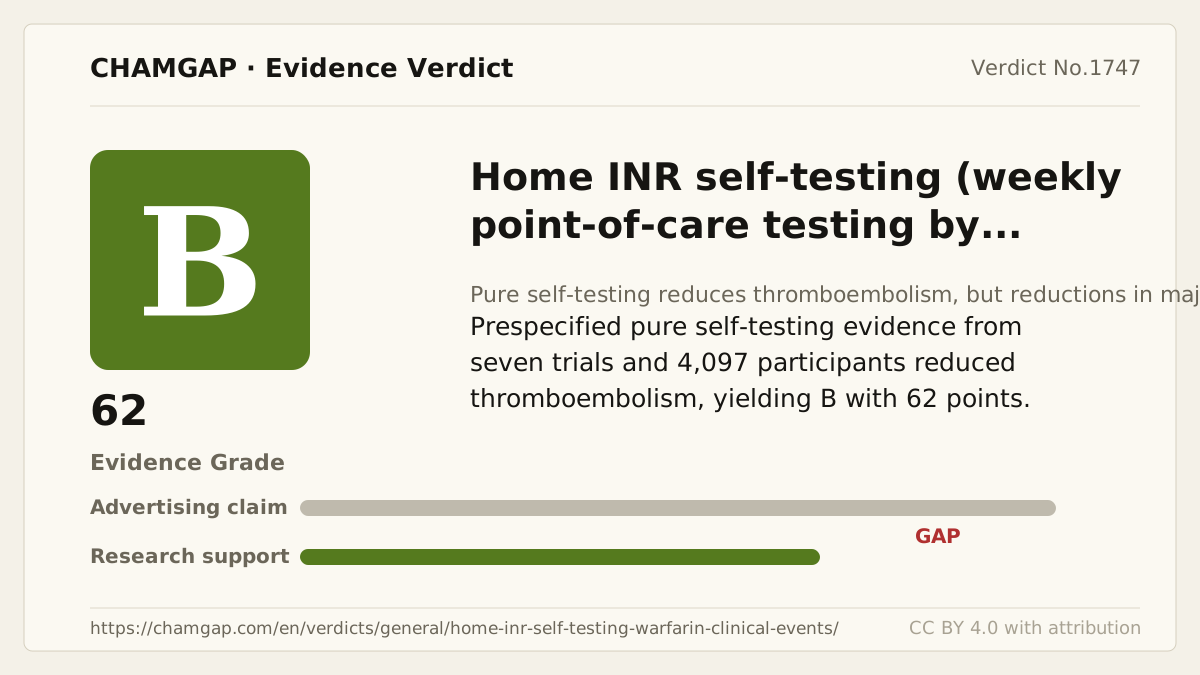
research showsHome INR self-testing is rated B because a hard endpoint improved significantly. The full Cochrane review included 28 trials and 8,950 participants; among seven pure self-testing trials with 4,097 participants, thromboembolism was reduced, RR 0.69 (95% CI 0.49 to 0.97), with moderate certainty. Self-testing and self-management were intervention categories prespecified by Cochrane, not post hoc data-driven subgroups, so rule ⑤ does not bar upgrading. Null major-bleeding and mortality results and dependence on patient selection, education, and adherence prevent an upper-B score, giving B with 62 points.
ads claimMarketing expands convenience and better time in range into definite superiority for preventing stroke, bleeding, and death.
Useful facts when choosing a product
- Home INR testing uses a finger-stick point-of-care device and transmits the result so a clinician can direct dosing.
- Self-monitoring differs from self-management; in self-management, the patient also adjusts warfarin dose using a predefined algorithm.
- Training, quality control, and periodic clinic verification are required, and not every warfarin user is suitable.
Chamgap Semantic Classification Code
Candidate index · review held
UNK.home-inr-self-testing.UNK.stroke-major-bleeding-and-death.reduce.UNKUnknown > Home INR self-testing > Unknown > stroke, major bleeding, and death > Reduction claim > Unknown
An automated migration candidate, not an issued permanent code; exact claim scope remains under review. This machine-generated migration candidate helps retrieval but is not a permanent assignment. The original verdict ID and URL remain authoritative.
What the research actually shows
THINRS failed its composite primary endpoint in all 2,922 participants, HR 0.88 with P=.14. However, the full Cochrane review included 28 trials and 8,950 participants, and its prespecified pure self-testing category reduced thromboembolism across seven trials and 4,097 participants, RR 0.69 (95% CI 0.49 to 0.97), with moderate certainty. Major bleeding was RR 0.95 (0.80 to 1.12) in 20 trials and 8,018 participants combining self-testing and self-management. All-cause mortality was RR 0.94 (0.78 to 1.15) in three pure self-testing trials and 3,300 participants. These estimates concern different sets.
Why this is classified as B (62)
Moderate-certainty reduction in the hard thromboembolism endpoint across seven prespecified pure self-testing trials and 4,097 participants supports B. Null major bleeding and mortality, plus dependence on patient selection, education, and adherence, prevent an upper-B score and give B with 62 points.
Counterpoint. It may have practical value for selected people with access barriers or frequent testing needs, but it does not guarantee fewer clinical events.
Rejudgment record. Cross-check applied — Applied the moderate-certainty hard-endpoint reduction in seven prespecified pure self-testing trials with 4,097 participants, while excluding an upper-B score because major bleeding and mortality were null and effectiveness depends heavily on patient selection, education, and adherence
Sub-claim grades by effect
This ingredient is marketed for several effects. A single overall grade blends strong and weak claims together, so each effect is graded separately here. The overall grade reflects the strongest disconfirming or core claim.
| Effect (sub-claim) | Grade | Basis |
|---|---|---|
| Reduction in the stroke, major-bleeding, and death composite | B | THINRS was null, but thromboembolism decreased significantly across seven prespecified pure self-testing trials with 4,097 participants. |
| Reduction in thromboembolism | B | Seven pure self-testing trials with 4,097 participants gave RR 0.69 (0.49 to 0.97), with moderate certainty. |
| Reduction in all-cause mortality | D | Mortality was null at RR 0.94 (0.78 to 1.15), with moderate certainty, in three pure self-testing trials and 3,300 participants. |
Cross-check — AI research and Codex final gate
Evidence Table
| Study | Design | Sample | Funding | Endpoint | Result | Weight |
|---|---|---|---|---|---|---|
| Matchar DB et al. 2010 | Randomized open-label high-quality-clinic-controlled trial | 2,922 randomized; all 2,922 in the intention-to-treat primary analysis | Public funding from the United States Department of Veterans Affairs Cooperative Studies Program | Primary composite of first stroke, major hemorrhage, or death | Primary endpoint failed: HR 0.88 (95% CI 0.75 to 1.04), P=.14. | Large direct confirmatory clinical-event trial |
| Heneghan CJ et al. 2016 | Cochrane systematic review and meta-analysis of randomized trials | Overall, 28 trials with 8,950 participants; pure self-testing thromboembolism, seven trials and 4,097 participants; combined major bleeding, 20 trials and 8,018 participants; pure self-testing mortality, three trials and 3,300 participants | Academic Cochrane synthesis; mixed industry and public funding across included trials | Thromboembolism, major hemorrhage, and all-cause mortality | Pure self-testing thromboembolism RR 0.69 (0.49 to 0.97), moderate certainty; both interventions combined for major bleeding RR 0.95 (0.80 to 1.12), moderate certainty; pure self-testing mortality RR 0.94 (0.78 to 1.15), moderate certainty. | Independent synthesis requiring intervention separation |
Receipt — 2 References
All 2 cited sources were verified for existence at the original page (as of 2026-07-24).
Final verification and publication gate: Codex · Evidence date: 2026-07-24 · Corrections: none
Cite this verdict
[Chamgap] Home INR self-testing x clinical events during warfarin therapy — Evidence Grade B·62. 2 cited sources checked. Source: https://chamgap.com/en/verdicts/general/home-inr-self-testing-warfarin-clinical-events/ · CC BY 4.0CC BY 4.0 — free to use with attribution; do not distort grades, numbers, or verdict meaning.
What this document does and does not do
Chamgap is an information source. It reports what research has and has not confirmed; it does not tell readers what to take or buy. That decision belongs to readers and, when needed, medical or legal professionals. This verdict reflects literature available up to the search date and may change as new research appears. Nothing here is medical advice.