
High water intake,
does it really help with Prevention of five-year recurrence after treatment of a first idiopathic calcium kidney stone?
research showsThe grade is B. A five-year randomized trial assigned 220 participants but analyzed 199 completers. Recurrence occurred in 12/99 (12.1%) with high water intake and 27/100 (27.0%) with usual intake, RR 0.45 (95% CI 0.24 to 0.84). Twenty-four-hour urine volume also separated to about 2.6 versus 1.0 L/day. The absence of an independent replication and the completer analysis limit the result to B with 70 points.
ads claimMore water truly increased urine volume and recurrence fell in this trial. Turning that result into a promise that two liters of plain water flushes out or prevents every kidney stone erases the population, urine target, and stone composition.
Useful facts when choosing a product
- The intervention targeted at least 2 L/day of 24-hour urine output, not simply drinking 2 L of water.
- Follow-up urine volume was about 2.6 L/day with high intake versus 1.0 L/day in controls.
- US adult adequate intakes of 2.7 L for women and 3.7 L for men refer to total water from plain water, other beverages, and food; they are not disease-prevention effect estimates.
- Verdict 989 is D with 33 points for exercise hydration, while verdict 1339 is D with 35 points for a diuretic in stone recurrence; this verdict evaluates a five-year urine-volume intervention.
Chamgap Semantic Classification Code
Candidate index · review held
UNK.high-water-intake-targeting-at-least-of-urine-per.oral.recurrence-after-treatment-of-a-first-idiopathic-calcium-kidney-stone.prevent.UNKUnknown > High water intake targeting at least of urine per > Oral > recurrence after treatment of a first idiopathic calcium kidney stone > Occurrence-prevention claim > Unknown
An automated migration candidate, not an issued permanent code; exact claim scope remains under review. This machine-generated migration candidate helps retrieval but is not a permanent assignment. The original verdict ID and URL remain authoritative.
What the research actually shows
Borghi randomized 220 Italian participants with a first idiopathic calcium stone, 110 per arm, during 1986 to 1991. The intervention targeted urine output of at least 2 L/day rather than a fixed amount consumed; controls received no special diet or fluid procedure. Recurrence was not self-reported but assessed annually by clinical, laboratory, and radiologic evaluation. Only the 99 and 100 participants completing five years were analyzed. Losses were 21/220 (9.55%) and balanced, 11 versus 10. Allocation concealment and imaging-assessor blinding were not reported and could not be confirmed. Follow-up urine volume was about 2.6 versus 1.0 L/day. The original article contains no funding-support statement. The independence value reflects unconfirmed funding, not an absence of industry funding; it is not a finding of mixed funding or absence of industry funding.
Why this is classified as B (70)
A long randomized trial showed a large benefit on objectively assessed recurrence with clear urine-volume separation, but completer analysis and no independent replication give B with 70 points.
Counterpoint. A single trial does not erase a positive event result, but one large finding cannot be treated as independent replication.
Rejudgment record. Cross-check applied — Five-year reduction in objectively assessed stone recurrence with clear urine-volume separation, tempered by completer analysis and no independent replication
| Endpoint | H | Hard endpoint - actual events such as death |
| Replication | R1 | Single confirmatory trial |
| Independence | I1 | Mixed funding sources |
| Effect size | E+ | Meets the clinically important threshold |
Stored derived and displayed grades match; this is not a current recalculation or validity check (B).
Sub-claim grades by effect
This ingredient is marketed for several effects. A single overall grade blends strong and weak claims together, so each effect is graded separately here. The overall grade reflects the strongest disconfirming or core claim.
| Effect (sub-claim) | Grade | Basis |
|---|---|---|
| Reduced five-year recurrence after a first calcium stone | B | Recurrence was 12.1% versus 27.0%, but analysis was limited to 199 completers. |
Cross-check — AI research and Codex final gate
Evidence Table
| Study | Design | Sample | Funding | Endpoint | Result | Weight |
|---|---|---|---|---|---|---|
| Borghi L et al. 1996 | Five-year single-center randomized prospective trial | 220 randomized (110/110), with 199 completers analyzed (99/100) | No funding-support statement in the article; I1 is the default for unconfirmed funding | Five-year clinically and radiologically assessed stone recurrence | 12/99 (12.1%) versus 27/100 (27.0%); RR 0.45 (95% CI 0.24 to 0.84); NNT about 7; urine volume about 2.6 versus 1.0 L/day | Pivotal long-term recurrence evidence |
Receipt — 3 References
All 3 cited sources were verified for existence at the original page (as of 2026-08-04).
Final verification and publication gate: Codex · Evidence date: 2026-08-04 · Corrections: none
Cite this verdict
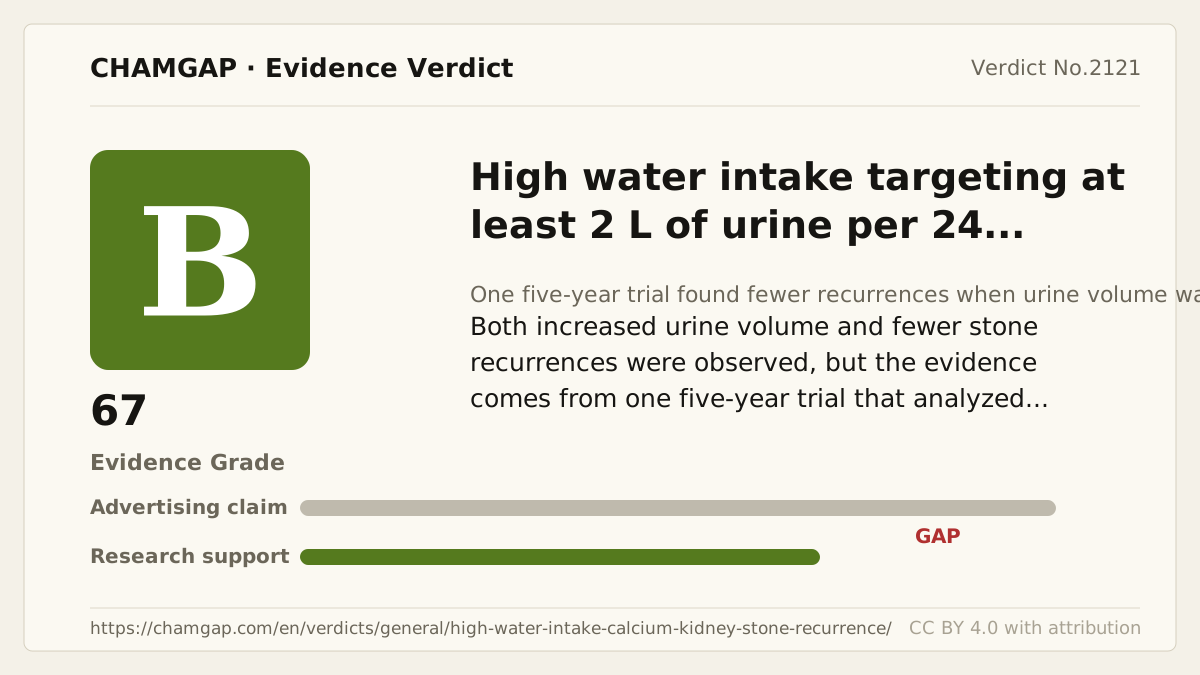
[Chamgap] High water intake x prevention of calcium kidney stone recurrence — Evidence Grade B·70. 3 cited sources checked. Source: https://chamgap.com/en/verdicts/general/high-water-intake-calcium-kidney-stone-recurrence/ · CC BY 4.0CC BY 4.0 — free to use with attribution; do not distort grades, numbers, or verdict meaning.
What this document does and does not do
Chamgap is an information source. It reports what research has and has not confirmed; it does not tell readers what to take or buy. That decision belongs to readers and, when needed, medical or legal professionals. This verdict reflects literature available up to the search date and may change as new research appears. Nothing here is medical advice.