
Hall Technique crown,
does it really help with Reduced major failure from pulpal disease or restoration failure requiring intervention in carious primary molars?
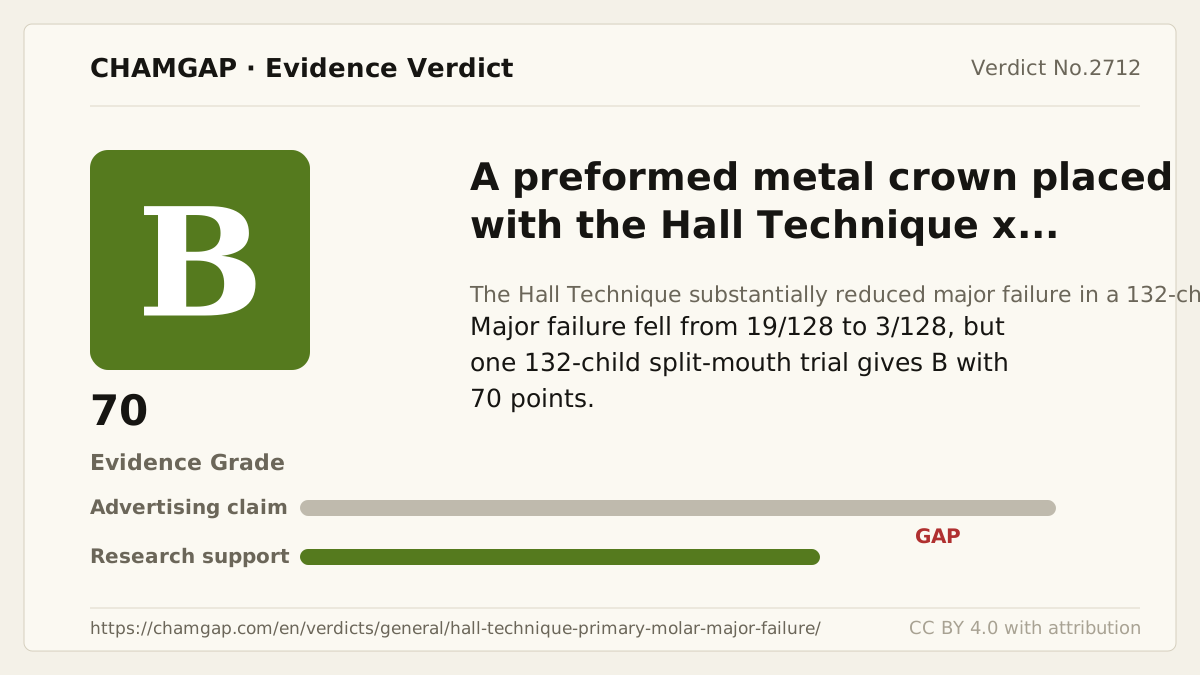
research showsThe grade is B with 70 points. A split-mouth randomized trial at 17 general dental practices compared matched primary molars in 132 children. Among teeth with at least 23 months of follow-up, major failure occurred in 3/128 Hall teeth versus 19/128 conventionally restored teeth, P<.0001. The within-child comparison reduced between-patient confounding and the absolute risk was about 12.5 points lower, but this remains one trial with 132 children.
ads claimThis does not mean every decayed primary tooth can simply be crowned. The trial involved matched, symptom-free primary molars without signs of pulpal pathology and found fewer major failures with sealing by the Hall Technique than with usual restorations.
Useful facts when choosing a product
- The Hall Technique seals caries under a preformed metal crown with glass-ionomer cement without caries removal, tooth preparation, or local anesthesia.
- Major failure included irreversible pulpitis, pulp necrosis, abscess, or an unrestorable loss of restoration and tooth.
- 3M/ESPE provided financial support, while the paper states that sponsors had no role in design, data collection, analysis, interpretation, or dissemination.
Chamgap Semantic Classification Code
Candidate index · review held
UNK.preformed-metal-crown-placed-with-the-hall-technique.UNK.major-failure-from-pulpal-disease-or-restoration-failure-requiring-intervention-in-carious-primary-molars.reduce.UNKUnknown > preformed metal crown placed with the Hall Technique > Unknown > major failure from pulpal disease or restoration failure requiring intervention in carious primary molars > Reduction claim > Unknown
An automated migration candidate, not an issued permanent code; exact claim scope remains under review. This machine-generated migration candidate helps retrieval but is not a permanent assignment. The original verdict ID and URL remain authoritative.
What the research actually shows
Each child contributed two carious primary molars matched for tooth type, arch, and caries extent. One received a Hall crown and the contralateral tooth received usual restoration. The paper states: 'Computer generated randomisation for sequence and side were held centrally, and accessed by telephone to a distant co-ordinator prior to treatment.' Allocation was therefore concealed centrally. Of 132 children, 124 (94%) had at least 23 months of follow-up, and analysis preserved the paired within-child structure. Enrollment below 200 was counted as the main limitation. ISRCTN47267892 was retrospectively registered, although the paper prespecified the two-year null hypotheses for pulpal disease and restoration longevity. Funding combined a Scottish public research fellowship with 3M/ESPE and EastRen support.
Why this is classified as B (70)
A large reduction in clinical failure with central allocation and within-child comparison is strong, but one trial of 132 children gives B with 70 points.
Counterpoint. Applicability depends on tooth status, occlusion, and clinician skill, while retrospective registration weakens confirmation of prespecification.
Rejudgment record. Cross-check applied — Cross-checked the paper and ISRCTN for central telephone allocation, split-mouth structure, 94% follow-up, failure counts, retrospective registration, and mixed public and 3M/ESPE funding
| Endpoint | H | Hard endpoint - actual events such as death |
| Replication | R1 | Single confirmatory trial |
| Independence | I1 | Mixed funding sources |
| Effect size | E+ | Meets the clinically important threshold |
Stored derived and displayed grades match; this is not a current recalculation or validity check (B).
Sub-claim grades by effect
This ingredient is marketed for several effects. A single overall grade blends strong and weak claims together, so each effect is graded separately here. The overall grade reflects the strongest disconfirming or core claim.
| Effect (sub-claim) | Grade | Basis |
|---|---|---|
| Reduced major failure requiring intervention | B | Events occurred in 3/128 versus 19/128 teeth. |
| Reduced minor restoration failure | B | Minor failure was 5% versus 46% in favor of the Hall Technique. |
Cross-check — AI research and Codex final gate
Evidence Table
| Study | Design | Sample | Funding | Endpoint | Result | Weight |
|---|---|---|---|---|---|---|
| Innes NPT et al. 2007 Hall Technique trial | Centrally randomized split-mouth trial in 17 general dental practices | 132 children and 132 tooth pairs; 124 had at least 23 months of follow-up, with 128 teeth analyzed per treatment | Scottish Executive Chief Scientist Office research fellowship, 3M/ESPE, and EastRen | Major failure from pulpal disease or need for intervention after at least 23 months | 3/128 vs 19/128, P<.0001; minor failure 5% vs 46% | Single split-mouth trial with a large reduction in clinical failure |
Receipt — 2 References
All 2 cited sources were verified for existence at the original page (as of 2026-08-18).
Final verification and publication gate: Codex · Evidence date: 2026-08-18 · Corrections: none
Cite this verdict
[Chamgap] Hall Technique crown x major failure in carious primary molars — Evidence Grade B·70. 2 cited sources checked. Source: https://chamgap.com/en/verdicts/general/hall-technique-primary-molar-major-failure/ · CC BY 4.0CC BY 4.0 — free to use with attribution; do not distort grades, numbers, or verdict meaning.
What this document does and does not do
Chamgap is an information source. It reports what research has and has not confirmed; it does not tell readers what to take or buy. That decision belongs to readers and, when needed, medical or legal professionals. This verdict reflects literature available up to the search date and may change as new research appears. Nothing here is medical advice.