
Guaifenesin,
does it really help with Reduced cough and phlegm and shorter recovery from an acute cold or upper respiratory infection?
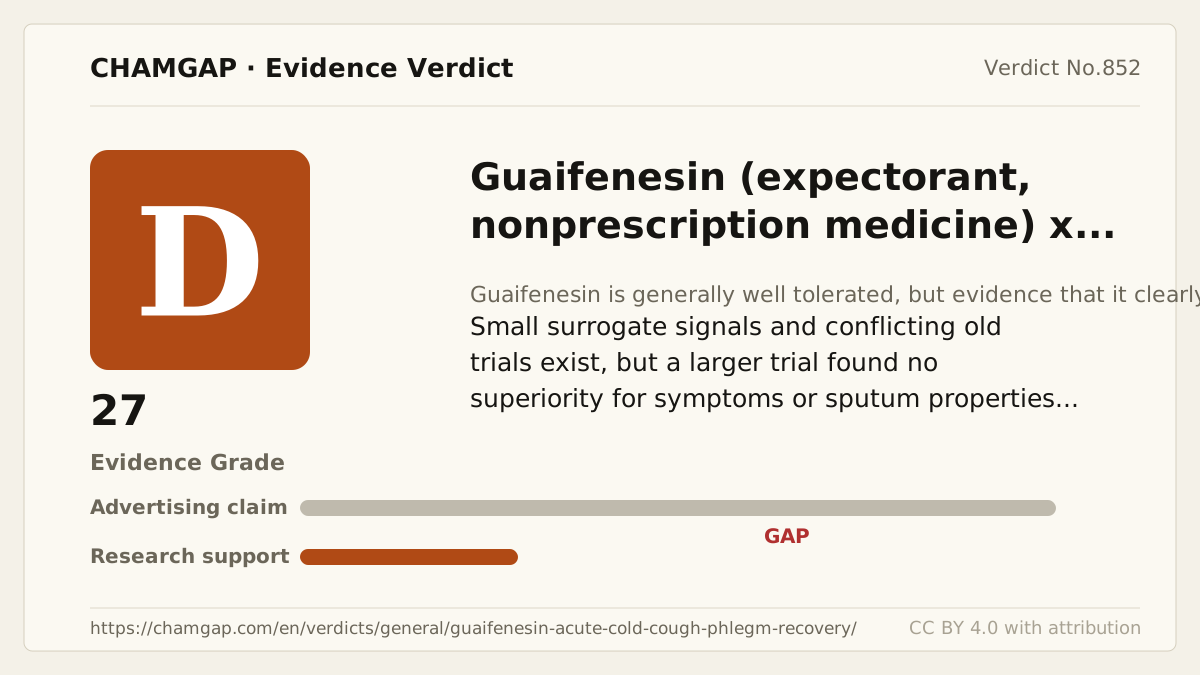
research showsGuaifenesin is rated D because evidence does not show a clear clinical reduction in cough or phlegm or a shorter recovery from an acute cold or upper respiratory infection. In the Cochrane review, one of three expectorant trials was positive and two were negative. In a 378-person placebo-controlled trial, symptoms improved similarly in both groups and no objective measure of sputum volume, viscosity, elasticity, or other properties differed. A 14-patient viral-infection study found a change in capsaicin cough-reflex threshold, but that was a small surrogate study rather than actual cough frequency or recovery duration. Generally favorable short-term safety is separate from inadequate efficacy.
ads claimMarketing can connect thinner mucus with a faster end to cough and a shorter cold. Consistent reductions in cough or phlegm have not been shown beyond the natural course of an acute infection, and there is no evidence that guaifenesin clears the virus or shortens recovery.
Useful facts when choosing a product
- Guaifenesin is included in many single-ingredient and combination cold products, so labels should be checked to avoid duplicate dosing.
- Adequate fluid intake is general self-care that may assist secretion clearance, but guaifenesin has not been established as clinically superior to hydration.
- Short courses are generally tolerated, although nausea, vomiting, abdominal discomfort, and dizziness can occur, and high or excessive doses should be avoided.
- High fever, breathing difficulty, chest pain, bloody sputum, dehydration, or a persistent cough requires medical assessment rather than routine cold self-treatment.
Chamgap Semantic Classification Code
Candidate index · review held
M.guaifenesin.UNK.cough-and-phlegm-and-shorter-recovery-from-an-acute-cold-or-upper-respiratory-infection.reduce.placeboMedicinal interventions > Guaifenesin > Unknown > cough and phlegm and shorter recovery from an acute cold or upper respiratory infection > Reduction claim > Placebo
An automated migration candidate, not an issued permanent code; exact claim scope remains under review. This machine-generated migration candidate helps retrieval but is not a permanent assignment. The original verdict ID and URL remain authoritative.
What the research actually shows
The Smith 2014 Cochrane review synthesized nonprescription medicines for cough from acute upper respiratory infections and judged the three guaifenesin trials inconsistent. The 378-person Albrecht 2012 study explored a candidate subjective composite at day four but was largely oriented toward measurement-tool development. Hoffer-Schaefer 2014 analyzed sputum in the same NCT01046136 dataset and found no superiority over placebo for symptoms or any objective sputum measure. Dicpinigaitis 2003 raised the capsaicin cough threshold after a single 400-mg dose in 14 people with viral infection but did not measure patient-important cough or recovery duration.
Why this is classified as D (27)
Three expectorant trials in the Cochrane review were inconsistent, and a 378-person direct trial found no difference from placebo in symptoms or objective sputum properties. The positive capsaicin cough-reflex signal was a small surrogate, and no recovery-duration trial supports the claim, yielding D with 27 points. Gastrointestinal adverse effects remain a separate safety issue.
Counterpoint. A person who feels transient symptomatic comfort may choose short-term use, but should not expect a shorter cold. In a combination product, effects and harms of the other ingredients must be judged separately.
Rejudgment record. New verdict — Assigned D because acute upper respiratory infection trials were inconsistent, a 378-person randomized trial found no superiority in symptoms, sputum volume, or sputum properties, positive findings were limited to a small cough-reflex surrogate or exploratory subjective score, and no evidence showed shorter recovery
Sub-claim grades by effect
This ingredient is marketed for several effects. A single overall grade blends strong and weak claims together, so each effect is graded separately here. The overall grade reflects the strongest disconfirming or core claim.
| Effect (sub-claim) | Grade | Basis |
|---|---|---|
| Reduced cough from an acute cold | D | Three trials in the Cochrane review were inconsistent, and a relatively large direct trial showed no superiority over placebo. |
| Reduced phlegm or improved expectoration in an acute cold | D | In a 378-person trial, sputum volume, hydration, viscosity, elasticity, and surface tension did not differ from placebo. |
| Shorter recovery from a cold | D | No human efficacy literature directly testing and establishing shorter recovery was identified. |
Cross-check — AI research and Codex final gate
Evidence Table
| Study | Design | Sample | Funding | Endpoint | Result | Weight |
|---|---|---|---|---|---|---|
| Smith SM et al. 2014 Cochrane review | Systematic review and meta-analysis of nonprescription medicines for acute cough | Twenty-nine trials overall; three placebo-controlled guaifenesin trials | Public and academic Cochrane review | Cough frequency, severity, and patient assessment in acute upper respiratory infection | One of three guaifenesin trials showed benefit and two showed no difference, preventing a consistent conclusion. | Key independent synthesis |
| Hoffer-Schaefer A et al. 2014 | Multicenter randomized double-blind placebo-controlled trial | 378 participants with productive cough from an acute respiratory infection | Investigator-initiated grant with product-related support | Seven-day symptoms and sputum volume, hydration, viscosity, elasticity, and surface tension | Symptoms improved similarly in both groups and every objective sputum measure was indistinguishable from placebo. | Relatively large direct null trial |
| Dicpinigaitis PV and Gayle YE. 2003 | Randomized double-blind placebo-controlled crossover trial | Fourteen participants with viral upper respiratory infection and fourteen healthy volunteers | Not reported in the abstract | Capsaicin-induced cough-reflex threshold after a single dose | The cough-reflex threshold increased only in the infected group, but actual cough, phlegm, and recovery duration were not assessed. | Very small surrogate signal |
Receipt — 4 References
All 4 cited sources were verified for existence at the original page (as of 2026-07-20).
Final verification and publication gate: Codex · Evidence date: 2026-07-20 · Corrections: none
Cite this verdict
[Chamgap] Guaifenesin x reduced cold cough and phlegm with faster recovery — Evidence Grade D·27. 4 cited sources checked. Source: https://chamgap.com/en/verdicts/general/guaifenesin-acute-cold-cough-phlegm-recovery/ · CC BY 4.0CC BY 4.0 — free to use with attribution; do not distort grades, numbers, or verdict meaning.
What this document does and does not do
Chamgap is an information source. It reports what research has and has not confirmed; it does not tell readers what to take or buy. That decision belongs to readers and, when needed, medical or legal professionals. This verdict reflects literature available up to the search date and may change as new research appears. Nothing here is medical advice.