
Ginkgo biloba extract,
does it really help with Reduction in subjective tinnitus loudness and distress?
research showsThe latest Cochrane analysis found a THI MD of -1.35 points (95% CI -8.26 to 5.55; two trials, 85 participants). The lower bound of -8.26 includes improvement greater than the 7-point THI minimal clinically important difference. Because the confidence interval does not exclude clinically meaningful benefit, the grade is D with 25 points, not F.
ads claimMarketing and selected product labels claim relief of ringing through better microcirculation. Separate research on circulation or cognition and the existence of a domestic medicine indication do not establish placebo-controlled efficacy for subjective tinnitus loudness or distress.
Useful facts when choosing a product
- Both Ginkgo medicines and Ginkgo dietary supplements are distributed in Korea. Authorized supplement functions concern memory and circulation, not proof of tinnitus treatment.
- Selected Korean medicine labels list 40 mg three times daily or 80 mg twice daily for tinnitus, but an indication and dosing instruction are not evidence-grade proof of efficacy.
- The large null trial used LI 1370 at 50 mg three times daily, totaling 150 mg/day for twelve weeks. Extract standardization and formulation vary by product.
- Ginkgo can cause headache, dizziness, and gastrointestinal symptoms and may increase bleeding risk with anticoagulants or antiplatelet drugs. Pregnancy, lactation, and use before surgery require caution.
Chamgap Semantic Classification Code
Candidate index · review held
S.ginkgo-biloba-extract.UNK.subjective-tinnitus-loudness-and-distress.reduce.placeboSupplements and nutraceuticals > Ginkgo biloba extract > Unknown > subjective tinnitus loudness and distress > Reduction claim > Placebo
An automated migration candidate, not an issued permanent code; exact claim scope remains under review. This machine-generated migration candidate helps retrieval but is not a permanent assignment. The original verdict ID and URL remain authoritative.
What the research actually shows
Drew and Davies 2001 assigned 1,243 people with self-reported tinnitus to Ginkgo LI 1370 at 150 mg/day or placebo for twelve weeks and found no difference in tinnitus improvement. The 2013 Hilton Cochrane review included four trials and 1,543 participants and concluded that there was no evidence of benefit in three trials and 1,143 people with primary tinnitus. An incidental tinnitus score in 400 people with dementia started at only 1.7 to 2.5 on a ten-point scale and had unclear clinical meaning. The 2022 Sereda Cochrane review assessed twelve studies and 1,915 participants and found that Ginkgo may make little or no difference to tinnitus severity and quality of life, with low or very low certainty.
Why this is classified as D (25)
The latest Cochrane analysis found a THI MD of -1.35 points (95% CI -8.26 to 5.55; two trials, 85 participants). The lower bound of -8.26 includes improvement greater than the 7-point THI minimal clinically important difference. Because the confidence interval does not exclude clinically meaningful benefit, the grade is D with 25 points, not F.
Counterpoint. Further independent trials using a specific standardized extract and validated modern tinnitus scales could reduce uncertainty. Current direct evidence does not support patient-perceived tinnitus improvement.
Rejudgment record. New verdict — The latest Cochrane analysis found a THI MD of -1.35 points (95% CI -8.26 to 5.55; two trials, 85 participants). The lower bound of -8.26 includes improvement greater than the 7-point THI minimal clinically important difference. Because the confidence interval does not exclude clinically meaningful benefit, the grade is D with 25 points, not F.
Sub-claim grades by effect
This ingredient is marketed for several effects. A single overall grade blends strong and weak claims together, so each effect is graded separately here. The overall grade reflects the strongest disconfirming or core claim.
| Effect (sub-claim) | Grade | Basis |
|---|---|---|
| Reduction in subjective tinnitus loudness | D | A large placebo-controlled trial and Cochrane synthesis found no consistent difference. |
| Improvement in tinnitus distress, severity, and quality of life | D | The latest Cochrane review found little or no difference may occur, with low or very low certainty. |
Cross-check — AI research and Codex final gate
Evidence Table
| Study | Design | Sample | Funding | Endpoint | Result | Weight |
|---|---|---|---|---|---|---|
| Drew S, Davies E. 2001 | Large double-blind randomized placebo-controlled trial | 12 | Product supplied with private research support | Self-reported tinnitus improvement, annoyance, and loudness | LI 1370 at 50 mg three times daily was no better than placebo for tinnitus improvement. | Decisive large null evidence |
| Hilton MP et al. 2013 | Cochrane systematic review | 1,143 | Cochrane and public or academic support | Tinnitus loudness, severity, and distress | There was no evidence supporting Ginkgo efficacy in patients whose primary complaint was tinnitus. | Decisive synthesis |
| Sereda M et al. 2022 | Updated Cochrane systematic review | 1,915 | Public and academic support | Tinnitus severity, health-related quality of life, and adverse effects | Benefit versus placebo was uncertain, with possibly little or no difference in severity or quality of life and low or very low certainty. | Latest repetition |
Receipt — 4 References
All 4 cited sources were verified for existence at the original page (as of 2026-07-18).
Final verification and publication gate: Codex · Evidence date: 2026-07-18 · Corrections: none
Cite this verdict
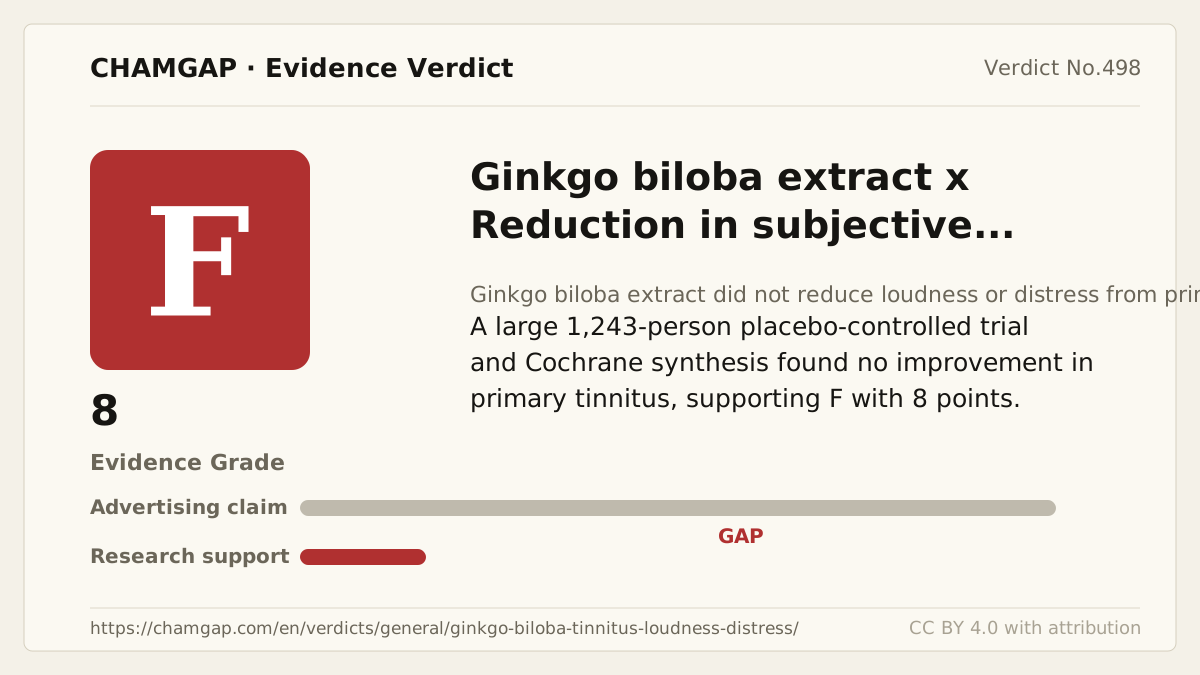
[Chamgap] Ginkgo biloba extract x reduction in tinnitus loudness and distress — Evidence Grade D·25. 4 cited sources checked. Source: https://chamgap.com/en/verdicts/general/ginkgo-biloba-tinnitus-loudness-distress/ · CC BY 4.0CC BY 4.0 — free to use with attribution; do not distort grades, numbers, or verdict meaning.
What this document does and does not do
Chamgap is an information source. It reports what research has and has not confirmed; it does not tell readers what to take or buy. That decision belongs to readers and, when needed, medical or legal professionals. This verdict reflects literature available up to the search date and may change as new research appears. Nothing here is medical advice.