
Fresh red-cell transfusion,
does it really help with Reduced 90-day all-cause mortality versus standard-issue red cells in critically ill adults?
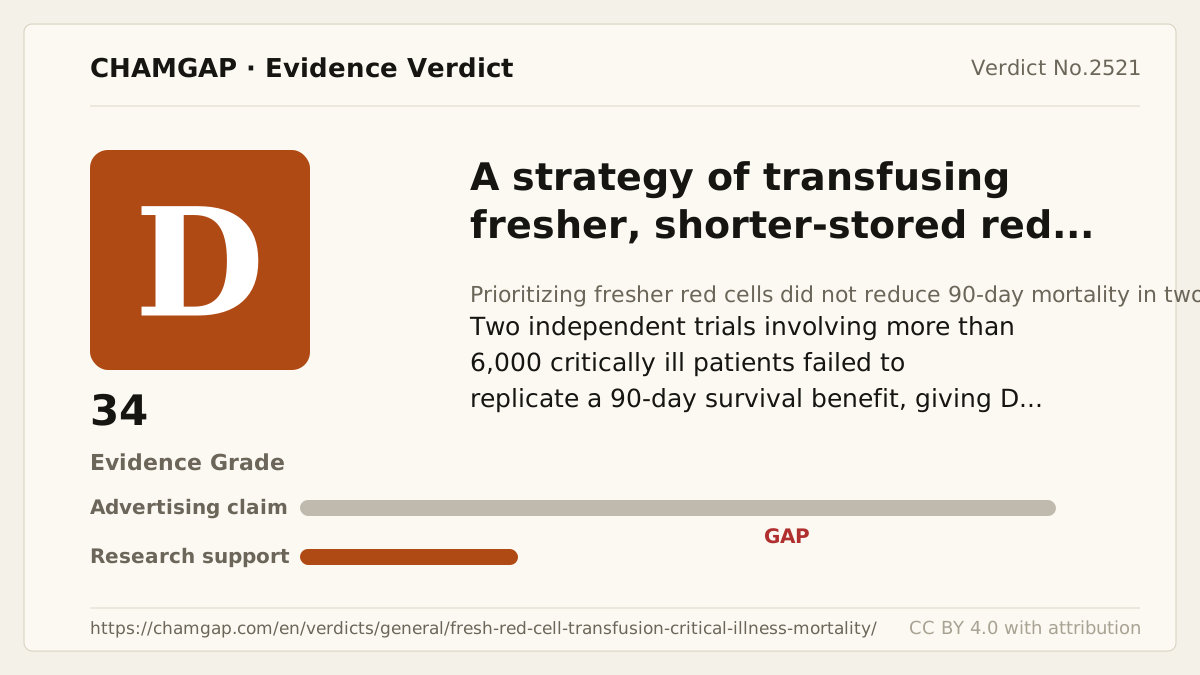
research showsThe grade is D. Two independent large randomized trials found no reduction in 90-day mortality with fresher rather than standard-issue red cells. Mortality was 37.0% versus 35.3% in ABLE and 24.8% versus 24.1% in TRANSFUSE, with both point estimates slightly higher in the fresh-blood group. The repeated null result lacks a validated prespecified threshold excluding every clinically meaningful mortality benefit, giving D with 34 points.
ads claimRed cells do change during storage, but that physical fact does not establish better survival with fresher inventory. In two large trials against real blood-bank standard issue, fresher cells did not reduce 90-day mortality.
Useful facts when choosing a product
- Mean red-cell storage was 6.1 days with fresh blood and 22.0 days with standard issue in ABLE.
- Mean storage was 11.8 days with freshest available blood and 22.4 days with standard issue in TRANSFUSE.
- Both trials compared real blood-bank inventory strategies rather than forcing allocation of near-expiry units.
- No duplicate ingredient-outcome verdict or reuse of either PMID/DOI pair was found in the existing list.
Chamgap Semantic Classification Code
Candidate index · review held
UNK.strategy-of-transfusing-fresher.UNK.all-cause-mortality.reduce.UNKUnknown > strategy of transfusing fresher > Unknown > all-cause mortality > Reduction claim > Unknown
An automated migration candidate, not an issued permanent code; exact claim scope remains under review. This machine-generated migration candidate helps retrieval but is not a permanent assignment. The original verdict ID and URL remain authoritative.
What the research actually shows
ABLE: (1) concealment used a “centralized computer-generated assignment sequence,” stratified by center with variable blocks and implemented by transfusion-service staff through the central system; (2) an “opaque sticker” covered bag dates so the “medical team would be unaware,” and transfusion staff did not disclose storage duration to clinical or research staff; (3) the paper said, “All the statistical analyses were based on the intention-to-treat principle,” but 2,430 of 2,510 randomized patients were analyzed after “80 (3.2%) were withdrawn” without a primary outcome, so this is not described here as complete ITT; and (4) the prospectively specified primary endpoint in ISRCTN44878718 and the paper was 90-day all-cause mortality. TRANSFUSE: (1) a center-stratified web-based central allocation used a “computer-generated schedule including variable-block randomization” and was implemented by transfusion services without clinical-team involvement; (2) collection and expiry dates were covered by “a bag with opaque panels” or opaque stickers, and a preceding trial had “confirmed the effectiveness of this blinding method”; (3) the paper specified ITT analysis and that “no assumptions were made for missing data,” analyzing 4,919 of 4,994 randomized patients after 39 consent withdrawals and 36 losses to 90-day follow-up; and (4) ACTRN12612000453886 and NCT01638416 prospectively specified the same 90-day all-cause mortality endpoint reported in the paper. The trials had nonoverlapping investigator groups and separate public or nonprofit funding, and each met all four requirements supporting B0.
Why this is classified as D (34)
Two independently funded, large, blinded randomized trials found no benefit on the same 90-day mortality endpoint. Mortality is a hard event, but no validated benefit-exclusion threshold was available, so this is repeated null evidence rather than definitive refutation, giving D with 34 points.
Counterpoint. This verdict does not address whether transfusion is needed or whether a restrictive transfusion threshold is preferable. It only asks whether prioritizing the freshest available red cells improves survival once transfusion is chosen.
Rejudgment record. Cross-check applied — We cross-checked the registered primary endpoints, randomization, masking, analysis populations, 90-day mortality results, and distinct public or nonprofit funding in ABLE and TRANSFUSE.
| Endpoint | H | Hard endpoint - actual events such as death |
| Replication | R2 | Independently replicated across trials |
| Independence | I2 | Decisive evidence is publicly or non-profit funded |
| Effect size | E0 | Null |
| Precision | C0 | The confidence interval leaves room for benefit |
Stored derived and displayed grades match; this is not a current recalculation or validity check (D).
Sub-claim grades by effect
This ingredient is marketed for several effects. A single overall grade blends strong and weak claims together, so each effect is graded separately here. The overall grade reflects the strongest disconfirming or core claim.
| Effect (sub-claim) | Grade | Basis |
|---|---|---|
| Red cells stored for less than eight days reduce 90-day mortality versus standard issue in critically ill adults. | D | ABLE found 37.0% versus 35.3%, with no reduction. |
| The freshest available red cells reduce 90-day mortality versus standard issue in critically ill adults. | D | TRANSFUSE found 24.8% versus 24.1%, with no reduction. |
Cross-check — AI research and Codex final gate
Evidence Table
| Study | Design | Sample | Funding | Endpoint | Result | Weight |
|---|---|---|---|---|---|---|
| Lacroix et al., ABLE, NEJM 2015 | Blinded parallel-group randomized trial at 64 centers | 2,510 randomized; 80 (3.2%) excluded, leaving 2,430 in the primary analysis: 1,211 fresh and 1,219 standard issue | Canadian Institutes of Health Research, Fonds de Recherche du Quebec-Sante, UK NIHR HTA, French Ministry of Health, and nonprofit blood services | 90-day all-cause mortality | 448/1,211 (37.0%) versus 430/1,219 (35.3%); absolute difference 1.7 points (95% CI -2.1 to 5.5), HR 1.1 (95% CI 0.9 to 1.2), P=.38 | Large independently funded null trial on a hard outcome |
| Cooper et al., TRANSFUSE, NEJM 2017 | Multinational multicenter randomized masked phase 3 trial | 4,994 randomized; 4,919 in the primary analysis: 2,457 freshest available and 2,462 standard issue | Australian NHMRC, Health Research Council of New Zealand, Irish Health Research Board, and Australian Red Cross Blood Service | 90-day all-cause mortality | 610/2,457 (24.8%) versus 594/2,462 (24.1%); absolute difference 0.7 points (95% CI -1.7 to 3.1), OR 1.04 (95% CI 0.91 to 1.18), P=.57 | Large independent replication by a separate team and funding sources |
Receipt — 2 References
All 2 cited sources were verified for existence at the original page (as of 2026-08-14).
Final verification and publication gate: Codex · Evidence date: 2026-08-14 · Corrections: none
Cite this verdict
[Chamgap] Fresh red-cell transfusion x lower 90-day mortality in critical illness — Evidence Grade D·34. 2 cited sources checked. Source: https://chamgap.com/en/verdicts/general/fresh-red-cell-transfusion-critical-illness-mortality/ · CC BY 4.0CC BY 4.0 — free to use with attribution; do not distort grades, numbers, or verdict meaning.
What this document does and does not do
Chamgap is an information source. It reports what research has and has not confirmed; it does not tell readers what to take or buy. That decision belongs to readers and, when needed, medical or legal professionals. This verdict reflects literature available up to the search date and may change as new research appears. Nothing here is medical advice.