
Fluoride toothpaste,
does it really help with Prevention of dental caries in primary and permanent teeth?
research showsStandard fluoride toothpaste is rated A because it reduces caries increments in primary and permanent teeth compared with non-fluoride toothpaste. The 2019 Cochrane review included 96 randomized trials and found high-certainty evidence that 1000-to-1250-ppm toothpaste reduced caries-surface increments in the permanent teeth of children and adolescents versus non-fluoride toothpaste. Preventive effects were also found in primary teeth and mature adult permanent teeth, although certainty for individual concentration comparisons was lower. These are repeated findings on actual decayed teeth and surfaces, while excessive swallowing and fluorosis risk remain separate safety issues.
ads claimFluoride-free or natural toothpaste marketing may imply that avoiding fluoride provides equal or better caries prevention. Current clinical evidence favors standard fluoride toothpaste over non-fluoride toothpaste, and a natural label does not establish clinical equivalence.
Useful facts when choosing a product
- Standard household fluoride toothpastes commonly contain about 1000 to 1500 ppm fluoride, and users should check the labeled active ingredient and fluoride concentration.
- Caries prevention accumulates with regular brushing rather than a single use, and toothpaste does not replace interdental cleaning, dietary control, or dental care.
- Children should use an age-appropriate small amount under adult supervision and be taught to spit to reduce repeated swallowing.
- Prescription high-fluoride toothpaste, fluoride varnish, gels, and rinses differ from standard nonprescription toothpaste in concentration, target population, and evidence and require separate assessment.
Chamgap Semantic Classification Code
Candidate index · review held
M.fluoride-toothpaste.UNK.dental-caries-in-primary-and-permanent-teeth.prevent.UNKMedicinal interventions > Fluoride toothpaste > Unknown > dental caries in primary and permanent teeth > Occurrence-prevention claim > Unknown
An automated migration candidate, not an issued permanent code; exact claim scope remains under review. This machine-generated migration candidate helps retrieval but is not a permanent assignment. The original verdict ID and URL remain authoritative.
What the research actually shows
Walsh and colleagues network-meta-analyzed 96 randomized trials with at least one year of follow-up. In the permanent teeth of children and adolescents, 1000-to-1250 ppm reduced caries increment versus non-fluoride toothpaste with high certainty, and 1450-to-1500 ppm was also beneficial. In primary teeth, one trial found 1500 ppm reduced dfs increment by 1.86 surfaces versus non-fluoride toothpaste; three adult trials involving 2,162 participants found reduced DMFS increment. The earlier Marinho review independently supported the direction and magnitude with a 24% D(M)FS prevented fraction across 74 trials and 42,300 participants. Evidence comparing concentrations and adverse-event reporting was less certain.
Why this is classified as A (92)
Across 96 randomized trials and roughly forty thousand evaluated participants, actual decayed-tooth and decayed-surface increments repeatedly fell versus non-fluoride toothpaste, and the core 1000-to-1250-ppm comparison had high certainty. Direct clinical endpoints, scale, independent replication, and consistency support A with 92 points. Concentration-specific uncertainty, childhood swallowing, and fluorosis remain separate from efficacy grading.
Counterpoint. Caries can still occur despite fluoride toothpaste because sugar exposure, brushing behavior, reduced saliva, and individual risk vary. Prevention means risk reduction, not a guarantee against every cavity.
Rejudgment record. New verdict — Applied grade A because numerous independent randomized trials comparing fluoride with non-fluoride toothpaste consistently reduced actual carious teeth and surfaces in primary and permanent dentitions, satisfying direct-endpoint, large-scale, independent-replication criteria
Sub-claim grades by effect
This ingredient is marketed for several effects. A single overall grade blends strong and weak claims together, so each effect is graded separately here. The overall grade reflects the strongest disconfirming or core claim.
| Effect (sub-claim) | Grade | Basis |
|---|---|---|
| Caries prevention in primary and permanent teeth with standard fluoride toothpaste | A | Numerous large randomized trials repeatedly found fewer new carious teeth or surfaces than with non-fluoride toothpaste. |
| Equivalent-strength efficacy claims for prescription high-fluoride toothpaste, varnish, and other professional products | ? | This file evaluates standard nonprescription fluoride toothpaste; professional products with different formulations, concentrations, and populations require separate verdicts. |
| Childhood toothpaste swallowing and dental fluorosis | ? | This is a safety rather than efficacy axis, with substantial uncertainty by exposure and age. |
Cross-check — AI research and Codex final gate
Evidence Table
| Study | Design | Sample | Funding | Endpoint | Result | Weight |
|---|---|---|---|---|---|---|
| Walsh T et al. 2019 | Cochrane systematic review and network meta-analysis | 96 randomized trials; 48,804 randomized and 40,066 evaluated in 85 studies of immature permanent dentition | Cochrane Oral Health and academic support; no known industry funding | Actual increments in carious teeth or surfaces, including D(M)FS, dmfs, and DMFT | Compared with non-fluoride toothpaste, 1000 to 1250 ppm reduced caries increment in children's and adolescents' permanent teeth (SMD -0.28, 95% CI -0.32 to -0.25), with preventive effects also found in primary and mature adult permanent teeth. | Key large-scale synthesis of direct endpoints |
| Marinho VCC et al. 2003 | Cochrane systematic review and meta-analysis of randomized trials | 74 studies and 42,300 children and adolescents | Academic and public research context | Increment in permanent-tooth D(M)FS | The D(M)FS prevented fraction for fluoride versus non-fluoride toothpaste was 24% (95% CI 21% to 28%). | Independent replication and consistency |
Receipt — 3 References
All 3 cited sources were verified for existence at the original page (as of 2026-07-19).
Final verification and publication gate: Codex · Evidence date: 2026-07-19 · Corrections: none
Cite this verdict
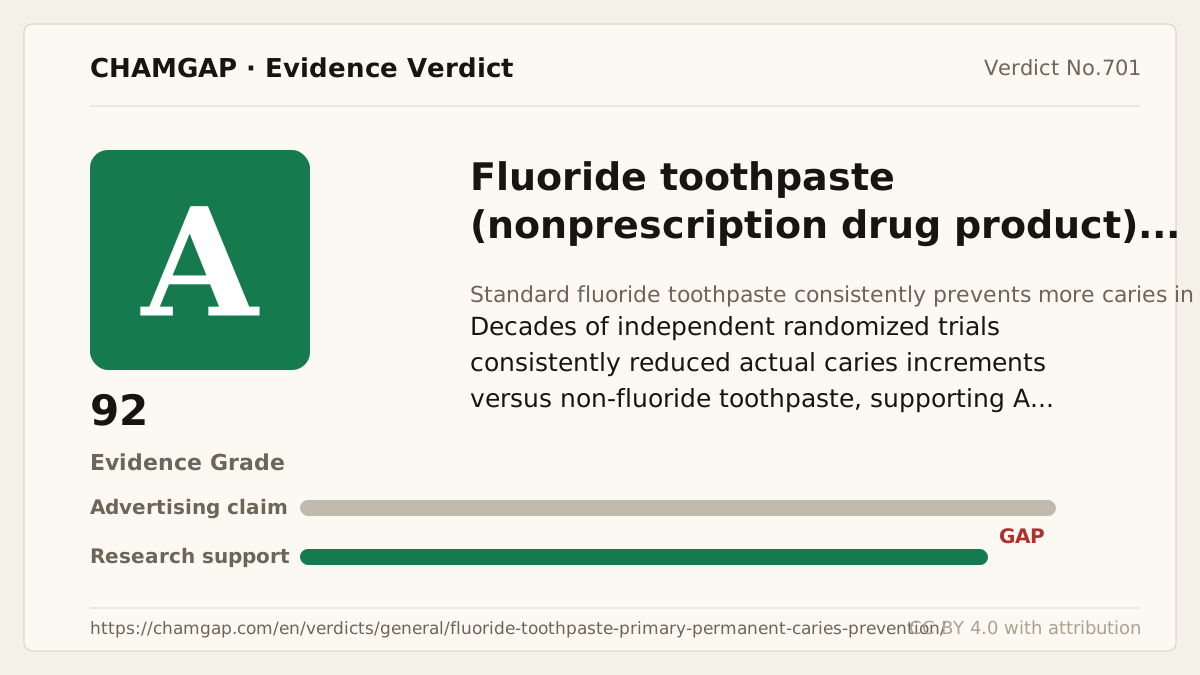
[Chamgap] Fluoride toothpaste x prevention of caries in primary and permanent teeth — Evidence Grade A·92. 3 cited sources checked. Source: https://chamgap.com/en/verdicts/general/fluoride-toothpaste-primary-permanent-caries-prevention/ · CC BY 4.0CC BY 4.0 — free to use with attribution; do not distort grades, numbers, or verdict meaning.
What this document does and does not do
Chamgap is an information source. It reports what research has and has not confirmed; it does not tell readers what to take or buy. That decision belongs to readers and, when needed, medical or legal professionals. This verdict reflects literature available up to the search date and may change as new research appears. Nothing here is medical advice.