
Fesoterodine,
does it really help with Reduced urinary frequency and urgency urinary incontinence in overactive bladder?
research showsFesoterodine is rated C. Two 12-week phase 3 trials reduced micturitions and urgency urinary incontinence more than placebo, but representative placebo-adjusted differences were only about 0.7 to 0.9 micturitions and 0.9 to 1.1 incontinence episodes daily. Decisive evidence is concentrated in the manufacturer program.
ads claimMarketing can imply that frequent bathroom visits largely disappear, while the mean placebo-adjusted reduction was around one episode daily. Large individual responses and the average treatment effect are different quantities.
Useful facts when choosing a product
- The pivotal trial randomized 836, treated 832, and analyzed 820 for the primary micturition endpoint.
- Once-daily 4-mg and 8-mg doses were studied for 12 weeks.
Chamgap Semantic Classification Code
Candidate index · review held
UNK.fesoterodine.UNK.urinary-frequency-and-urgency-urinary-incontinence-in-overactive-bladder.reduce.MULTIUnknown > Fesoterodine > Unknown > urinary frequency and urgency urinary incontinence in overactive bladder > Reduction claim > Multiple: primary unresolved
An automated migration candidate, not an issued permanent code; exact claim scope remains under review. This machine-generated migration candidate helps retrieval but is not a permanent assignment. The original verdict ID and URL remain authoritative.
What the research actually shows
Nitti 2007 randomized 836 and treated 832; 820 with valid diaries entered the primary micturition analysis. Daily changes were -1.02 versus -1.74 and -1.94, giving placebo-adjusted differences of -0.72 and -0.92, P<0.001. The separate Chapple 2007 SP583 trial randomized 1,135 and treated 1,132; placebo-adjusted micturition differences were -0.8 (95% CI -1.26 to -0.36) for 4 mg and -0.9 (-1.38 to -0.49) for 8 mg. An independent Cochrane review found a micturition MD of -0.85 (95% CI -0.98 to -0.73) across 30 anticholinergic trials and 19,395 participants, but every fesoterodine trial it pooled was manufacturer-funded, so I0 remains. No single established MCID for daily micturitions was identified, and the small between-group effect supports E~. Verdicts 1044, 684, and 793 are B for related drugs; fesoterodine is C because axis 4 explicitly classifies its small between-group difference as E~.
Why this is classified as C (50)
P, R1, I0, E~, and B0 derive C with 50 points under effect-size and manufacturer-only ceilings.
Counterpoint. Some patients can achieve at least 50% fewer urgency-incontinence episodes despite the small average difference.
Rejudgment record. Cross-check applied — Phase 3 trials succeeded, but placebo-adjusted frequency and incontinence changes were small and decisive evidence was concentrated in the manufacturer program
| Endpoint | P | Symptom or function itself is the target - including patient reports and performance tests |
| Replication | R1 | Single confirmatory trial |
| Independence | I0 | Evidence comes only from manufacturer studies |
| Effect size | E~ | Statistically positive but below the threshold |
Stored derived and displayed grades match; this is not a current recalculation or validity check (C).
Sub-claim grades by effect
This ingredient is marketed for several effects. A single overall grade blends strong and weak claims together, so each effect is graded separately here. The overall grade reflects the strongest disconfirming or core claim.
| Effect (sub-claim) | Grade | Basis |
|---|---|---|
| Fewer daily micturitions | C | Results were repeatedly positive, but placebo-adjusted reduction was under one daily episode. |
| Fewer urgency urinary incontinence episodes | C | The average placebo-adjusted difference was about 0.9 to 1.1 daily episodes. |
| Improved patient-perceived bladder condition | C | Patient-reported outcomes were significant but confined to manufacturer evidence. |
Cross-check — AI research and Codex final gate
Evidence Table
| Study | Design | Sample | Funding | Endpoint | Result | Weight |
|---|---|---|---|---|---|---|
| Nitti VW et al. SP584, 2007 | Twelve-week multicenter randomized double-blind placebo-controlled phase 3 trial | 836 randomized; 832 treated; 820 in the primary micturition analysis; 633 in the UUI analysis | Manufacturer development trial by Schwarz Pharma; rights later acquired by Pfizer, with employee coauthors | Change in micturitions per 24 hours and coprimary UUI endpoint | Placebo-adjusted micturitions -0.72 and -0.92, P<0.001; UUI -0.86 and -1.07; primary endpoint succeeded | Key confirmatory trial |
| Chapple C et al. SP583, 2007 | Twelve-week multicenter randomized double-blind placebo- and active-controlled phase 3 trial | 1,135 randomized; 1,132 treated | Manufacturer development program by Schwarz Pharma | Micturitions per 24 hours with UUI and treatment-response coprimary endpoints | Placebo-adjusted micturitions: -0.8 (95% CI -1.26 to -0.36) for 4 mg and -0.9 (-1.38 to -0.49) for 8 mg; succeeded | Replication within the same manufacturer program |
| Stoniute A et al. Cochrane review, 2023 | Systematic review and meta-analysis of randomized anticholinergic trials | Thirty trials and 19,395 participants for micturitions | Independent Cochrane synthesis; all included fesoterodine trials were manufacturer-funded | Micturitions per 24 hours | Overall anticholinergic MD -0.85 (95% CI -0.98 to -0.73) | Independent synthesis for detecting and adjusting bias; it does not change trial funding sources |
Receipt — 4 References
All 4 cited sources were verified for existence at the original page (as of 2026-07-24).
Final verification and publication gate: Codex · Evidence date: 2026-07-24 · Corrections: none
Cite this verdict
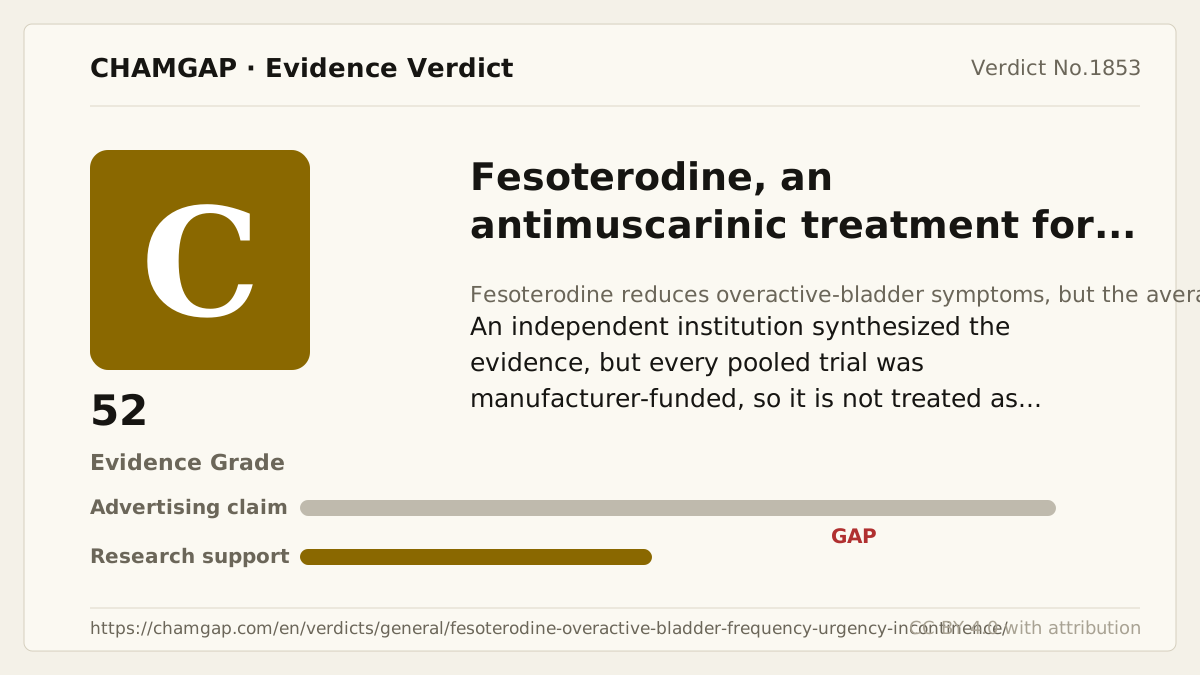
[Chamgap] Fesoterodine x reduced frequency and urgency urinary incontinence in overactive bladder — Evidence Grade C·50. 4 cited sources checked. Source: https://chamgap.com/en/verdicts/general/fesoterodine-overactive-bladder-frequency-urgency-incontinence/ · CC BY 4.0CC BY 4.0 — free to use with attribution; do not distort grades, numbers, or verdict meaning.
What this document does and does not do
Chamgap is an information source. It reports what research has and has not confirmed; it does not tell readers what to take or buy. That decision belongs to readers and, when needed, medical or legal professionals. This verdict reflects literature available up to the search date and may change as new research appears. Nothing here is medical advice.