
Fenbendazole,
does it really help with Tumor shrinkage and longer survival in people with advanced cancer?
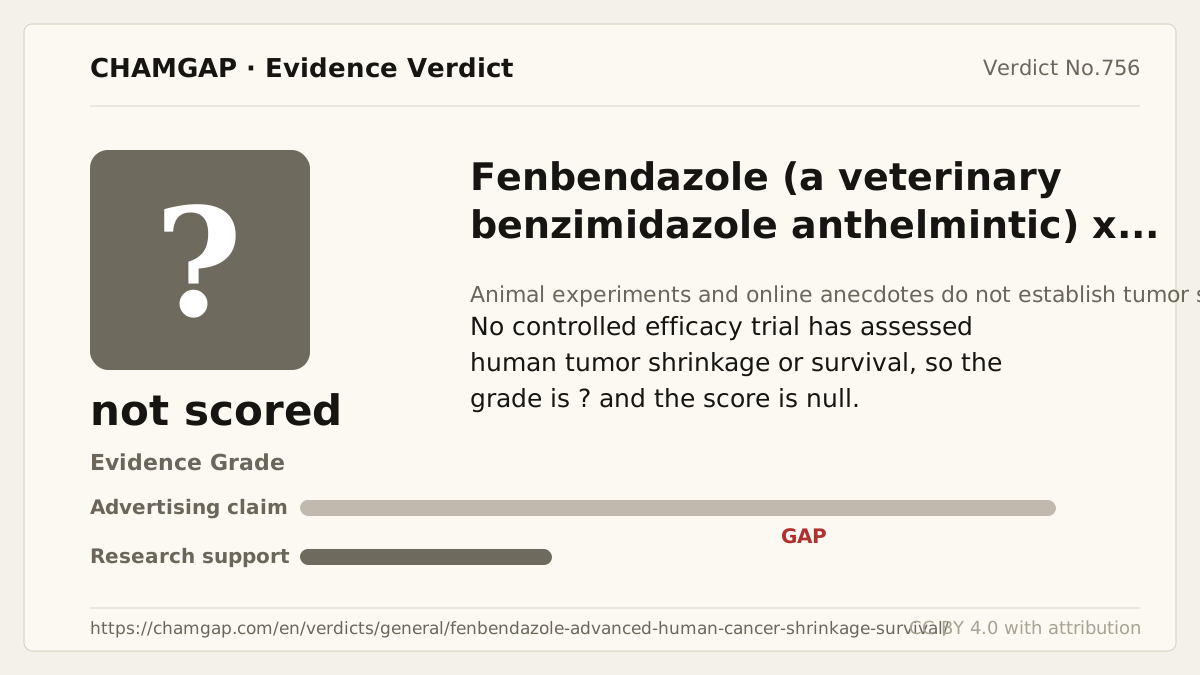
research showsFenbendazole is rated ? because no controlled clinical trial evaluating tumor shrinkage or survival in people with advanced cancer was identified. Cell and mouse studies contain conflicting antitumor signals, but they do not establish human dosing, exposure, tumor response, or survival. Self-treatment case reports and social-media anecdotes cannot control for standard therapy or natural history, and a favorable three-patient case series published in 2025 was retracted in 2026. Human self-treatment with veterinary products is unapproved and carries risks of severe liver injury and delay of standard cancer care.
ads claimOnline claims combine cell-death mechanisms, animal tumor models, and individual imaging or survival stories into a cheap cancer cure. No controlled study has established an effective human dose, response rate, progression-free survival, or overall survival.
Useful facts when choosing a product
- Fenbendazole is a benzimidazole veterinary dewormer used for parasites in animals such as dogs, cattle, and goats, and it is not an approved human anticancer medicine.
- Veterinary formulations are not quality-controlled for human dosing, impurities, absorption, or interactions, so a human dose cannot be inferred from the animal label.
- Jaundice and severe hepatocellular drug-induced liver injury have followed human self-administration, and the injury can be confused with toxicity from concurrent treatments such as immunotherapy.
- Delaying surgery, chemotherapy, radiotherapy, targeted therapy, or other standard cancer care for unproven self-treatment can cause irreversible harm, so an oncology team should be consulted.
Chamgap Semantic Classification Code
Candidate index · review held
UNK.fenbendazole.UNK.tumor-shrinkage-and-longer-survival-with-advanced-cancer.assess.UNKUnknown > Fenbendazole > Unknown > Tumor shrinkage and longer survival with advanced cancer > Association or change assessment > Unknown
An automated migration candidate, not an issued permanent code; exact claim scope remains under review. This machine-generated migration candidate helps retrieval but is not a permanent assignment. The original verdict ID and URL remain authoritative.
What the research actually shows
Duan and colleagues in 2013 tested several regimens in EMT6 breast-cancer cells and mouse solid tumors but found no evidence supporting fenbendazole's value in cancer therapy. Later cell and animal studies have also reported positive results, leaving a mixed preclinical signal. Nguyen and colleagues' 2024 review stated that fenbendazole is not approved for human use by the FDA or EMA, that human pharmacokinetics and safety are poorly documented, and that clinical trials are required. In Yamaguchi and colleagues' 2021 case of self-treatment during advanced lung cancer, there was no tumor shrinkage and liver injury resolved after stopping fenbendazole. Thakurdesai and colleagues in 2024 reported biopsy-confirmed severe drug-induced liver injury. These are safety observations, not evidence of anticancer efficacy.
Why this is classified as ?
No controlled clinical trial has assessed tumor shrinkage or survival in advanced human cancer. Preclinical signals and uncontrolled cases are not human efficacy literature, producing a ? grade and a null score. Unapproved veterinary formulations, hepatotoxicity, absent human quality control, and delayed standard care remain separate safety concerns.
Counterpoint. A repurposing hypothesis is not the same as a treatment that can be recommended to patients. Without an appropriate formal clinical trial, fenbendazole should not replace or be added to proven cancer care.
Rejudgment record. New verdict — Applied ? for absent human efficacy literature because no controlled trial has evaluated tumor shrinkage or survival in advanced human cancer and the available record consists of cell and animal studies, uncontrolled cases, and social-media anecdotes
Sub-claim grades by effect
This ingredient is marketed for several effects. A single overall grade blends strong and weak claims together, so each effect is graded separately here. The overall grade reflects the strongest disconfirming or core claim.
| Effect (sub-claim) | Grade | Basis |
|---|---|---|
| Tumor shrinkage in advanced human cancer | ? | No controlled human trial has evaluated tumor response. |
| Longer survival in advanced human cancer | ? | No human efficacy literature has evaluated progression-free or overall survival. |
| Extension of cell and animal antitumor signals to human efficacy | ? | Preclinical results are mixed and cannot determine human efficacy. |
| Anticancer efficacy inferred from case reports and social-media anecdotes | ? | They lack controls and control of concurrent treatment and therefore are not causal efficacy evidence. |
Cross-check — AI research and Codex final gate
Evidence Table
| Study | Design | Sample | Funding | Endpoint | Result | Weight |
|---|---|---|---|---|---|---|
| Duan Q et al. 2013 | Preclinical cancer-cell and mouse solid-tumor experiments | EMT6 cells and tumor-bearing mice; zero humans | Academic preclinical research | Cytotoxicity, mouse tumor growth, and radiation response | The tested conditions provided no evidence that fenbendazole would have value in cancer therapy. | Preclinical negative evidence that cannot establish human efficacy |
| Nguyen J et al. 2024 | Narrative review of oral fenbendazole for cancer repurposing | Cell, animal, and pharmacokinetic literature; zero controlled human efficacy trials | No commercial clinical trial program reported | Preclinical mechanisms, pharmacokinetics, toxicity, and clinical-development gaps | Human pharmacokinetics and safety were poorly documented, and trials of anticancer effect, dose, and tolerability were deemed necessary. | Confirmation of the human efficacy evidence gap |
| Yamaguchi T et al. 2021 | Single self-administration case in advanced non-small-cell lung cancer | One 80-year-old woman | Academic case report | Liver-injury course and tumor imaging | Liver injury occurred during fenbendazole use and resolved after withdrawal; no tumor shrinkage occurred. | Safety case; efficacy not assessable |
Receipt — 4 References
All 4 cited sources were verified for existence at the original page (as of 2026-07-20).
Final verification and publication gate: Codex · Evidence date: 2026-07-20 · Corrections: none
Cite this verdict
[Chamgap] Fenbendazole x tumor shrinkage and longer survival in people with advanced cancer — Evidence Grade ?. 4 cited sources checked. Source: https://chamgap.com/en/verdicts/general/fenbendazole-advanced-human-cancer-shrinkage-survival/ · CC BY 4.0CC BY 4.0 — free to use with attribution; do not distort grades, numbers, or verdict meaning.
What this document does and does not do
Chamgap is an information source. It reports what research has and has not confirmed; it does not tell readers what to take or buy. That decision belongs to readers and, when needed, medical or legal professionals. This verdict reflects literature available up to the search date and may change as new research appears. Nothing here is medical advice.