
Epley manoeuvre,
does it really help with Early resolution of vertigo and nystagmus in posterior-canal benign paroxysmal positional vertigo?
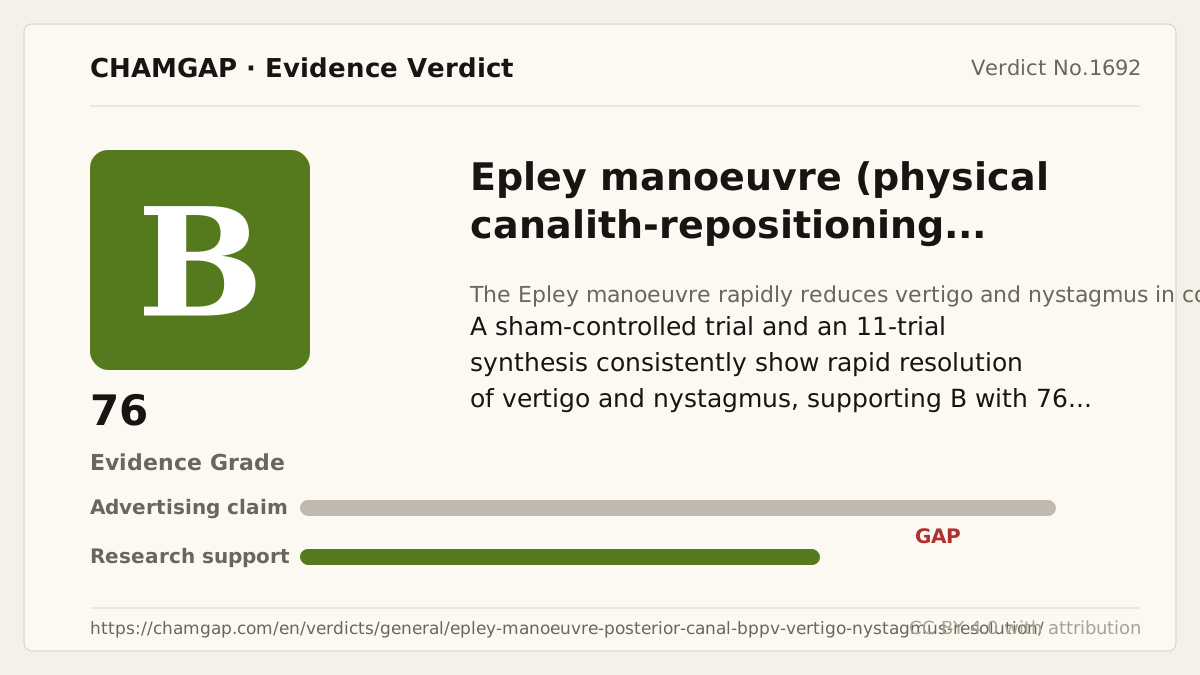
research showsThe Epley manoeuvre is rated B because it rapidly resolves vertigo and provoked nystagmus in posterior-canal BPPV. The von Brevern trial randomized 67 participants, but one spontaneous resolution before treatment left 66 in the actual analysis, 35 Epley and 31 sham. At 24 hours, combined resolution of symptoms and nystagmus occurred in 80% versus 10%, P<.001, so the clinical target succeeded. A Cochrane review found 11 trials with 745 participants; complete symptom resolution in five trials with 273 participants was 56% versus 21%, OR 4.42 (95% CI 2.62 to 7.44). Multiple independent trials show concordant benefit, but practitioner blinding was impossible and trials were small, short-term, and limited for recurrence, yielding B with 76 points.
ads claimMarketing can portray one manoeuvre as an instant cure for every form of dizziness. The evidence applies to correctly diagnosed posterior-canal BPPV. Other canal disorders, central vertigo, and nonvestibular dizziness require different assessment and sometimes different manoeuvres.
Useful facts when choosing a product
- The Epley manoeuvre is not a drug or supplement; it uses a sequence of head and body positions to return posterior-canal particles to the vestibule.
- A typical history and Dix-Hallpike testing should identify the affected side and canal before a trained clinician performs the procedure.
- Temporary intense spinning or nausea can occur during treatment, and particles can rarely move into another canal.
- Neck or back disease, major vascular disease, or restricted mobility may require a modified manoeuvre or specialist assessment.
Chamgap Semantic Classification Code
Candidate index · review held
P.epley-manoeuvre.procedural.early-resolution-of-vertigo-and-nystagmus-in-posterior-canal-benign-paroxysmal-positional-vertigo.assess.shamProcedures, devices and tests > Epley manoeuvre > Procedural > Early resolution of vertigo and nystagmus in posterior-canal benign paroxysmal positional vertigo > Association or change assessment > Sham procedure or device
An automated migration candidate, not an issued permanent code; exact claim scope remains under review. This machine-generated migration candidate helps retrieval but is not a permanent assignment. The original verdict ID and URL remain authoritative.
What the research actually shows
Von Brevern et al. 2006 assigned 67 people with posterior-canal BPPV to the Epley manoeuvre or a sham procedure. One Epley participant resolved spontaneously before treatment, leaving 66 participants, 35 and 31, for statistical analysis. Combined resolution of vertigo and nystagmus at 24 hours occurred in 28 of 35 versus 3 of 31 and succeeded. The 2014 Hilton and Pinder Cochrane review included 11 trials and 745 participants. Complete symptom resolution in five trials with 273 participants was 56% versus 21%, OR 4.42 (95% CI 2.62 to 7.44), and conversion to a negative Dix-Hallpike test favored Epley in eight trials with 507 participants, OR 9.62. Practitioner blinding was impossible, and individual trials and long-term follow-up were limited.
Why this is classified as B (76)
The pivotal trial randomized 67 and analyzed 66, with combined 24-hour symptom and nystagmus resolution of 80% versus 10%. A Cochrane review of 11 trials and 745 participants replicated complete symptom resolution and negative Dix-Hallpike conversion. Concordant direct symptoms and objective findings are strong, but small short trials and uncertain recurrence prevention yield B with 76 points.
Counterpoint. The procedure is highly effective short term for correctly diagnosed posterior-canal BPPV, but recurrence or a different diagnosis can require reassessment or another manoeuvre.
Rejudgment record. Cross-check applied — Treated concurrent resolution of the target symptom of vertigo and objective nystagmus as direct efficacy, accepted consistency between the pivotal sham-controlled trial and 11 randomized trials, and deducted for small short-term studies and limited recurrence data
Sub-claim grades by effect
This ingredient is marketed for several effects. A single overall grade blends strong and weak claims together, so each effect is graded separately here. The overall grade reflects the strongest disconfirming or core claim.
| Effect (sub-claim) | Grade | Basis |
|---|---|---|
| Combined resolution of vertigo and nystagmus at 24 hours | B | The pivotal sham-controlled trial succeeded with 80% versus 10%. |
| Complete resolution of subjective vertigo symptoms | B | Five trials with 273 participants found 56% versus 21%, OR 4.42. |
| Conversion to a negative Dix-Hallpike response | B | Eight trials with 507 participants favored Epley with OR 9.62. |
Cross-check — AI research and Codex final gate
Evidence Table
| Study | Design | Sample | Funding | Endpoint | Result | Weight |
|---|---|---|---|---|---|---|
| von Brevern M et al. 2006 | Prospective double-blind randomized sham-controlled trial | 67 randomized; 66 actually analyzed after one pretreatment spontaneous resolution (35/31) | No external or manufacturer funding reported in the article; academic Charite study | Combined resolution of vertigo and provoked nystagmus at 24 hours | Primary clinical target succeeded: 28/35 (80%) versus 3/31 (10%), P<.001. | Pivotal direct short-term efficacy evidence |
| Hilton MP and Pinder DK. 2014 | Cochrane systematic review and meta-analysis of randomized trials | 11 randomized trials and 745 participants; five trials and 273 participants in complete symptom-resolution analysis | Review authors declared no conflicts; academic Cochrane ENT review without manufacturer sponsorship | Complete symptom resolution and conversion to a negative Dix-Hallpike test | Symptom resolution was 56% versus 21%, OR 4.42 (95% CI 2.62 to 7.44); negative conversion OR 9.62. | Replication across independent trials |
Receipt — 2 References
All 2 cited sources were verified for existence at the original page (as of 2026-07-24).
Final verification and publication gate: Codex · Evidence date: 2026-07-24 · Corrections: none
Cite this verdict
[Chamgap] Epley manoeuvre x resolution of vertigo and nystagmus in posterior-canal BPPV — Evidence Grade B·76. 2 cited sources checked. Source: https://chamgap.com/en/verdicts/general/epley-manoeuvre-posterior-canal-bppv-vertigo-nystagmus-resolution/ · CC BY 4.0CC BY 4.0 — free to use with attribution; do not distort grades, numbers, or verdict meaning.
What this document does and does not do
Chamgap is an information source. It reports what research has and has not confirmed; it does not tell readers what to take or buy. That decision belongs to readers and, when needed, medical or legal professionals. This verdict reflects literature available up to the search date and may change as new research appears. Nothing here is medical advice.