
Energy-dense enteral nutrition,
does it really help with Reduced 90-day mortality in mechanically ventilated critically ill adults?
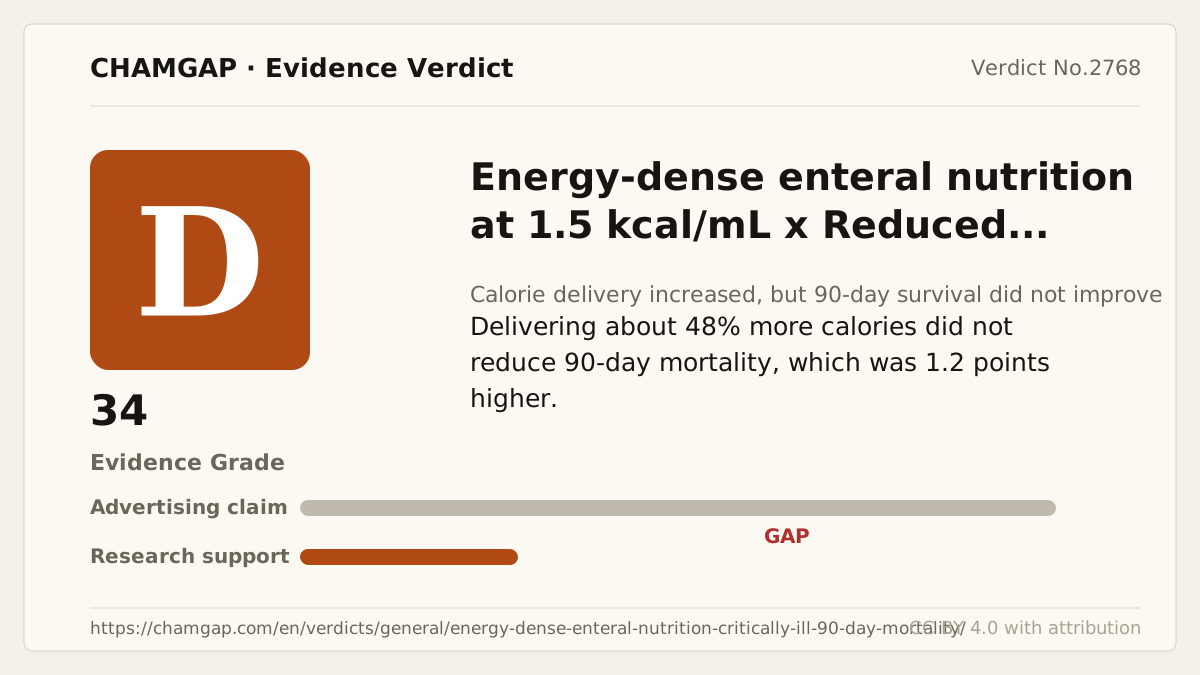
research showsThe grade is D. In the actual TARGET analysis of 90-day mortality, deaths were 523/1,948 (26.8%) with energy-dense nutrition versus 505/1,966 (25.7%) with routine nutrition, an absolute difference of +1.2 points, RR 1.05 (95% CI 0.94 to 1.16), p=0.41. This large double-blind trial found no survival benefit, but its power assumption was not a validated minimum important difference, so meaningful benefit was not definitively excluded; the result is D with 34 points.
ads claimThe trial does not support a claim that meeting a higher calorie target improves survival. A denser formula increased calorie delivery at the same target rate, but did not reduce 90-day mortality.
Useful facts when choosing a product
- The trial formulas contained 1.5 and 1.0 kcal/mL, with similar protein concentrations of 56 and 55 g/L.
- Trial nutrition continued for up to 28 days or until enteral feeding stopped, death, or ICU discharge.
- Both formulas supplied by Fresenius Kabi were randomized intervention materials, not assessment tools.
Chamgap Semantic Classification Code
Candidate index · review held
UNK.energy-dense-enteral-nutrition-at-ml.enteral.mortality-in-mechanically-ventilated-critically-ill-adults.reduce.UNKUnknown > Energy-dense enteral nutrition at /mL > Enteral or tube feeding > mortality in mechanically ventilated critically ill adults > Reduction claim > Unknown
An automated migration candidate, not an issued permanent code; exact claim scope remains under review. This machine-generated migration candidate helps retrieval but is not a permanent assignment. The original verdict ID and URL remain authoritative.
What the research actually shows
There were 4,000 randomization events, with three patients randomized twice, leaving 3,997 randomized patients. The prespecified modified intention-to-treat population was 3,957, 1,971 versus 1,986; the actual 90-day primary analysis included 3,914, 1,948 versus 1,966. Australia's NHMRC and New Zealand's Health Research Council provided grants. Fresenius Kabi Deutschland provided in-kind supply and delivery of both trial formulas, which were intervention materials rather than assessment tools. The company reviewed and commented on the manuscript, while investigators designed, conducted, analyzed, and decided to submit the trial. Axis 6 B0 evidence ① Allocation concealment: "Concealment of the treatment assignments was maintained with a secure, Web-based randomization system, which was accessible 24 hours a day." ② Blinding: "We conducted an investigator-initiated, randomized, double-blind, pragmatic trial"; "The formulations were indistinguishable in color and packaging." ③ Analysis population and missing data: "All analyses were conducted with the use of a modified intention-to-treat principle."; "No imputation was used to estimate missing data, and analyses were based on all available data with numbers of available observations reported." ④ Prespecified primary endpoint: "The primary outcome was all-cause mortality within 90 days after randomization." — consistent with registration NCT02306746
Why this is classified as D (34)
A large double-blind hard-outcome trial found no survival benefit and left benefit possible, giving D with 34 points. Secure web allocation, blinding, prespecified modified intention-to-treat analysis and missing-data handling, and a registry-consistent primary endpoint were documented.
Counterpoint. This verdict is limited to 90-day survival. Specific deficiency states, protein dose, and long-term functional recovery are separate questions.
Rejudgment record. Cross-check applied — Centers the actual 3,914-person 90-day mortality analysis and its absolute and relative estimates while accounting for mixed funding, in-kind intervention supply, and four directly documented trial-quality requirements
| Endpoint | H | Hard endpoint - actual events such as death |
| Replication | R1 | Single confirmatory trial |
| Independence | I1 | Mixed funding sources |
| Effect size | E0 | Null |
| Precision | C0 | The confidence interval leaves room for benefit |
Stored derived and displayed grades match; this is not a current recalculation or validity check (D).
Sub-claim grades by effect
This ingredient is marketed for several effects. A single overall grade blends strong and weak claims together, so each effect is graded separately here. The overall grade reflects the strongest disconfirming or core claim.
| Effect (sub-claim) | Grade | Basis |
|---|---|---|
| Energy-dense enteral nutrition reduces 90-day mortality | D | Mortality was 26.8% versus 25.7%, RR 1.05, with no benefit. |
| Energy-dense enteral nutrition increases delivered calories | B | It delivered a mean 601 kcal/day more from trial nutrition. |
Cross-check — AI research and Codex final gate
Evidence Table
| Study | Design | Sample | Funding | Endpoint | Result | Weight |
|---|---|---|---|---|---|---|
| TARGET Investigators. 2018 TARGET | Double-blind pragmatic randomized trial in 46 Australian and New Zealand ICUs | 3,997 randomized; modified ITT 3,957, 1,971 versus 1,986; actual primary analysis 3,914, 1,948 versus 1,966 | Grants from Australia's NHMRC and New Zealand's Health Research Council plus in-kind supply and delivery of both trial formulas by Fresenius Kabi Deutschland | All-cause mortality within 90 days after randomization | 523/1,948 (26.8%) versus 505/1,966 (25.7%); absolute difference +1.2 points; RR 1.05 (95% CI 0.94 to 1.16), p=0.41 | Large rigorously designed null hard-outcome trial |
Receipt — 1 References
All 1 cited sources were verified for existence at the original page (as of 2026-08-18).
Final verification and publication gate: Codex · Evidence date: 2026-08-18 · Corrections: none
Cite this verdict
[Chamgap] Energy-dense enteral nutrition x 90-day mortality in mechanically ventilated critical illness — Evidence Grade D·34. 1 cited sources checked. Source: https://chamgap.com/en/verdicts/general/energy-dense-enteral-nutrition-critically-ill-90-day-mortality/ · CC BY 4.0CC BY 4.0 — free to use with attribution; do not distort grades, numbers, or verdict meaning.
What this document does and does not do
Chamgap is an information source. It reports what research has and has not confirmed; it does not tell readers what to take or buy. That decision belongs to readers and, when needed, medical or legal professionals. This verdict reflects literature available up to the search date and may change as new research appears. Nothing here is medical advice.