
Early tracheostomy,
does it really help with Reduced 30-day mortality in adults expected to require prolonged mechanical ventilation?
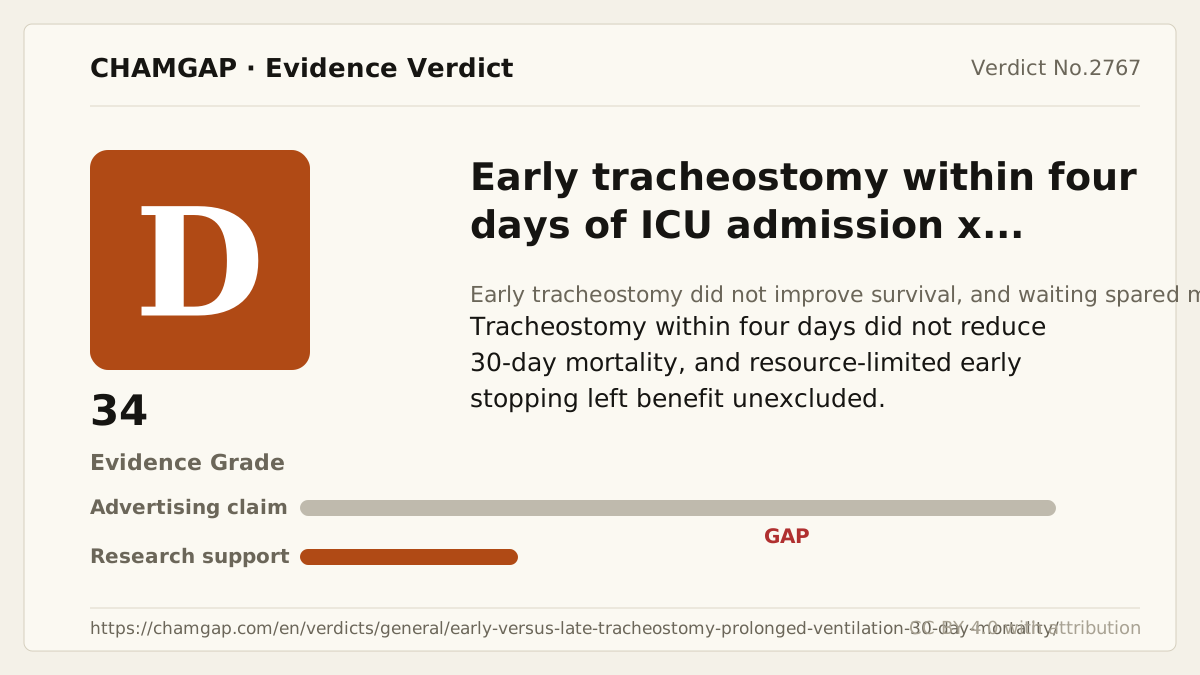
research showsThe grade is D. In TracMan, 30-day mortality was 139/451 (30.8%) with early tracheostomy versus 141/448 (31.5%) when tracheostomy was delayed until day 10 and performed only if still needed. The absolute risk reduction was 0.7 points (95% CI -5.4 to 6.7), RR 0.98 (0.81 to 1.19), p=0.89. Recruitment stopped at 909 rather than 1,692 because of recruitment fatigue and exhausted funding, leaving meaningful benefit possible in a single trial and giving D with 34 points.
ads claimThe trial does not support a claim that earlier airway access improves survival. It supports saying that mortality was unchanged and that waiting until day 10 spared more than half of the delayed group from tracheostomy.
Useful facts when choosing a product
- Early meant within four days; delayed meant day 10 or later and only if still indicated.
- Only 44.9% of the delayed group underwent tracheostomy.
- Recruitment ended for resource reasons, not after crossing an efficacy or harm boundary.
Chamgap Semantic Classification Code
Candidate index · review held
UNK.early-tracheostomy-within-of-icu-admission.UNK.mortality-expected-to-require-prolonged-mechanical-ventilation.reduce.UNKUnknown > Early tracheostomy within of ICU admission > Unknown > mortality expected to require prolonged mechanical ventilation > Reduction claim > Unknown
An automated migration candidate, not an issued permanent code; exact claim scope remains under review. This machine-generated migration candidate helps retrieval but is not a permanent assignment. The original verdict ID and URL remain authoritative.
What the research actually shows
Across 72 UK ICUs, 909 patients were assigned, 455 early and 454 delayed. After duplicate randomization and withdrawals, the primary analysis included 451 versus 448. ‘Randomization was conducted using an automated 24-hour telephone service,’ main analyses followed an a priori intention-to-treat plan, and survival came from UK death registers. The target was 1,692, but ‘study fatigue’ and ‘exhaustion of funding’ prevented completion; the steering committee stopped for ‘practical rather than for statistical reasons.’ This was resource-limited early stopping. The UK Intensive Care Society and Medical Research Council funded the study, no conflicts were reported, and no company-supplied tracheostomy material or assessment tool was identified.
Why this is classified as D (34)
A large publicly funded hard-outcome trial was null, and resource-limited early stopping left benefit possible, giving D with 34 points.
Counterpoint. This is a null survival verdict, not a prohibition of early tracheostomy for every airway-management circumstance.
Rejudgment record. Cross-check applied — Accounts for the absolute 30-day mortality difference, the 899-person primary analysis, and practical resource-limited stopping rather than a statistical boundary
| Endpoint | H | Hard endpoint - actual events such as death |
| Replication | R1 | Single confirmatory trial |
| Independence | I2 | Decisive evidence is publicly or non-profit funded |
| Effect size | E0 | Null |
| Precision | C0 | The confidence interval leaves room for benefit |
Stored derived and displayed grades match; this is not a current recalculation or validity check (D).
Sub-claim grades by effect
This ingredient is marketed for several effects. A single overall grade blends strong and weak claims together, so each effect is graded separately here. The overall grade reflects the strongest disconfirming or core claim.
| Effect (sub-claim) | Grade | Basis |
|---|---|---|
| Tracheostomy within four days reduces 30-day mortality | D | Mortality was 30.8% versus 31.5%, RR 0.98, with no benefit. |
| Waiting until day 10 avoids unnecessary tracheostomy | B | Only 44.9% of the delayed group underwent tracheostomy. |
Cross-check — AI research and Codex final gate
Evidence Table
| Study | Design | Sample | Funding | Endpoint | Result | Weight |
|---|---|---|---|---|---|---|
| Young D et al. 2013 TracMan | Open pragmatic randomized trial in 72 UK ICUs | 909 randomized, 455 versus 454; primary analysis 899, 451 versus 448 | Public and nonprofit funding from the UK Intensive Care Society and Medical Research Council; no company-supplied trial material or assessment tool | All-cause mortality 30 days after randomization | 139/451 (30.8%) versus 141/448 (31.5%); absolute risk reduction 0.7 points (95% CI -5.4 to 6.7); RR 0.98 (0.81 to 1.19), p=0.89 | Null publicly funded hard-outcome trial with resource-limited early stopping |
Receipt — 1 References
All 1 cited sources were verified for existence at the original page (as of 2026-08-18).
Final verification and publication gate: Codex · Evidence date: 2026-08-18 · Corrections: none
Cite this verdict
[Chamgap] Early tracheostomy x 30-day mortality in patients expected to need prolonged ventilation — Evidence Grade D·34. 1 cited sources checked. Source: https://chamgap.com/en/verdicts/general/early-versus-late-tracheostomy-prolonged-ventilation-30-day-mortality/ · CC BY 4.0CC BY 4.0 — free to use with attribution; do not distort grades, numbers, or verdict meaning.
What this document does and does not do
Chamgap is an information source. It reports what research has and has not confirmed; it does not tell readers what to take or buy. That decision belongs to readers and, when needed, medical or legal professionals. This verdict reflects literature available up to the search date and may change as new research appears. Nothing here is medical advice.