
Early goal-directed therapy,
does it really help with Reduced 90-day mortality in septic shock versus contemporary usual care?
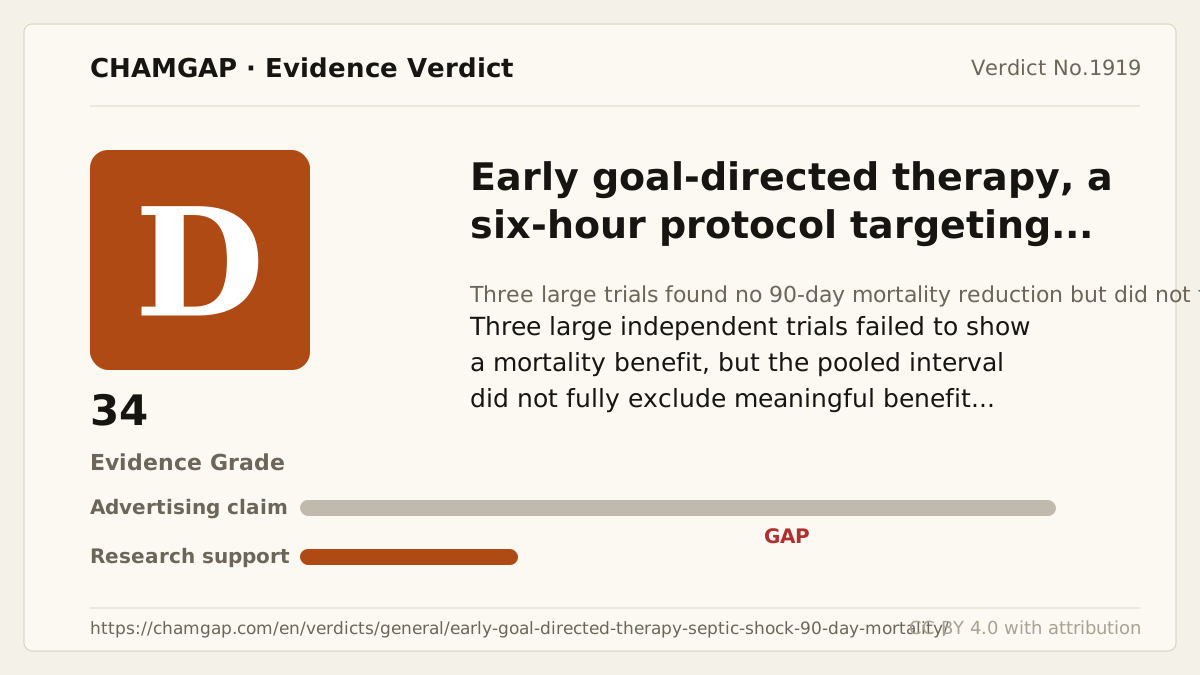
research showsThe grade is D. The modern multicenter ProCESS, ARISE, and ProMISe trials found no mortality benefit from adding the early goal-directed protocol to usual care. PRISM randomized 3,763 and analyzed 3,723 at 90 days: mortality was 24.9% versus 25.4%, adjusted OR 0.97 (95% CI 0.82 to 1.14). The OR lower bound retained about an 18% reduction in the odds of death, giving D with 34 points.
ads claimA protocol called goal-directed and aggressive does not establish longer survival. Materials should state that adding these invasive targets to contemporary usual care did not lower 90-day mortality.
Useful facts when choosing a product
- The tested EGDT adjusted fluids, vasopressors, transfusion, and inotropes during the first six hours to central venous pressure, mean arterial pressure, and central venous oxygen saturation targets.
- ProCESS used US public funding, ARISE used Australasian public and nonprofit funding, and ProMISe used the UK NIHR Health Technology Assessment program.
- Existing sepsis verdicts concern postpartum azithromycin, high-dose intravenous vitamin C, and hydroxyethyl starch, not this intervention.
Chamgap Semantic Classification Code
Candidate index · review held
M.early-goal-directed-therapy.intravenous.mortality-in-septic-shock.reduce.usual-careMedicinal interventions > Early goal-directed therapy > Intravenous > mortality in septic shock > Reduction claim > Usual care
An automated migration candidate, not an issued permanent code; exact claim scope remains under review. This machine-generated migration candidate helps retrieval but is not a permanent assignment. The original verdict ID and URL remain authoritative.
What the research actually shows
ProCESS randomized 1,341: 439 to early goal-directed therapy, 446 to protocol-based standard care, and 456 to usual care. Sixty-day in-hospital mortality was 21.0%, 18.2%, and 18.9%; the two protocol groups combined versus usual care gave RR 1.04 (95% CI 0.82 to 1.31). ARISE randomized 1,600 and found 90-day mortality of 18.6% versus 18.8%, difference -0.3 points (95% CI -4.1 to 3.6). ProMISe randomized 1,260 and analyzed 623 versus 620: 29.5% versus 29.2%, RR 1.01 (0.85 to 1.20). PRISM randomized 3,763 and analyzed 3,723 at 90 days: 24.9% versus 25.4%, adjusted OR 0.97 (0.82 to 1.14). Rivers 2001 was positive in a single center with 263 patients, 130 versus 133: hospital mortality 30.5% versus 46.5%, P=0.009. Three much larger independent multicenter trials repeatedly overturned that small single-center result under contemporary usual care; the modern trials do not conflict with one another.
Why this is classified as D (34)
Three independent publicly funded large trials and the 3,723-patient analysis repeatedly found no mortality benefit from adding the protocol to contemporary usual care, but the OR lower bound retained about an 18% reduction in the odds of death, giving D with 34 points.
Counterpoint. D means survival benefit from this protocol was not established; it does not reject prompt standard resuscitation.
Rejudgment record. Cross-check applied — Independent ProCESS, ARISE, and ProMISe trials and their 3,723-patient individual-data analysis repeatedly failed to show lower mortality when the protocol was added to contemporary usual care, but the OR interval retained about an 18% reduction in the odds of death
| Endpoint | H | Hard endpoint - actual events such as death |
| Replication | RX | Repeatedly refuted in the same indication |
| Independence | I2 | Decisive evidence is publicly or non-profit funded |
| Effect size | E0 | Null |
| Precision | C0 | The confidence interval leaves room for benefit |
Stored derived and displayed grades match; this is not a current recalculation or validity check (D).
Sub-claim grades by effect
This ingredient is marketed for several effects. A single overall grade blends strong and weak claims together, so each effect is graded separately here. The overall grade reflects the strongest disconfirming or core claim.
| Effect (sub-claim) | Grade | Basis |
|---|---|---|
| Reduced 90-day mortality in ProMISe | D | The 1,243-patient analysis found RR 1.01 (95% CI 0.85 to 1.20). |
| Reduced pooled 90-day mortality across three trials | D | The three-trial synthesis found OR 0.97 (95% CI 0.82 to 1.14) in 3,723 patients. |
| Reduced mortality in severe subgroups | D | PRISM found no benefit in hyperlactatemic or high-risk subgroups. |
Cross-check — AI research and Codex final gate
Evidence Table
| Study | Design | Sample | Funding | Endpoint | Result | Weight |
|---|---|---|---|---|---|---|
| Mouncey et al. 2015 ProMISe | Pragmatic randomized open-label controlled trial in 56 hospitals | 1,260 randomized, 630 per arm; 1,243 in the 90-day primary analysis, 623 versus 620 | UK NIHR Health Technology Assessment public funding; no commercial funding | Primary all-cause mortality at 90 days | 184/623 (29.5%) versus 181/620 (29.2%), RR 1.01 (95% CI 0.85 to 1.20), P=0.90. | Pivotal independent large hard-outcome trial |
| PRISM 2017 individual-patient-data meta-analysis | Prospectively planned individual-patient-data synthesis of ProCESS, ARISE, and ProMISe | 3,763 randomized; 3,723 analyzed at 90 days, 1,852 versus 1,871 | International collaboration of three publicly and noncommercially funded trials | All-cause mortality at 90 days | 462/1,852 (24.9%) versus 475/1,871 (25.4%), adjusted OR 0.97 (95% CI 0.82 to 1.14), P=0.68. | Pooled evidence of independent repeated null trials |
Receipt — 3 References
All 3 cited sources were verified for existence at the original page (as of 2026-08-01).
Final verification and publication gate: Codex · Evidence date: 2026-08-01 · Corrections: none
Cite this verdict
[Chamgap] Early goal-directed therapy x reduced 90-day mortality in septic shock — Evidence Grade D·34. 3 cited sources checked. Source: https://chamgap.com/en/verdicts/general/early-goal-directed-therapy-septic-shock-90-day-mortality/ · CC BY 4.0CC BY 4.0 — free to use with attribution; do not distort grades, numbers, or verdict meaning.
What this document does and does not do
Chamgap is an information source. It reports what research has and has not confirmed; it does not tell readers what to take or buy. That decision belongs to readers and, when needed, medical or legal professionals. This verdict reflects literature available up to the search date and may change as new research appears. Nothing here is medical advice.