
Ear candling,
does it really help with Cerumen removal?
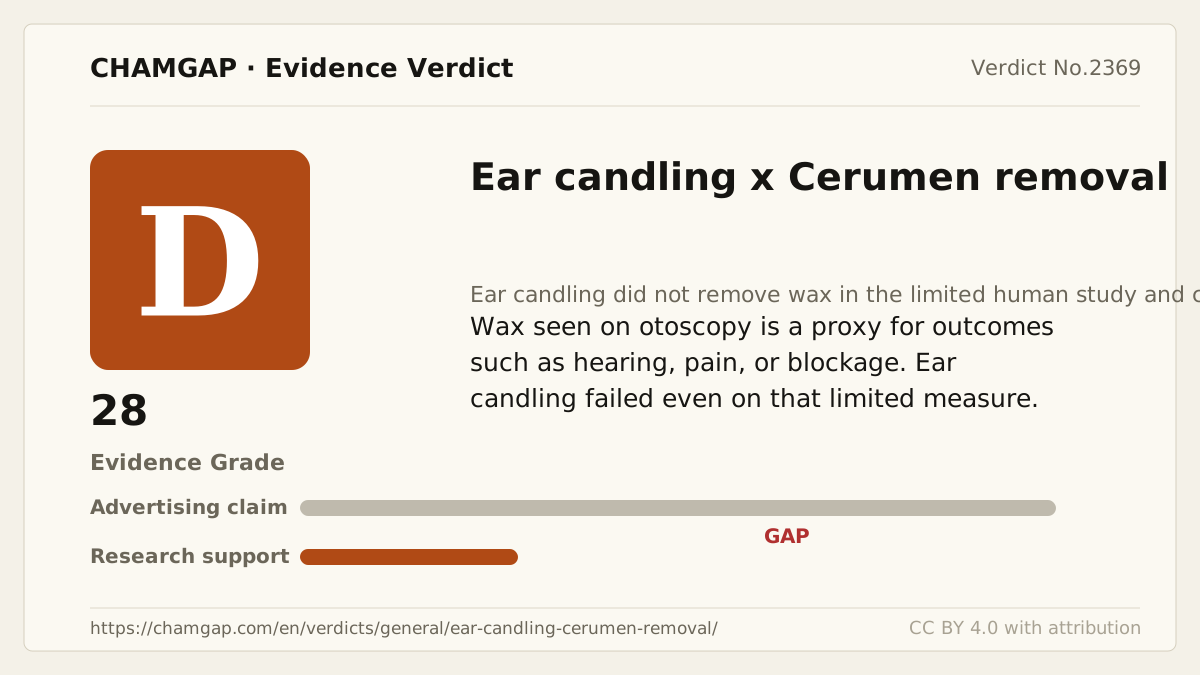
research showsIn a nonrandomized limited trial of eight ears, impacted wax was not removed and candle wax was deposited in previously clear ears. Efficacy outcomes for hearing or ear symptoms were not tested.
ads claimEar candles are also sold through Korean online marketplaces. Availability and a suction narrative do not establish clinical wax removal.
Useful facts when choosing a product
- Ear candles generated no negative pressure in an ear-canal model.
- The human component was a nonrandomized limited trial of eight ears: four with wax and four without.
- The survey of 122 otolaryngologists reported by Seely DR, Quigley SM, and Langman AW recorded 13 burns, 7 occlusions, 6 temporary hearing-loss reports, 3 cases of otitis externa, and 1 tympanic-membrane perforation; categories may overlap.
- A separate patient case report by Rafferty J, Tsikoudas A, and Davis BC required removal under general anesthesia and documented a small perforation with persistent conductive hearing loss.
Chamgap Semantic Classification Code
Candidate index · review held
UNK.ear-candling.UNK.cerumen-removal.assess.UNKUnknown > Ear candling > Unknown > Cerumen removal > Association or change assessment > Unknown
An automated migration candidate, not an issued permanent code; exact claim scope remains under review. This machine-generated migration candidate helps retrieval but is not a permanent assignment. The original verdict ID and URL remain authoritative.
What the research actually shows
The clinical sample comprised only eight ears and lacked randomization, a formal control procedure, and confidence intervals. It measured otoscopic wax, not hearing, pain, fullness, or patient satisfaction.
Why this is classified as D (28)
Human evidence exists, so judgment is not deferred. The only direct trial failed to remove wax, but its eight-ear sample and absent precision estimates prevent a strong exclusion claim.
Counterpoint. Burns, perforation, and retained candle wax warrant a separate safety warning but were not used to grade efficacy. They were not a repeated, randomized increase in a prespecified safety endpoint.
Rejudgment record. Cross-check applied — The assessment separated the nonrandomized eight-ear trial and physician survey by Seely DR, Quigley SM, and Langman AW from the patient case report by Rafferty J, Tsikoudas A, and Davis BC.
| Endpoint | S | Surrogate marker - laboratory or imaging measures |
| Replication | R1 | Single confirmatory trial |
| Independence | I1 | Mixed funding sources |
| Effect size | E0 | Null |
| Precision | CX | No pooled confidence interval could be confirmed |
Stored derived and displayed grades match; this is not a current recalculation or validity check (D).
Sub-claim grades by effect
This ingredient is marketed for several effects. A single overall grade blends strong and weak claims together, so each effect is graded separately here. The overall grade reflects the strongest disconfirming or core claim.
| Effect (sub-claim) | Grade | Basis |
|---|---|---|
| Removal of otoscopically visible cerumen | D | No removal occurred in the eight-ear trial. |
| Improved hearing or ear symptoms | ? | No trial directly measuring these efficacy outcomes was found in this verification. |
Cross-check — AI research and Codex final gate
Evidence Table
| Study | Design | Sample | Funding | Endpoint | Result | Weight |
|---|---|---|---|---|---|---|
| Seely et al. 1996 | Nonrandomized limited clinical trial plus ear-canal model | 8 ears | Not reported | Cerumen on otoscopic photographs | No cerumen removed; candle wax deposited in previously clear ears | Only direct human efficacy evidence |
| Rafferty et al. 2007 case report | Case report | 1 patient | Not reported | Retained candle wax, perforation, and hearing | Removal under general anesthesia; small perforation and conductive loss persisted | Direct harm documentation |
Receipt — 2 References
All 2 cited sources were verified for existence at the original page (as of 2026-08-07).
Final verification and publication gate: Codex · Evidence date: 2026-08-07 · Corrections: none
Cite this verdict
[Chamgap] Does ear candling remove earwax? — Evidence Grade D·28. 2 cited sources checked. Source: https://chamgap.com/en/verdicts/general/ear-candling-cerumen-removal/ · CC BY 4.0CC BY 4.0 — free to use with attribution; do not distort grades, numbers, or verdict meaning.
What this document does and does not do
Chamgap is an information source. It reports what research has and has not confirmed; it does not tell readers what to take or buy. That decision belongs to readers and, when needed, medical or legal professionals. This verdict reflects literature available up to the search date and may change as new research appears. Nothing here is medical advice.