
Daily flossing,
does it really help with Reduced gingivitis and prevention of long-term periodontal disease?
research showsThe grade is C with 50 points. At one month, gingival index favored brushing plus floss across eight trials and 585 participants, SMD -0.58 (95% CI -1.12 to -0.04), but certainty was low. Plaque across seven trials and 542 participants was not clearly reduced, SMD -0.42 (-0.85 to 0.02). This is a short-term local-index signal, not proof of long-term periodontitis prevention or tooth retention.
ads claimMechanical removal between teeth is real, but it is not equivalent to proving prevention of long-term periodontitis or tooth loss. The measured evidence is mainly short-term and local.
Useful facts when choosing a product
- At one month, gingival index favored flossing with SMD -0.58 (95% CI -1.12 to -0.04) across eight trials and 585 participants.
- One-month plaque was not statistically clear: SMD -0.42 (95% CI -0.85 to 0.02) across seven trials and 542 participants.
- Verdict 1885 is C with 50 points for powered toothbrushes, while verdict 701 is A with 92 points for fluoride toothpaste and caries prevention; this verdict concerns adding floss to brushing.
Chamgap Semantic Classification Code
Candidate index · review held
UNK.dental-floss-added-to-toothbrushing.UNK.gingivitis-and-prevention-of-long-term-periodontal-disease.prevent.addonUnknown > dental floss added to toothbrushing > Unknown > gingivitis and prevention of long-term periodontal disease > Occurrence-prevention claim > Added intervention on common background care
An automated migration candidate, not an issued permanent code; exact claim scope remains under review. This machine-generated migration candidate helps retrieval but is not a permanent assignment. The original verdict ID and URL remain authoritative.
What the research actually shows
The 2019 Cochrane review found 15 floss-versus-brushing-only trials. The one-month gingival-index analysis included eight trials and 585 participants; plaque included seven trials and 542. Participants could not be blinded, and examiner masking varied or was unclear. Across all 35 device studies, 18 used supervised instruction; some checked diaries, returned supplies, or telephone reports, while others did not assess adherence. Twenty-four studies were industry funded and eight did not report funding, so independent replication for the floss subset was not established.
Why this is classified as C (50)
A medium-sized short-term gingival-index signal is limited by surrogate outcomes and small, brief, low-certainty trials, giving C with 50 points.
Counterpoint. This verdict does not say floss is ineffective; it says long-term periodontal prevention is not established.
Rejudgment record. Cross-check applied — Separated measured plaque findings from long-term health claims and evaluated short-term gingival effect, certainty, duration, adherence, and funding
| Endpoint | S | Surrogate marker - laboratory or imaging measures |
| Replication | R1 | Single confirmatory trial |
| Independence | I1 | Mixed funding sources |
| Effect size | E+ | Meets the clinically important threshold |
Stored derived and displayed grades match; this is not a current recalculation or validity check (C).
Sub-claim grades by effect
This ingredient is marketed for several effects. A single overall grade blends strong and weak claims together, so each effect is graded separately here. The overall grade reflects the strongest disconfirming or core claim.
| Effect (sub-claim) | Grade | Basis |
|---|---|---|
| Lower gingival index at one month | C | Eight trials and 585 participants gave SMD -0.58, with low certainty. |
| Prevention of long-term periodontitis | ? | Most trials lasted one to six months and did not provide long-term disease-event data. |
Cross-check — AI research and Codex final gate
Evidence Table
| Study | Design | Sample | Funding | Endpoint | Result | Weight |
|---|---|---|---|---|---|---|
| Worthington et al. 2019 Cochrane review | Systematic review of randomized trials | Fifteen floss trials; eight trials and 585 participants for one-month gingival index, seven trials and 542 for plaque | Across 35 trials, 24 were industry funded and eight unreported; independence of the floss subset was not established | Gingival index, bleeding sites, and plaque at one, three, and six months | One-month gingival-index SMD -0.58 (-1.12 to -0.04); plaque -0.42 (-0.85 to 0.02). | Decisive but low-certainty short-term evidence |
Receipt — 1 References
All 1 cited sources were verified for existence at the original page (as of 2026-08-04).
Final verification and publication gate: Codex · Evidence date: 2026-08-04 · Corrections: none
Cite this verdict
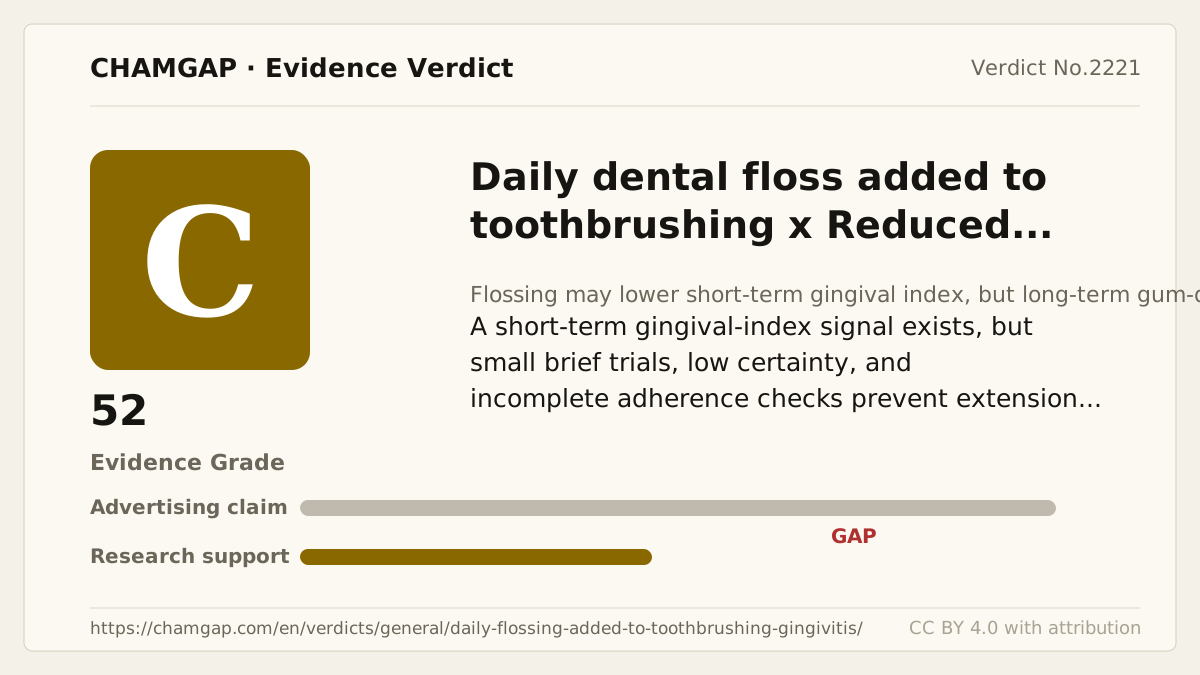
[Chamgap] Daily flossing x reduced gingivitis — Evidence Grade C·50. 1 cited sources checked. Source: https://chamgap.com/en/verdicts/general/daily-flossing-added-to-toothbrushing-gingivitis/ · CC BY 4.0CC BY 4.0 — free to use with attribution; do not distort grades, numbers, or verdict meaning.
What this document does and does not do
Chamgap is an information source. It reports what research has and has not confirmed; it does not tell readers what to take or buy. That decision belongs to readers and, when needed, medical or legal professionals. This verdict reflects literature available up to the search date and may change as new research appears. Nothing here is medical advice.