
Cycle commuting,
does it really help with Reduced incidence of newly diagnosed cancer?
research showsThe grade is C. In a prospective cohort of 263,450 employed UK Biobank participants, cycle commuters had a lower cancer-incidence hazard than non-active commuters, HR 0.55, 95% CI 0.44-0.69. Commuting mode was self-reported once, however, and people able to cycle were already healthier and more active and differed in income and residential environment. This does not show that starting cycle commuting reduces cancer by 45%.
ads claimReporting a commuting mode is not the same as assigning people to cycling and preventing cancer. Policy communication should disclose healthy-user selection, short initial incidence follow-up, and variation by cancer site.
Useful facts when choosing a product
- Exposure came from one baseline commuting question rather than GPS or employment records; reported distance and round trips were not repeatedly updated.
- The non-active reference used only motor vehicles or public transport, while the cycling category combined cycling alone with cycling plus walking.
- The original report lacked a verified first-years exclusion, while the 2025 analysis found similar associations after excluding four years. A healthy-user effect could still remain.
Chamgap Semantic Classification Code
Candidate index · review held
UNK.habitual-cycle-commuting.UNK.incidence-of-newly-diagnosed-cancer.reduce.UNKUnknown > Habitual cycle commuting > Unknown > incidence of newly diagnosed cancer > Reduction claim > Unknown
An automated migration candidate, not an issued permanent code; exact claim scope remains under review. This machine-generated migration candidate helps retrieval but is not a permanent assignment. The original verdict ID and URL remain authoritative.
What the research actually shows
Commuting mode was reported once on a baseline electronic questionnaire, and cancer events came from registry linkage. Median follow-up was 5.0 years for mortality but only 2.1 years for incident cancer. Among 3,748 incident cancers, cycle commuting had HR 0.55, 95% CI 0.44-0.69; cancer mortality had HR 0.60, 0.40-0.90. An analysis excluding the first two years of cancers was not identified in the original paper. A 2025 analysis of the same UK Biobank with 11.7 years of follow-up found associations for colon cancer, HR 0.72; renal cancer, 0.60; and stomach cancer, 0.27. Associations remained similar after excluding the first four years, although a healthy-user effect could still remain and not all cancer sites were significant.
Why this is classified as C (56)
A large publicly funded cohort, registry events, and a strong association are offset by low recruitment participation, healthy-user selection, multiple comparisons, and one-time self-reported exposure, giving C with 56 points.
Counterpoint. A large association is not automatically an equally large causal effect, and later site-specific analysis was significant for only some cancers.
Rejudgment record. Cross-check applied — Registry-confirmed cancer and a large association balanced against healthy-user selection, low participation, multiplicity, and one-time self-reported exposure
| Endpoint | H | Hard endpoint - actual events such as death |
| Replication | R1 | Single confirmatory trial |
| Independence | I2 | Decisive evidence is publicly or non-profit funded |
| Effect size | E+ | Meets the clinically important threshold |
Stored derived and displayed grades match; this is not a current recalculation or validity check (C).
Sub-claim grades by effect
This ingredient is marketed for several effects. A single overall grade blends strong and weak claims together, so each effect is graded separately here. The overall grade reflects the strongest disconfirming or core claim.
| Effect (sub-claim) | Grade | Basis |
|---|---|---|
| Association with lower overall cancer incidence | C | HR was 0.55, but exposure was observational. |
| Association with lower cancer mortality | C | HR was 0.60 (0.40-0.90). |
| Prevention across all cancer sites | D | Later analysis was significant for only some sites. |
Cross-check — AI research and Codex final gate
Evidence Table
| Study | Design | Sample | Funding | Endpoint | Result | Weight |
|---|---|---|---|---|---|---|
| Celis-Morales et al. 2017 UK Biobank | Prospective observational cohort | 263,450 employed participants; 3,748 incident cancers | British Heart Foundation, Cancer Research UK, MRC, and other public or nonprofit support | New cancer diagnosis through registry linkage | Cycle commuting HR 0.55 (95% CI 0.44-0.69) | Large hard-outcome association with nonrandomized one-time exposure |
| Thu et al. 2025 UK Biobank site-specific analysis | Longer site-specific analysis of the same cohort | 252,334 participants; median 11.7 years | Public cohort data | Sixteen site-specific cancers | Cycling was significant for colon, renal, and stomach cancer, but not other sites | Supporting evidence showing variation by cancer site |
Receipt — 2 References
All 2 cited sources were verified for existence at the original page (as of 2026-08-05).
Final verification and publication gate: Codex · Evidence date: 2026-08-05 · Corrections: none
Cite this verdict
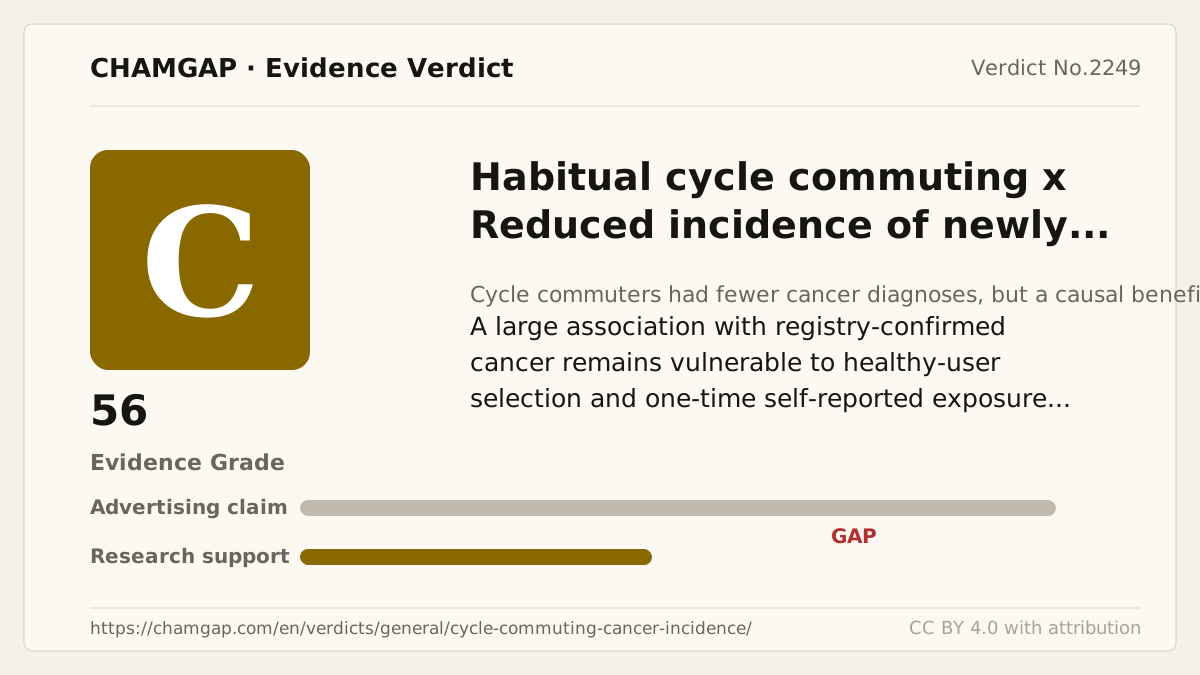
[Chamgap] Cycle commuting x lower cancer incidence — Evidence Grade C·56. 2 cited sources checked. Source: https://chamgap.com/en/verdicts/general/cycle-commuting-cancer-incidence/ · CC BY 4.0CC BY 4.0 — free to use with attribution; do not distort grades, numbers, or verdict meaning.
What this document does and does not do
Chamgap is an information source. It reports what research has and has not confirmed; it does not tell readers what to take or buy. That decision belongs to readers and, when needed, medical or legal professionals. This verdict reflects literature available up to the search date and may change as new research appears. Nothing here is medical advice.