
Raw cucumber plus radish,
does it really help with Worsened vitamin C status or clinical deficiency?
research showsThe verdict is pending. Cucumber genuinely contains ascorbate oxidase and purified-enzyme activity has been measured. The enzyme oxidizes ascorbate to dehydroascorbate, however, and human erythrocytes rapidly reduce that oxidized form back to ascorbate. No human trial measuring absorption, vitamin status, or deficiency after the cucumber-radish combination was identified, so no score was assigned.
ads claimActive cucumber enzyme is a real fact. Claiming that it destroys all radish vitamin C and causes deficiency, without measuring total loss in a dish or human status, expands chemistry into an untested clinical outcome.
Useful facts when choosing a product
- Purified cucumber ascorbate oxidase had molecular weight about 132,000, eight copper atoms, and specific activity of 3,500 Dawson units/mg.
- In cucumber juice, reported optimum conditions were pH 6.5 and 40°C; the enzyme was inactive at pH 3.9, and pH 3.4 orange juice stopped measured ascorbate oxidation.
- A 1990 cutting study found total vitamin C in cut cucumber and radish sprouts equal to fresh samples. It was not a human feeding study of cucumber plus radish root.
- Human erythrocytes rapidly take up dehydroascorbate and reduce it to ascorbate, so initial oxidation does not equal total loss of biological vitamin C.
- Heating can denature enzyme protein, but the accessible evidence did not establish residual activity for a specific cooked cucumber-radish recipe across time and temperature.
Chamgap Semantic Classification Code
Candidate index · review held
F.eating-raw-cucumber-and-raw-radish-after-cutting-them-together.oral.worsened-vitamin-c-status-or-clinical-deficiency.assess.UNKFoods and beverages > Eating raw cucumber and raw radish after cutting them together > Oral > Worsened vitamin C status or clinical deficiency > Association or change assessment > Unknown
An automated migration candidate, not an issued permanent code; exact claim scope remains under review. This machine-generated migration candidate helps retrieval but is not a permanent assignment. The original verdict ID and URL remain authoritative.
What the research actually shows
Nakamura 1968 purified cucumber enzyme and measured molecular weight about 132,000, eight copper atoms, and specific activity 3,500 Dawson units/mg. A 1985 cucumber-juice study reported optimum pH 6.5 and 40°C, inactivation at pH 3.9, and cessation of measured ascorbate oxidation after adding pH 3.4 orange juice. These were food-enzyme experiments, not human trials. Oba 1990 found total vitamin C unchanged in cut cucumber and radish sprouts versus fresh samples. May 1995 showed human erythrocyte reduction of oxidized vitamin C. Funding for the pivotal chemistry work was not confirmed.
Why this is classified as ?
Enzyme activity was directly measured, but no human study measured vitamin C absorption, status, or deficiency after cucumber plus radish; the verdict is pending without a score.
Counterpoint. Vitamin C loss can vary with cut size, storage time, oxygen, temperature, and acidity. This does not mean the enzyme is absent.
Rejudgment record. Cross-check applied — Cucumber enzyme and food chemistry were verified, but no human absorption, nutritional-status, or deficiency study tested the cucumber-radish combination
| Endpoint | H | Hard endpoint - actual events such as death |
Stored derived and displayed grades match; this is not a current recalculation or validity check (?).
Sub-claim grades by effect
This ingredient is marketed for several effects. A single overall grade blends strong and weak claims together, so each effect is graded separately here. The overall grade reflects the strongest disconfirming or core claim.
| Effect (sub-claim) | Grade | Basis |
|---|---|---|
| Eating cucumber with radish causes human vitamin C deficiency | ? | No eligible human combination study was identified. Enzyme existence is recorded as a measured fact in product_facts. |
Cross-check — AI research and Codex final gate
Evidence Table
| Study | Design | Sample | Funding | Endpoint | Result | Weight |
|---|---|---|---|---|---|---|
| Nakamura et al. 1968 | Purified cucumber-enzyme biochemical analysis | No human participants | Original funding not confirmed | Molecular weight, copper content, and specific activity | Molecular weight about 132,000, eight copper atoms, and 3,500 Dawson units/mg | Direct evidence that the enzyme exists |
| Kim et al. 1985 | Food-enzyme study in cucumber juice | No human participants | Original funding not confirmed | Enzyme activity by pH and temperature | Optimum pH 6.5 and 40°C; inactive at pH 3.9; oxidation stopped with pH 3.4 orange juice | Supporting acidity and preparation evidence |
| May et al. 1995 | Ex vivo transport and reduction study in human erythrocytes | Human erythrocytes | US Public Health Service research support | Dehydroascorbate uptake and ascorbate regeneration | Rapid uptake of oxidized vitamin and intracellular reduction to ascorbate | Supporting evidence that oxidation is not complete loss |
Receipt — 4 References
All 4 cited sources were verified for existence at the original page (as of 2026-08-04).
Final verification and publication gate: Codex · Evidence date: 2026-08-04 · Corrections: none
Cite this verdict
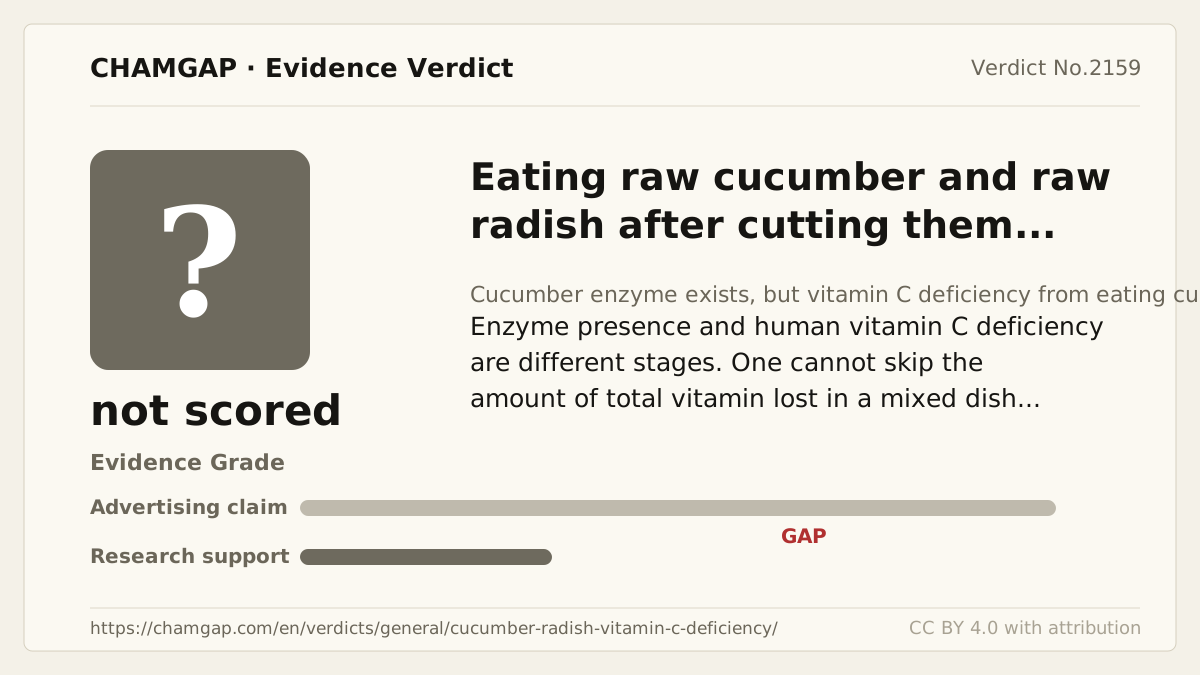
[Chamgap] Raw cucumber plus radish x vitamin C deficiency — Evidence Grade ?. 4 cited sources checked. Source: https://chamgap.com/en/verdicts/general/cucumber-radish-vitamin-c-deficiency/ · CC BY 4.0CC BY 4.0 — free to use with attribution; do not distort grades, numbers, or verdict meaning.
What this document does and does not do
Chamgap is an information source. It reports what research has and has not confirmed; it does not tell readers what to take or buy. That decision belongs to readers and, when needed, medical or legal professionals. This verdict reflects literature available up to the search date and may change as new research appears. Nothing here is medical advice.