
Chlorella,
does it really help with Detoxification, immunity, and cholesterol?
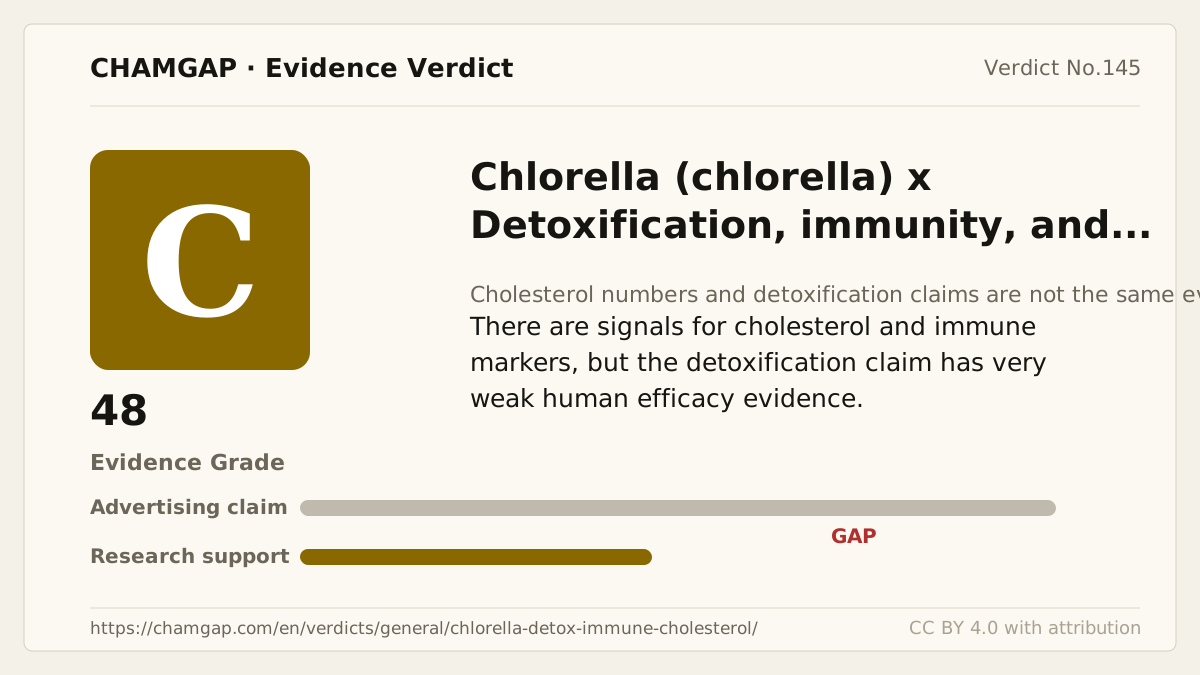
research showsChlorella has human signals for cardiovascular surrogate markers such as cholesterol and blood pressure and immune surrogate markers such as NK cells and cytokines. However, 'detoxification' is difficult to regard as a clinically proven claim in humans, and cholesterol and immune effects also are not evidence of disease prevention.
ads claimAdvertising combines 'heavy-metal elimination,' 'chlorophyll detox,' 'immunity,' and 'cholesterol.' The research evidence is divided into blood numbers and immune-cell markers, and it does not directly match advertising detox wording.
Useful facts when choosing a product
- For chlorella products, whether the cell wall is broken, protein and chlorophyll contents, and contamination control are important.
- Because of vitamin K content, people taking anticoagulants such as warfarin need caution.
- Gastrointestinal discomfort, green stool, and allergic reactions are possible.
- For people taking immunosuppressants or with autoimmune diseases, immune-stimulation wording is difficult to apply as-is.
Chamgap Semantic Classification Code
Candidate index · review held
UNK.chlorella.UNK.detoxification-immunity-and-cholesterol.assess.placeboUnknown > Chlorella > Unknown > Detoxification, immunity, and cholesterol > Association or change assessment > Placebo
An automated migration candidate, not an issued permanent code; exact claim scope remains under review. This machine-generated migration candidate helps retrieval but is not a permanent assignment. The original verdict ID and URL remain authoritative.
What the research actually shows
Fallah 2018 meta-analysis pooled chlorella RCTs and reported signals for changes in cardiovascular risk markers such as total cholesterol, LDL, blood pressure, and fasting glucose. Ryu 2014 reported that 4 weeks of chlorella intake lowered total cholesterol and LDL in 63 adults with mild hypercholesterolemia. Kwak 2012 reported increased NK-cell activity and some cytokines after 8 weeks of intake in 51 healthy adults. For detoxification, there are small or special-situation data related to dioxins and heavy metals, but these are weak as evidence for 'detox' in generally healthy people.
Why this is classified as C (48)
Human evidence for cholesterol and immune markers makes the middle of C possible, but all are surrogate markers and the clinical evidence for detoxification is weak, so I do not raise it to B. It is C, 48 points.
Counterpoint. For the narrow claim of improved lipid numbers, the evidence is close to the upper part of C. But when detoxification and immune enhancement are bundled, the evidence becomes weaker.
Rejudgment record. Draft — Human surrogate-marker RCTs and meta-analysis exist, but clinical evidence for detoxification is insufficient
Cross-check — AI research and Codex final gate
Evidence Table
| Study | Design | Sample | Funding | Endpoint | Result | Weight |
|---|---|---|---|---|---|---|
| Fallah AA et al. 2018 | Meta-analysis of RCTs | Mixed | Cardiovascular risk markers such as cholesterol, blood pressure, and blood glucose | Reported signals of improvement in some markers, including total cholesterol, LDL, and blood pressure. | Core | |
| Ryu NH et al. 2014 | Randomized double-blind placebo-controlled trial | 63 | Unknown/product study | Blood lipids | Reported reductions in total cholesterol and LDL after 4 weeks of intake. | Core |
| Kwak JH et al. 2012 | Randomized double-blind placebo-controlled trial | 51 | Unknown/possible product provision | NK-cell activity, IFN-gamma, and IL-12 | Reported increases in immune-cell and cytokine surrogate markers. | Supporting |
Receipt — 4 References
All 4 cited sources were verified for existence at the original page (as of 2026-07-09).
Final verification and publication gate: Codex · Evidence date: 2026-07-09 · Corrections: none
Cite this verdict
[Chamgap] Chlorella x detoxification, immunity, and cholesterol — Evidence Grade C·48. 4 cited sources checked. Source: https://chamgap.com/en/verdicts/general/chlorella-detox-immune-cholesterol/ · CC BY 4.0CC BY 4.0 — free to use with attribution; do not distort grades, numbers, or verdict meaning.
What this document does and does not do
Chamgap is an information source. It reports what research has and has not confirmed; it does not tell readers what to take or buy. That decision belongs to readers and, when needed, medical or legal professionals. This verdict reflects literature available up to the search date and may change as new research appears. Nothing here is medical advice.