
Chest-radiograph screening,
does it really help with Detecting lung cancer early and reducing lung-cancer mortality in asymptomatic adults?
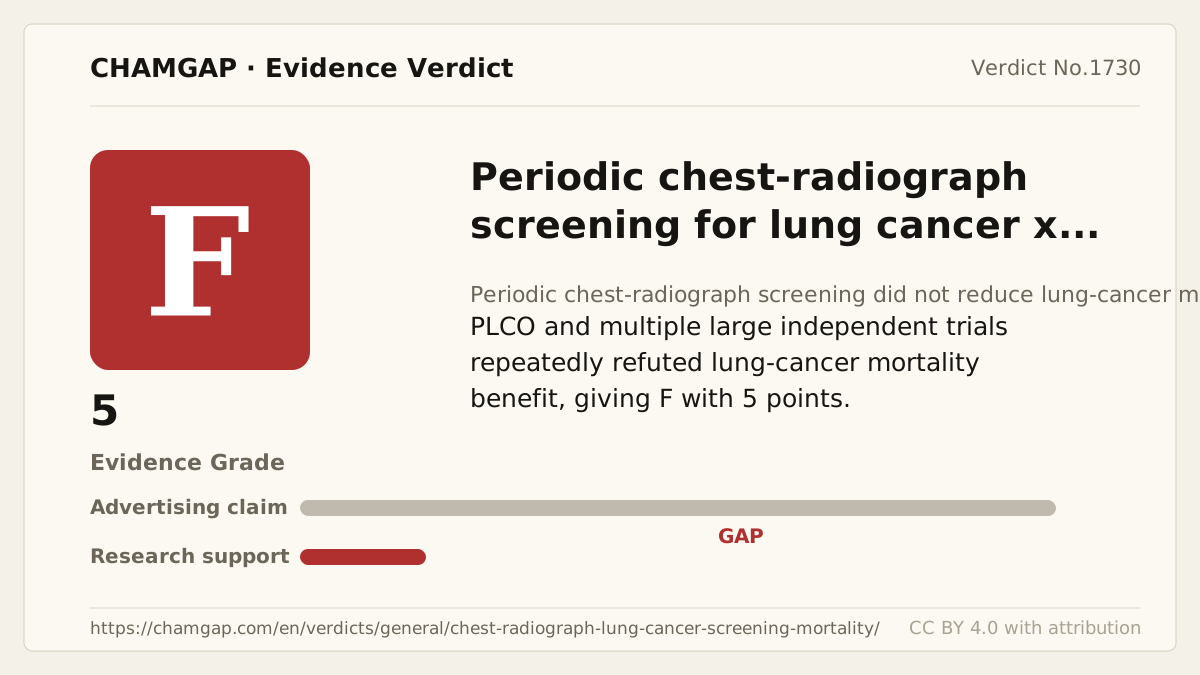
research showsPeriodic chest-radiograph screening of asymptomatic adults to reduce lung-cancer mortality is rated F. PLCO analyzed all 154,901 participants by intention to screen and found 1,213 versus 1,230 lung-cancer deaths, RR 0.99 (95% CI 0.87 to 1.22). The full Manser 2013 Cochrane review included nine trials and 453,965 participants, but RR 1.11 (95% CI 1.00 to 1.23) came from a separate long-term mortality meta-analysis of four trials, Czech, Kaiser, Mayo, and North London, with about 81,303 participants. verdict 1291, which is A with 92 points, concerns a different test and population.
ads claimA simple radiograph is promoted as life-saving early detection, but more detection did not translate into fewer lung-cancer deaths.
Useful facts when choosing a product
- Chest radiography can be useful for diagnostic evaluation of symptoms, which is different from asymptomatic screening efficacy.
- For eligible high-risk smokers, the recommended screening modality is low-dose CT, not chest radiography.
- Abnormal radiographs can trigger CT and biopsy, with false positives, overdiagnosis, and radiation exposure to consider.
Chamgap Semantic Classification Code
Candidate index · review held
P.periodic-chest-radiograph-screening.diagnostic.detecting-lung-cancer-early-and-reducing-lung-cancer-mortality.reduce.usual-careProcedures, devices and tests > Periodic chest-radiograph screening > Diagnostic or screening > Detecting lung cancer early and reducing lung-cancer mortality > Reduction claim > Usual care
An automated migration candidate, not an issued permanent code; exact claim scope remains under review. This machine-generated migration candidate helps retrieval but is not a permanent assignment. The original verdict ID and URL remain authoritative.
What the research actually shows
PLCO analyzed all 154,901 participants by intention to screen and found 1,213 lung-cancer deaths with radiography versus 1,230 with usual care, RR 0.99 (95% CI 0.87 to 1.22). It had public US NCI funding. The full Manser 2013 Cochrane review included nine trials and 453,965 participants. RR 1.11 (95% CI 1.00 to 1.23) was not the pooled result of all nine trials; it came from a separate long-term lung-cancer mortality meta-analysis of the Czech, Kaiser, Mayo, and North London trials, about 81,303 participants. Erfurt was excluded for insufficient original data. verdict 1291, which is A with 92 points, concerns NLST: 53,454 high-risk smokers were assigned to low-dose CT or chest radiography, and low-dose CT reduced lung-cancer mortality by 20.0% (95% CI 6.8 to 26.7). Failure of radiography versus usual care and success of low-dose CT versus radiography differ in test and population and are not contradictory.
Why this is classified as F (5)
PLCO alone permits as much as a 13% benefit, but multiple independent trials of the same test and a four-trial meta-analysis of about 81,303 participants repeatedly denied benefit, giving F with 5 points.
Counterpoint. Cough, hemoptysis, or unexplained weight loss calls for diagnostic evaluation rather than screening.
Rejudgment record. Cross-check applied — Although PLCO alone permits as much as a 13% benefit, multiple independent trials of the same chest-radiograph test and a long-term four-trial meta-analysis of about 81,303 participants repeatedly denied lung-cancer mortality benefit
Sub-claim grades by effect
This ingredient is marketed for several effects. A single overall grade blends strong and weak claims together, so each effect is graded separately here. The overall grade reflects the strongest disconfirming or core claim.
| Effect (sub-claim) | Grade | Basis |
|---|---|---|
| Reduction of lung-cancer mortality in asymptomatic adults | F | PLCO and multiple independent trials of the same test were repeatedly null. |
| Mortality reduction from chest radiography in high-risk smokers | F | The high-risk PLCO subgroup also showed no benefit. |
| Lower lung-cancer mortality with more frequent chest radiography | F | The four-trial meta-analysis of about 81,303 participants with long-term data showed no reduction, RR 1.11. |
Cross-check — AI research and Codex final gate
Evidence Table
| Study | Design | Sample | Funding | Endpoint | Result | Weight |
|---|---|---|---|---|---|---|
| Oken MM et al. 2011 | Large randomized screening trial | 154,901 randomized and all 154,901 analyzed by intention to screen | Public funding and intramural support from the US National Cancer Institute; not manufacturer-led | Primary 13-year lung-cancer mortality endpoint | 1,213 versus 1,230 deaths, RR 0.99 (95% CI 0.87 to 1.22); failed. | Key large hard-endpoint evidence |
| Manser R et al. 2013 | Cochrane systematic review and meta-analysis | Nine trials and 453,965 participants overall; four trials and about 81,303 participants in the long-term lung-cancer mortality RR meta-analysis | Academic Cochrane review; no manufacturer funding reported | Long-term lung-cancer mortality with more frequent versus less frequent chest radiography | RR 1.11 (95% CI 1.00 to 1.23) across the Czech, Kaiser, Mayo, and North London trials; Erfurt was excluded for insufficient original data. | Independent replicated synthesis |
Receipt — 2 References
All 2 cited sources were verified for existence at the original page (as of 2026-07-24).
Final verification and publication gate: Codex · Evidence date: 2026-07-24 · Corrections: none
Cite this verdict
[Chamgap] Chest-radiograph screening x prevention of lung-cancer death — Evidence Grade F·5. 2 cited sources checked. Source: https://chamgap.com/en/verdicts/general/chest-radiograph-lung-cancer-screening-mortality/ · CC BY 4.0CC BY 4.0 — free to use with attribution; do not distort grades, numbers, or verdict meaning.
What this document does and does not do
Chamgap is an information source. It reports what research has and has not confirmed; it does not tell readers what to take or buy. That decision belongs to readers and, when needed, medical or legal professionals. This verdict reflects literature available up to the search date and may change as new research appears. Nothing here is medical advice.