
Cerumenolytic ear drops,
does it really help with Complete clearance of impacted earwax and reduced need for further removal?
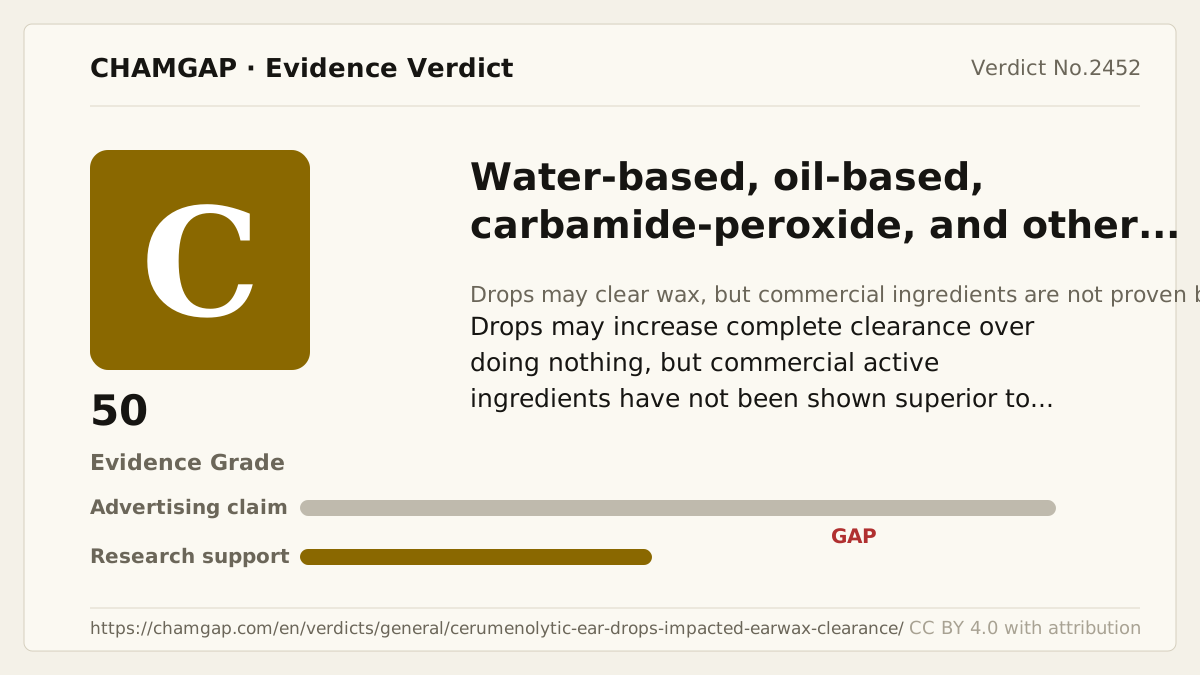
research showsThe grade is C with 50 points. A 2018 Cochrane review included 10 trials and 623 participants, while six trials and 360 participants contributed complete-clearance data. Active drops improved clearance versus no treatment in one small trial, but did not outperform water or saline. Evidence for hearing or symptom improvement was scarce or absent.
ads claimA water or saline control is not a no-treatment control. Evidence does not establish that a commercial cerumenolytic is better than simple water or that it improves hearing.
Useful facts when choosing a product
- Pharmacies in Korea sell carbamide-peroxide and glycerin-based cerumenolytics; ingredient, age limits, and duration vary by product.
- Active treatment achieved 22% versus 5% complete clearance, but this came from one 117-ear comparison.
- Verdict 2369 is D with 28 points and concerns ear candling, a different intervention from liquid softening drops.
Chamgap Semantic Classification Code
Candidate index · review held
UNK.water-based.UNK.complete-clearance-of-impacted-earwax-and-reduced-need-for-further-removal.reduce.noneUnknown > Water-based > Unknown > Complete clearance of impacted earwax and reduced need for further removal > Reduction claim > No intervention
An automated migration candidate, not an issued permanent code; exact claim scope remains under review. This machine-generated migration candidate helps retrieval but is not a permanent assignment. The original verdict ID and URL remain authoritative.
What the research actually shows
The review included 10 trials, 623 participants, and 900 ears; six trials, 360 participants, and 491 ears contributed complete-clearance data. Keane 1995 compared Cerumol containing arachis oil 57.3%, chlorobutanol 5%, and paradichlorobenzene 2%, sodium bicarbonate drops, sterile water, and no treatment. Each drop arm used four drops twice daily for five days. Ninety-seven of 113 participants were randomized and 155 ears analyzed after 16 participants left hospital or died. Active versus no treatment used 117 ears and water versus no treatment 76 ears. Across active-versus-water or saline trials, exposure ranged from a single 15-minute application to twice daily for five days. A pooled heterogeneity statistic could not be confirmed. Overall trial bias was low or unclear and certainty for clearance was low. Trial registration and Keane funding could not be confirmed.
Why this is classified as C (50)
Clearance improved, but it is a surrogate-like finding supported by one small trial, with no superiority over water or saline and little patient-centered evidence, giving C with 50 points.
Counterpoint. Simple drops may facilitate natural or subsequent removal, but superiority of a specific commercial ingredient is unproven.
Rejudgment record. Cross-check applied — Separate evaluation of complete clearance, further irrigation, symptoms, and hearing with explicit distinction between no-treatment and water or saline controls
| Endpoint | S | Surrogate marker - laboratory or imaging measures |
| Replication | R1 | Single confirmatory trial |
| Independence | I1 | Mixed funding sources |
| Effect size | E+ | Meets the clinically important threshold |
Stored derived and displayed grades match; this is not a current recalculation or validity check (C).
Sub-claim grades by effect
This ingredient is marketed for several effects. A single overall grade blends strong and weak claims together, so each effect is graded separately here. The overall grade reflects the strongest disconfirming or core claim.
| Effect (sub-claim) | Grade | Basis |
|---|---|---|
| Complete wax clearance with active cerumenolytics | C | Clearance exceeded no treatment, but only in one small trial. |
| Active cerumenolytics outperform water or saline | D | Three trials were null, pooled RR 1.47 (0.79 to 2.75). |
| Improved hearing or ear symptoms | ? | The review found very limited or no direct data. |
Cross-check — AI research and Codex final gate
Evidence Table
| Study | Design | Sample | Funding | Endpoint | Result | Weight |
|---|---|---|---|---|---|---|
| Aaron et al. 2018 Cochrane review | Systematic review of randomized trials | Ten trials, 623 participants and 900 ears; complete clearance in six trials, 360 participants and 491 ears | National Institute for Health Research infrastructure funding for Cochrane ENT; no internal support | Complete wax clearance and adverse effects; secondary symptoms and need for further removal | Active versus no treatment RR 4.09 (1.00 to 16.80; 117 ears); active versus water or saline RR 1.47 (0.79 to 2.75; 257 ears) | Decisive synthesis |
| Keane et al. 1995 | Four-arm randomized trial | 97 randomized and 155 ears analyzed; 16 of 113 recruited participants lost | Not reported | Complete wax clearance after five days | Active drops 22% versus no treatment 5%; no clear difference among water, sodium bicarbonate, and Cerumol | Only direct active-versus-no-treatment comparison |
Receipt — 3 References
All 3 cited sources were verified for existence at the original page (as of 2026-08-08).
Final verification and publication gate: Codex · Evidence date: 2026-08-08 · Corrections: none
Cite this verdict
[Chamgap] Cerumenolytic ear drops x clearance of impacted earwax — Evidence Grade C·50. 3 cited sources checked. Source: https://chamgap.com/en/verdicts/general/cerumenolytic-ear-drops-impacted-earwax-clearance/ · CC BY 4.0CC BY 4.0 — free to use with attribution; do not distort grades, numbers, or verdict meaning.
What this document does and does not do
Chamgap is an information source. It reports what research has and has not confirmed; it does not tell readers what to take or buy. That decision belongs to readers and, when needed, medical or legal professionals. This verdict reflects literature available up to the search date and may change as new research appears. Nothing here is medical advice.