
Carnivore diet,
does it really help with Improved overall perceived health and well-being?
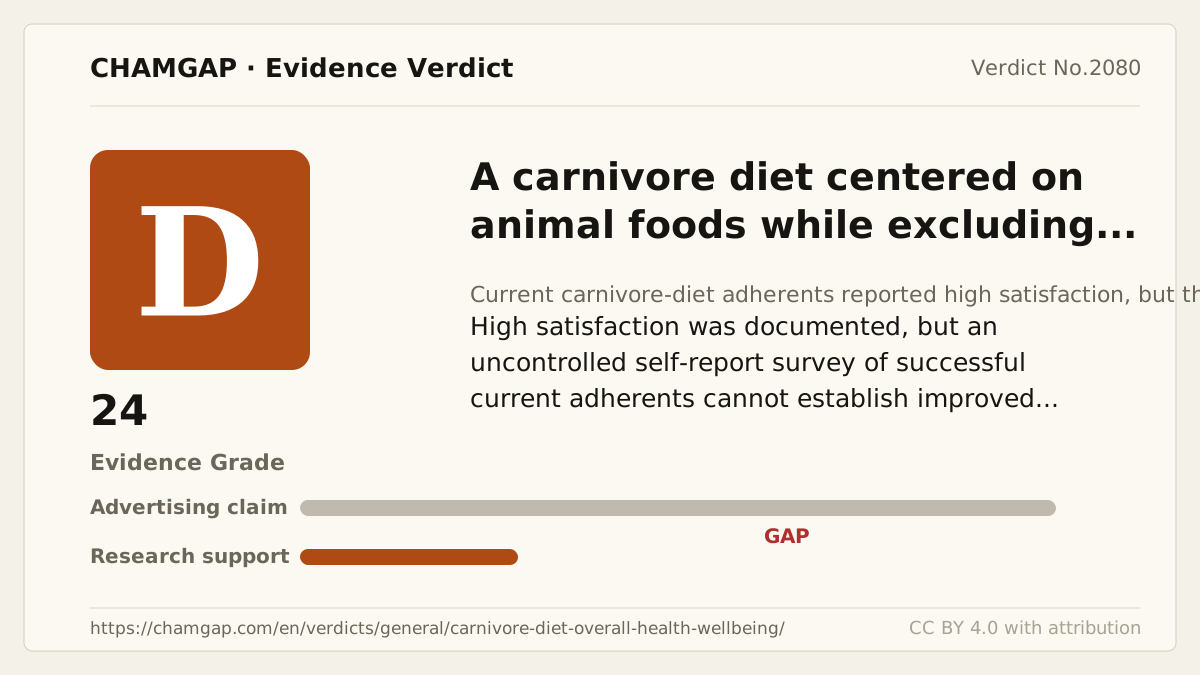
research showsThe grade is D with 30 points. In a peer-reviewed cross-sectional survey, 95% of 2,029 volunteers who had followed a carnivore diet for a median 14 months reported better overall health than before. There was no comparison group or objective baseline, and recruitment selected people from carnivore communities who had already maintained the diet for at least six months. The response proportion is not a causal dietary effect.
ads claimFrequent red-meat intake and near-exclusion of plant foods were measured dietary patterns. Responding that health improved does not show that the diet caused the improvement. Verdict 2061 is C with 56 points for spicy-food habits and all-cause mortality; this verdict addresses a different question, subjective health in an uncontrolled cross-sectional carnivore survey.
Useful facts when choosing a product
- Eighty-five percent reported red meat at least daily, and fewer than 10% consumed fruit, vegetables, or grains more often than monthly.
- Carnivore-diet social-media communities produced 3,883 initial respondents, of whom 2,029, or 52%, were analyzed; sources included Facebook 23%, Instagram 18%, and Reddit 7%, without comparable recruitment of former users or non-carnivore controls.
- Median current LDL was 172 mg/dL in a reporting subset, but without prediet values this is not a measured increase or decrease.
- Meat cuts, grams per day, grilling, frying, smoking, and doneness were not standardized, preventing cooking-specific inference.
- IARC Group 1 for processed meat and Group 2A for red meat describe certainty of carcinogenic evidence, not equal risk magnitude. Sharing a group with tobacco does not mean processed meat has the same absolute risk as smoking.
Chamgap Semantic Classification Code
Candidate index · review held
D.carnivore-diet-centered-on-animal-foods-while-excluding-nearly-all-fruit.dietary.overall-perceived-health-and-well-being.improve.UNKDietary patterns and eating practices > carnivore diet centered on animal foods while excluding nearly all fruit > Dietary regimen > overall perceived health and well-being > Improvement claim > Unknown
An automated migration candidate, not an issued permanent code; exact claim scope remains under review. This machine-generated migration candidate helps retrieval but is not a permanent assignment. The original verdict ID and URL remain authoritative.
What the research actually shows
The survey recruited from carnivore-diet social-media communities from March to June 2020. Of 3,883 initial respondents, 2,029, or 52%, were analyzed; recruitment sources included Facebook 23%, Instagram 18%, and Reddit 7%. Median age was 44, 67% were male, and median diet duration was 14 months. Funding was NIDDK K23 DK119546 and R03 DK123541 plus NCCIH T32 AT004094. David Ludwig disclosed royalties from books on carbohydrate-modified diets and that his spouse owned a nutrition education and consulting business.
Why this is classified as D (30)
A human study asked the subjective outcome, but it had no control group, objective baseline, or prospective follow-up. Cross-sectional timing, self-report, and strong current-adherent selection do not support causal efficacy, giving D with 30 points.
Counterpoint. Anyone attempting the diet should monitor LDL, blood pressure, kidney function, uric acid, nutritional status, and gastrointestinal symptoms. Long-term benefit and harm require prospective controlled research.
Rejudgment record. Cross-check applied — Checked recruitment, food frequencies, self-reported outcomes, and current lipid values against the original report, separated response proportions from causal effects, and applied observational-study limitations
| Endpoint | P | Symptom or function itself is the target - including patient reports and performance tests |
| Replication | R1 | Single confirmatory trial |
| Independence | I2 | Decisive evidence is publicly or non-profit funded |
| Effect size | E0 | Null |
| Precision | CX | No pooled confidence interval could be confirmed |
Stored derived and displayed grades match; this is not a current recalculation or validity check (D).
Sub-claim grades by effect
This ingredient is marketed for several effects. A single overall grade blends strong and weak claims together, so each effect is graded separately here. The overall grade reflects the strongest disconfirming or core claim.
| Effect (sub-claim) | Grade | Basis |
|---|---|---|
| High satisfaction among current carnivore-diet adherents | C | A descriptive survey found that 95% reported better overall health. |
| The carnivore diet improves overall health and well-being | D | No control, objective baseline, or prospective follow-up supported a causal effect. |
Cross-check — AI research and Codex final gate
Evidence Table
| Study | Design | Sample | Funding | Endpoint | Result | Weight |
|---|---|---|---|---|---|---|
| Lennerz et al. 2021 | Uncontrolled cross-sectional self-report survey recruited from carnivore-diet social-media communities | 2,029 of 3,883 initial respondents analyzed, 52% | NIDDK K23 DK119546 and R03 DK123541, NCCIH T32 AT004094; Ludwig disclosed book royalties and spouse's nutrition business | Current versus recalled prediet overall health and well-being | Overall health improvement reported by 95% and well-being improvements by 66% to 91%; no control, objective baseline, or between-group CI | Human responses that cannot establish causal efficacy |
Receipt — 1 References
All 1 cited sources were verified for existence at the original page (as of 2026-08-03).
Final verification and publication gate: Codex · Evidence date: 2026-08-03 · Corrections: none
Cite this verdict
[Chamgap] Carnivore diet x improved overall health and well-being — Evidence Grade D·30. 1 cited sources checked. Source: https://chamgap.com/en/verdicts/general/carnivore-diet-overall-health-wellbeing/ · CC BY 4.0CC BY 4.0 — free to use with attribution; do not distort grades, numbers, or verdict meaning.
What this document does and does not do
Chamgap is an information source. It reports what research has and has not confirmed; it does not tell readers what to take or buy. That decision belongs to readers and, when needed, medical or legal professionals. This verdict reflects literature available up to the search date and may change as new research appears. Nothing here is medical advice.