
Black pepper plus turmeric,
does it really help with Greater chronic-pain reduction than turmeric alone?
research showsThe grade is D with 28 points. A prospectively registered crossover trial randomized 30 adults with moderate chronic pain and analyzed 29. Adding pepper did not improve the registered primary 0-to-10 pain outcome, P=0.157, and there was no interaction with turmeric dose, P=0.338.
ads claimPepper 0.3 g is about 0.13 teaspoon, 0.043 tablespoon, or one pinch; turmeric doses are about 0.1, 0.33, and 1 teaspoon. These are culinary amounts, but capsules were used, and increased absorption cannot be translated into reduced pain.
Useful facts when choosing a product
- Piperine content varies across Korean retail peppers, and this pain trial did not assay its actual 0.3 g pepper dose.
- Purified piperine 20 mg increased pharmacokinetic exposure to 2 g curcumin in a different formulation and dose setting.
- Verdict 064 is C with 48 points for standardized curcumin and verdict 1306 is C with 48 points for muscle soreness; this verdict tests the incremental pain effect of culinary turmeric plus pepper.
Chamgap Semantic Classification Code
Candidate index · review held
F.adding-ground-black-pepper-to-0-3.food.greater-chronic-pain-reduction-than-turmeric-alone.reduce.UNKFoods and beverages > Adding ground black pepper to 0.3 > Food consumption > Greater chronic-pain reduction than turmeric alone > Reduction claim > Unknown
An automated migration candidate, not an issued permanent code; exact claim scope remains under review. This machine-generated migration candidate helps retrieval but is not a permanent assignment. The original verdict ID and URL remain authoritative.
What the research actually shows
Durham 2026 randomized 30 adults aged at least 40 with chronic pain to the sequence of turmeric alone and turmeric plus pepper in a double-masked crossover trial. One withdrew for gastrointestinal symptoms and 29 were analyzed. Each condition and washout lasted one week. Capsules delivered 0.3, 1, or 3 g turmeric and 0.3 g pepper. NCT05206266 was submitted on 2021-12-13 and posted on 2022-01-25 before the 2022-02-13 start, and specified pain as primary. McCormick Science Institute and NIH supported the study; author James O. Hill disclosed receiving an honorarium as a McCormick Science Institute advisory-board member.
Why this is classified as D (28)
The prospectively registered patient-centered primary outcome was null, but one imprecise 29-person, one-week, no-placebo trial leaves room for worthwhile benefit, giving D with 28 points.
Counterpoint. This verdict does not deny purified piperine pharmacokinetics; it asks whether that fact translated into less pain with this culinary combination.
Rejudgment record. Cross-check applied — The null prospectively registered primary pain comparison was weighed with the uncertainty from a small, short, active-control crossover design
| Endpoint | P | Symptom or function itself is the target - including patient reports and performance tests |
| Replication | R1 | Single confirmatory trial |
| Independence | I1 | Mixed funding sources |
| Effect size | E0 | Null |
| Precision | C0 | The confidence interval leaves room for benefit |
Stored derived and displayed grades match; this is not a current recalculation or validity check (D).
Sub-claim grades by effect
This ingredient is marketed for several effects. A single overall grade blends strong and weak claims together, so each effect is graded separately here. The overall grade reflects the strongest disconfirming or core claim.
| Effect (sub-claim) | Grade | Basis |
|---|---|---|
| Incremental pain reduction from added pepper | D | The registered primary outcome was null at P=0.157. |
Cross-check — AI research and Codex final gate
Evidence Table
| Study | Design | Sample | Funding | Endpoint | Result | Weight |
|---|---|---|---|---|---|---|
| Durham L et al. 2026 | Prospectively registered randomized double-masked crossover trial | 30 randomized and 29 analyzed | Support from McCormick Science Institute and NIH | Seven-day mean 0-to-10 numeric pain rating | Pepper addition P=0.157 and pepper-by-turmeric-dose P=0.338; no between-condition 95% CI reported. | Direct null registered primary outcome |
Receipt — 2 References
All 2 cited sources were verified for existence at the original page (as of 2026-08-03).
Final verification and publication gate: Codex · Evidence date: 2026-08-03 · Corrections: none
Cite this verdict
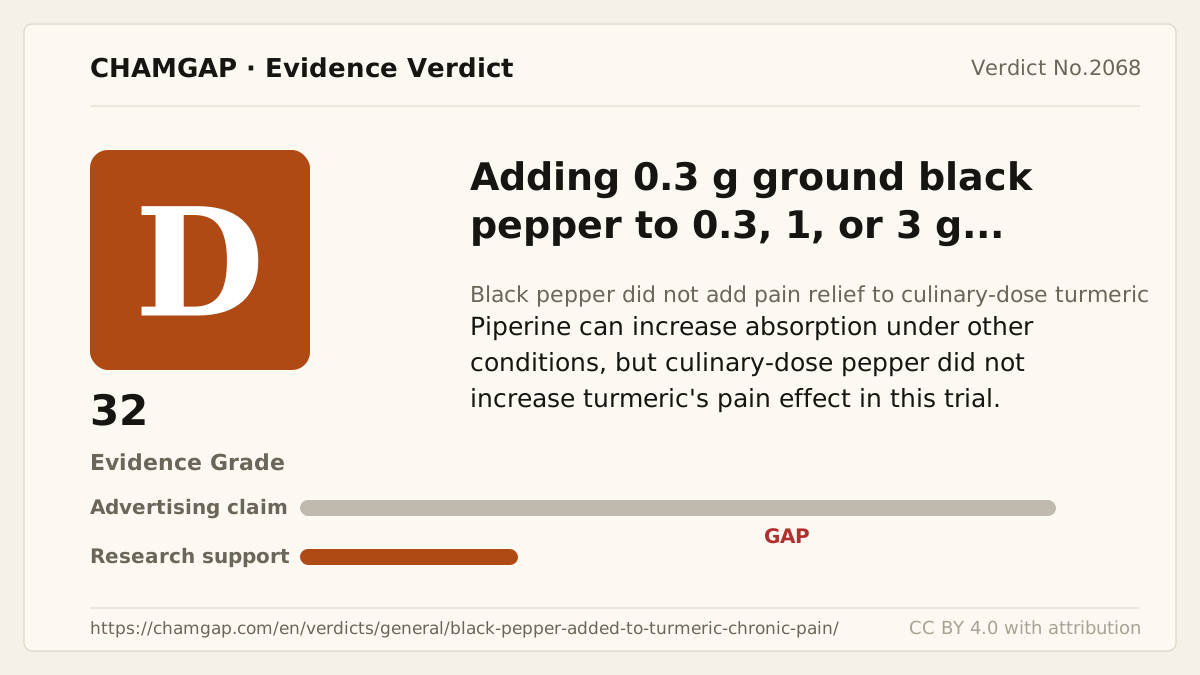
[Chamgap] Black pepper plus turmeric x chronic pain — Evidence Grade D·28. 2 cited sources checked. Source: https://chamgap.com/en/verdicts/general/black-pepper-added-to-turmeric-chronic-pain/ · CC BY 4.0CC BY 4.0 — free to use with attribution; do not distort grades, numbers, or verdict meaning.
What this document does and does not do
Chamgap is an information source. It reports what research has and has not confirmed; it does not tell readers what to take or buy. That decision belongs to readers and, when needed, medical or legal professionals. This verdict reflects literature available up to the search date and may change as new research appears. Nothing here is medical advice.