
Back blows and abdominal thrusts for adult foreign-body airway obstruction,
does it really help with Favorable neurological outcome at 30 days?
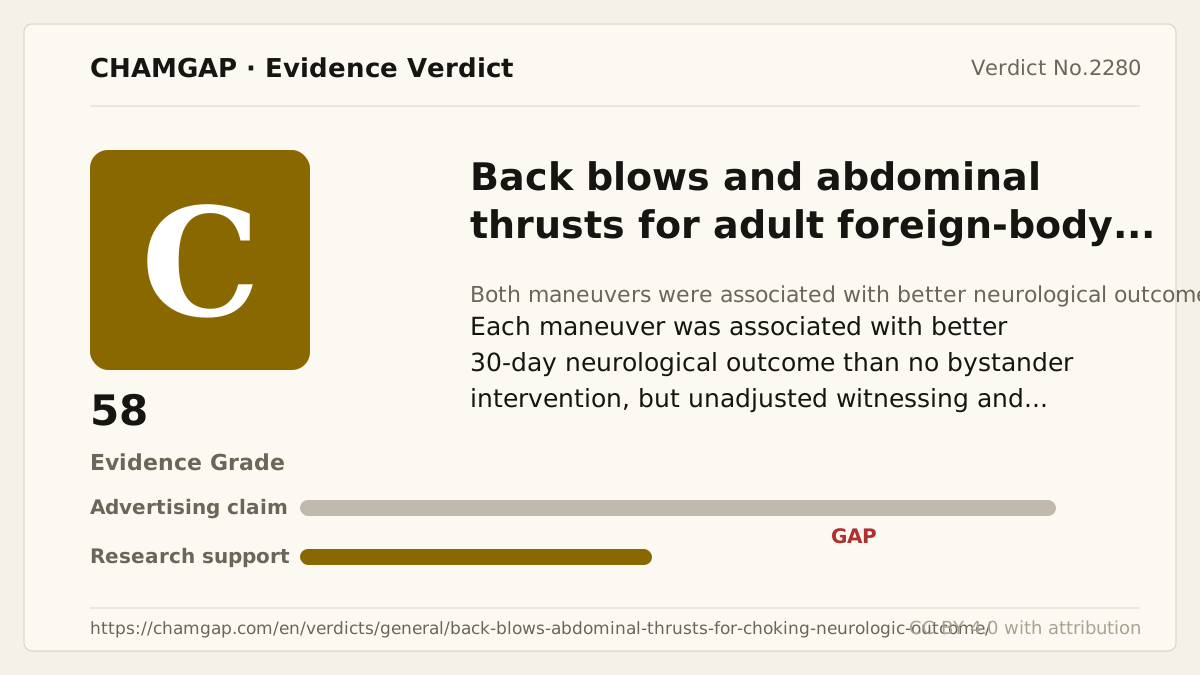
research showsGrade C, 58 points. In a prospective registry across 25 Japanese hospitals, favorable neurological outcome at 30 days was about 16% with no bystander intervention, 31% after back blows first, and 38% after abdominal thrusts first. Adjusted odds ratios were 2.37 and 3.37, respectively. People who could receive a maneuver generally had a bystander present, and witnessing itself improves early recognition and response. The analysis adjusted witness age, sex, and medical training, but did not adjust whether the event was witnessed.
ads claimEmergency-care summaries may present this observational association as a randomized causal effect or a direct ranking of the two techniques. The study only observed that each treated group had better outcomes than the untreated group.
Useful facts when choosing a product
- The primary endpoint was favorable neurological outcome at 30 days, not 30-day survival.
- The comparator was no bystander intervention, not the other maneuver.
- Of 407 patients, 352 had a witnessed event and 192 received bystander intervention.
- Funding came from the non-profit Japanese Association for Acute Medicine, and the authors reported no competing interests.
Chamgap Semantic Classification Code
Candidate index · review held
UNK.back-blows-and-abdominal-thrusts.UNK.favorable-neurological-outcome-at.assess.noneUnknown > Back blows and abdominal thrusts > Unknown > Favorable neurological outcome at > Association or change assessment > No intervention
An automated migration candidate, not an issued permanent code; exact claim scope remains under review. This machine-generated migration candidate helps retrieval but is not a permanent assignment. The original verdict ID and URL remain authoritative.
What the research actually shows
MOCHI prospectively enrolled adults transported with foreign-body airway obstruction at 25 Japanese hospitals from 2020 to 2023. Of 407 patients, 352 events, 86.5%, were witnessed and 192 received a bystander intervention. In the 2025 analysis, favorable neurological outcome at 30 days was 31% after back blows first versus about 16% with no intervention, adjusted OR 2.37, 95% CI 1.20 to 4.67. It was 38% after abdominal thrusts first versus about 16%, adjusted OR 3.37, 95% CI 1.07 to 10.6. Thirty-day survival was secondary; mortality hazard was lower after back blows but not significantly different after abdominal thrusts.
Why this is classified as C (56)
A large association on a hard patient outcome and non-profit funding are strengths. However, this was one observational study and it did not adequately adjust witnessing and obstruction duration, both determinants of treatment opportunity and prognosis. Multiple avoidable confounding problems cap the result at C with 56 points.
Counterpoint. Verdict 2235 is D with 30 points and concerns whether modified baby-led weaning prevents choking events; this verdict concerns neurological outcome after rescue treatment for an adult obstruction that has already occurred.
Rejudgment record. Cross-check applied — Propensity variables, absolute 30-day neurological outcomes, the secondary survival endpoint, and comparator construction were checked directly, with confounding by indication treated as central.
| Endpoint | H | Hard endpoint - actual events such as death |
| Replication | R1 | Single confirmatory trial |
| Independence | I2 | Decisive evidence is publicly or non-profit funded |
| Effect size | E+ | Meets the clinically important threshold |
Stored derived and displayed grades match; this is not a current recalculation or validity check (C).
Sub-claim grades by effect
This ingredient is marketed for several effects. A single overall grade blends strong and weak claims together, so each effect is graded separately here. The overall grade reflects the strongest disconfirming or core claim.
| Effect (sub-claim) | Grade | Basis |
|---|---|---|
| Back blows improve 30-day neurological outcome versus no bystander intervention | C | A 31% versus about 16% association remained strongly confounded by witnessed status. |
| Abdominal thrusts improve 30-day neurological outcome versus no bystander intervention | C | A 38% versus about 16% association came from only 24 treated patients with major residual confounding. |
Cross-check — AI research and Codex final gate
Evidence Table
| Study | Design | Sample | Funding | Endpoint | Result | Weight |
|---|---|---|---|---|---|---|
| Igarashi et al., 2025 prospective MOCHI registry analysis | Prospective multicenter observational cohort across 25 Japanese hospitals | 407 patients; 24 abdominal-thrust first, 76 back-blow first, and 175 with no bystander intervention | Non-profit Japanese Association for Acute Medicine funding; no competing interests reported | Primary: favorable neurological outcome at 30 days; secondary: 30-day survival | About 16% untreated, 31% back blows with adjusted OR 2.37 (1.20 to 4.67), and 38% abdominal thrusts with adjusted OR 3.37 (1.07 to 10.6) | Prospective real-world hard outcome, but strongly limited by residual confounding from witnessing and obstruction duration |
Receipt — 2 References
All 2 cited sources were verified for existence at the original page (as of 2026-08-05).
Final verification and publication gate: Codex · Evidence date: 2026-08-05 · Corrections: none
Cite this verdict
[Chamgap] Back blows and abdominal thrusts for choking × neurological outcome — Evidence Grade C·56. 2 cited sources checked. Source: https://chamgap.com/en/verdicts/general/back-blows-abdominal-thrusts-for-choking-neurologic-outcome/ · CC BY 4.0CC BY 4.0 — free to use with attribution; do not distort grades, numbers, or verdict meaning.
What this document does and does not do
Chamgap is an information source. It reports what research has and has not confirmed; it does not tell readers what to take or buy. That decision belongs to readers and, when needed, medical or legal professionals. This verdict reflects literature available up to the search date and may change as new research appears. Nothing here is medical advice.