
Atovaquone/proguanil,
does it really help with Prevention of clinical malaria in travelers to endemic areas?
research showsAtovaquone/proguanil is rated B for preventing clinical malaria in nonimmune travelers to endemic areas. Double-blind active-controlled traveler trials found similarly high preventive effectiveness compared with mefloquine or chloroquine-proguanil, with better tolerability or fewer discontinuations. The main traveler trials were not placebo-superiority trials, and complete adherence plus destination-specific selection remains essential.
ads claimMarketing can imply that one pill before travel provides complete protection while omitting the full regimen and mosquito avoidance. It is taken daily starting before exposure, throughout travel, and for seven days afterward, together with bite prevention.
Useful facts when choosing a product
- The usual adult prophylaxis tablet combines atovaquone 250 mg with proguanil 100 mg and is taken once daily with food or a milky drink.
- CDC guidance generally starts it one to two days before arrival, continues daily during exposure, and continues for seven days after departure.
- Abdominal pain, nausea, vomiting, headache, and elevated liver enzymes can occur; severe vomiting or diarrhea can impair absorption.
- It is not used for prophylaxis in severe renal impairment, and destination resistance, pregnancy or breastfeeding, weight, and interactions require prescriber review.
Chamgap Semantic Classification Code
Candidate index · review held
M.atovaquone-proguanil.oral.clinical-malaria-in-travelers-to-endemic-areas.prevent.MULTIMedicinal interventions > Atovaquone/proguanil > Oral > clinical malaria in travelers to endemic areas > Occurrence-prevention claim > Multiple: primary unresolved
An automated migration candidate, not an issued permanent code; exact claim scope remains under review. This machine-generated migration candidate helps retrieval but is not a permanent assignment. The original verdict ID and URL remain authoritative.
What the research actually shows
Overbosch and colleagues randomized 976 nonimmune travelers under double masking; neither group had confirmed malaria, and atovaquone/proguanil caused fewer treatment-related neuropsychiatric events and discontinuations than mefloquine. Høgh and colleagues conducted a double-blind equivalence trial in 1,083 travelers; prevention was similar to chloroquine-proguanil, while treatment-related gastrointestinal events were 12% versus 20%. The CDC Yellow Book lists the combination according to destination-specific susceptibility.
Why this is classified as B (72)
Double-blind active-controlled traveler trials reproduced high preventive effectiveness and favorable tolerability, but the evidence is not primarily placebo-superiority, giving B with 72 points.
Counterpoint. When selected for the destination and taken for the entire regimen, it is a convenient and generally well-tolerated option for short trips.
Rejudgment record. New verdict — Accepted reproducible high preventive effectiveness and tolerability in double-blind active-controlled trials of nonimmune travelers while limiting the grade because the main traveler evidence is equivalence or active-control rather than placebo superiority
Sub-claim grades by effect
This ingredient is marketed for several effects. A single overall grade blends strong and weak claims together, so each effect is graded separately here. The overall grade reflects the strongest disconfirming or core claim.
| Effect (sub-claim) | Grade | Basis |
|---|---|---|
| Prevention of clinical malaria in nonimmune travelers to endemic areas | B | High preventive performance was reproduced in active-controlled traveler trials. |
| Maintained clinical-malaria prevention compared with mefloquine | B | No confirmed malaria occurred in either arm of the active-controlled traveler trial; this was not a placebo-superiority study. |
| Prevention of falciparum and vivax malaria in a drug-resistant endemic area | B | A placebo-controlled trial in nonimmune migrants supports prevention of both species, with indirectness to short-term travelers. |
Cross-check — AI research and Codex final gate
Evidence Table
| Study | Design | Sample | Funding | Endpoint | Result | Weight |
|---|---|---|---|---|---|---|
| Overbosch D et al. 2001 | Randomized double-blind mefloquine-controlled trial in nonimmune travelers | 976 participants | GlaxoSmithKline involvement and sponsorship | Confirmed clinical malaria, adverse events, and discontinuation | No confirmed malaria occurred in either group; treatment-related neuropsychiatric events were 14% versus 29% and discontinuation 1.2% versus 5.0%. | Key active-controlled traveler evidence |
| Høgh B et al. 2000 | Randomized double-blind equivalence trial in nonimmune travelers | 1,083 randomized; 511 per group in the safety analysis | Malarone International Study Team with industry involvement | Suspected or confirmed malaria and tolerability | Preventive performance was similar to chloroquine-proguanil, and treatment-related gastrointestinal events were 12% versus 20%. | Large traveler replication evidence |
| Ling J et al. 2002 | Randomized double-blind placebo-controlled trial in nonimmune migrants | 297 participants | United States naval medical research with industry collaboration | Development of P. falciparum or P. vivax malaria | Prevented malaria versus placebo among nonimmune migrants in a drug-resistant area. | Supporting efficacy evidence with indirectness to travelers |
Receipt — 3 References
All 3 cited sources were verified for existence at the original page (as of 2026-07-23).
Final verification and publication gate: Codex · Evidence date: 2026-07-23 · Corrections: none
Cite this verdict
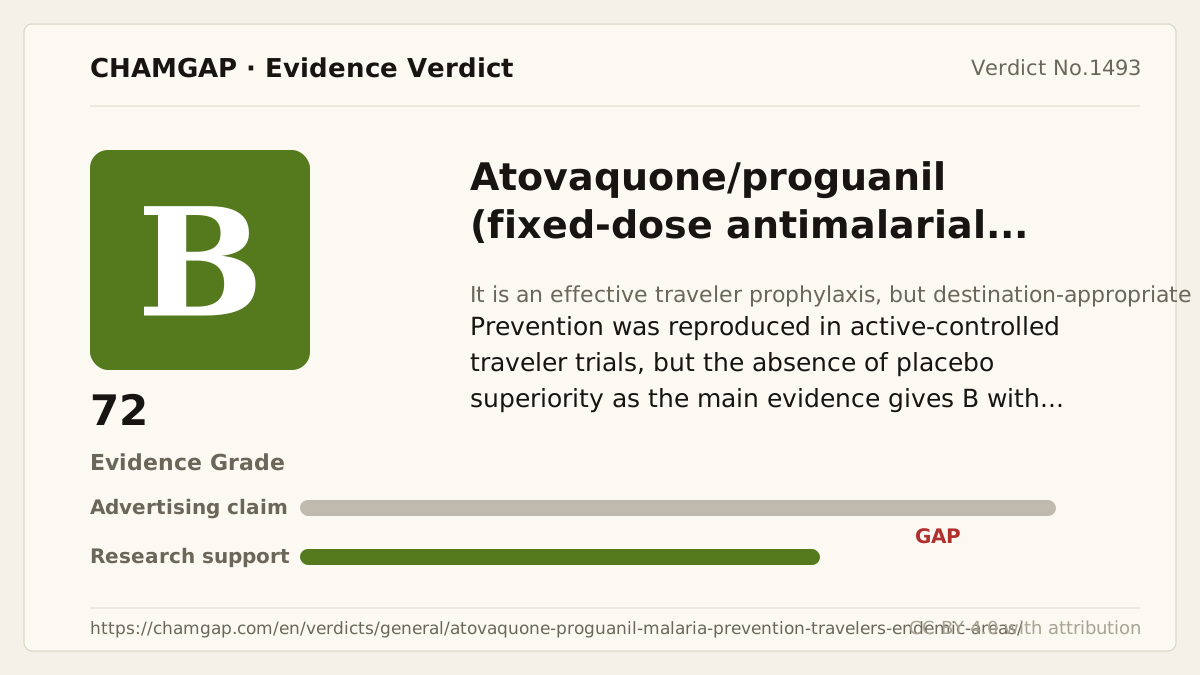
[Chamgap] Atovaquone/proguanil x prevention of clinical malaria in travelers to endemic areas — Evidence Grade B·72. 3 cited sources checked. Source: https://chamgap.com/en/verdicts/general/atovaquone-proguanil-malaria-prevention-travelers-endemic-areas/ · CC BY 4.0CC BY 4.0 — free to use with attribution; do not distort grades, numbers, or verdict meaning.
What this document does and does not do
Chamgap is an information source. It reports what research has and has not confirmed; it does not tell readers what to take or buy. That decision belongs to readers and, when needed, medical or legal professionals. This verdict reflects literature available up to the search date and may change as new research appears. Nothing here is medical advice.