
Apixaban,
does it really help with Prevention of recurrent cancer-associated venous thromboembolism?
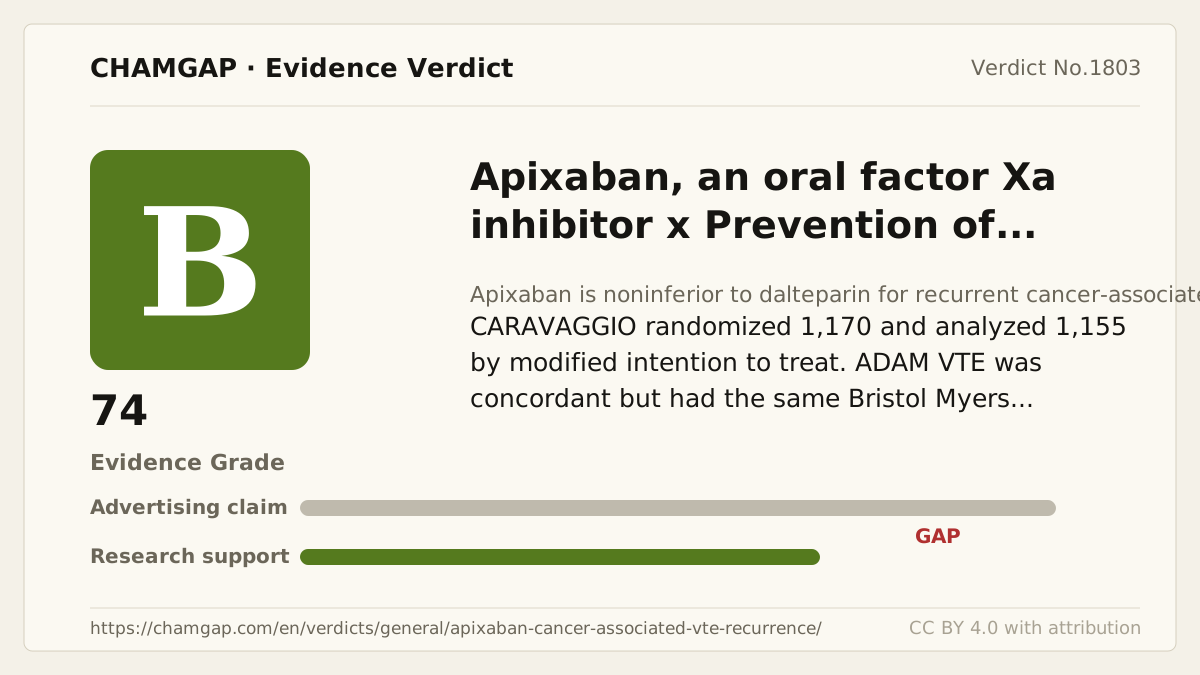
research showsApixaban is rated B because it was noninferior to dalteparin for cancer-associated VTE. CARAVAGGIO randomized 1,170 participants and analyzed 1,155 by modified intention to treat; recurrence was 5.6% versus 7.9%, HR 0.63 (95% CI 0.37 to 1.07), P<.001 for noninferiority. The prespecified HR margin was 2.00, and superiority was not established.
ads claimClaims of universal superiority to injections or suitability for every cancer and bleeding-risk profile exceed the trials.
Useful facts when choosing a product
- CARAVAGGIO used 10 mg twice daily for seven days, then 5 mg twice daily for six months.
- Brain tumors, known cerebral metastases, and acute leukemia were excluded.
Chamgap Semantic Classification Code
Candidate index · review held
UNK.apixaban.MULTI.recurrent-cancer-associated-venous-thromboembolism.prevent.activeUnknown > Apixaban > Multiple: primary unresolved > recurrent cancer-associated venous thromboembolism > Occurrence-prevention claim > Active comparator
An automated migration candidate, not an issued permanent code; exact claim scope remains under review. This machine-generated migration candidate helps retrieval but is not a permanent assignment. The original verdict ID and URL remain authoritative.
What the research actually shows
CARAVAGGIO randomized 1,170 and included 1,155 in modified intention-to-treat analysis, 576 apixaban and 579 dalteparin. Recurrent VTE occurred in 32 versus 46, HR 0.63 (0.37 to 1.07), P<.001 for noninferiority, meeting the primary endpoint. FADOI sponsored the trial with an unrestricted Bristol Myers Squibb-Pfizer Alliance grant. ADAM VTE randomized 300 and analyzed 287; recurrence was 0.7% versus 6.3%, HR 0.099, P=.0281, with the same alliance funding. Verdict 1334, which is B with 73 points, and verdict 1352, which is B with 74 points, address other drugs in general acute VTE. Verdict 659, which is B with 79 points, is the same drug in atrial fibrillation and was not transferred to this indication.
Why this is classified as B (72)
The profile is H, R1, I0, E+, and B1 with the large hard-endpoint prescription-drug exception. ADAM VTE shared Bristol Myers Squibb-Pfizer Alliance funding with CARAVAGGIO, so it is not independent replication and R1 is retained, giving B with 72 points.
Counterpoint. Cancer type, renal function, interactions, platelet count, and gastrointestinal or genitourinary bleeding risk guide selection.
Rejudgment record. Cross-check applied — Successful large objective VTE-recurrence noninferiority trial plus a second trial
| Endpoint | H | Hard endpoint - actual events such as death |
| Replication | R1 | Single confirmatory trial |
| Independence | I0 | Evidence comes only from manufacturer studies |
| Effect size | E+ | Meets the clinically important threshold |
Stored derived and displayed grades match; this is not a current recalculation or validity check (B).
Sub-claim grades by effect
This ingredient is marketed for several effects. A single overall grade blends strong and weak claims together, so each effect is graded separately here. The overall grade reflects the strongest disconfirming or core claim.
| Effect (sub-claim) | Grade | Basis |
|---|---|---|
| Prevention of recurrent VTE | B | CARAVAGGIO met noninferiority. |
| Prevention of recurrent deep-vein thrombosis | B | This is a component of objectively confirmed recurrence. |
| Prevention of recurrent pulmonary embolism | B | This is a component of objectively confirmed recurrence. |
Cross-check — AI research and Codex final gate
Evidence Table
| Study | Design | Sample | Funding | Endpoint | Result | Weight |
|---|---|---|---|---|---|---|
| Agnelli G et al. 2020 | Open-label noninferiority trial with blinded event adjudication | 1,170 randomized and 1,155 in modified intention-to-treat analysis | Unrestricted Bristol Myers Squibb-Pfizer Alliance grant | Recurrent VTE | 5.6% versus 7.9%, HR 0.63 (0.37 to 1.07), P<.001 for noninferiority; met | Decisive trial |
| McBane RD II et al. 2020 | Randomized active-controlled trial | 300 randomized and 287 analyzed | Bristol Myers Squibb-Pfizer Alliance | Major bleeding primary; recurrent VTE secondary | Recurrence 0.7% versus 6.3%, HR 0.099, P=.0281 | Supportive evidence with the same BMS-Pfizer funding, not independent replication |
Receipt — 2 References
All 2 cited sources were verified for existence at the original page (as of 2026-07-24).
Final verification and publication gate: Codex · Evidence date: 2026-07-24 · Corrections: none
Cite this verdict
[Chamgap] Apixaban x prevention of recurrent cancer-associated venous thromboembolism — Evidence Grade B·72. 2 cited sources checked. Source: https://chamgap.com/en/verdicts/general/apixaban-cancer-associated-vte-recurrence/ · CC BY 4.0CC BY 4.0 — free to use with attribution; do not distort grades, numbers, or verdict meaning.
What this document does and does not do
Chamgap is an information source. It reports what research has and has not confirmed; it does not tell readers what to take or buy. That decision belongs to readers and, when needed, medical or legal professionals. This verdict reflects literature available up to the search date and may change as new research appears. Nothing here is medical advice.