
Allopurinol,
does it really help with Prevention of kidney-function decline and kidney failure in gout-free asymptomatic hyperuricemia with chronic kidney disease?
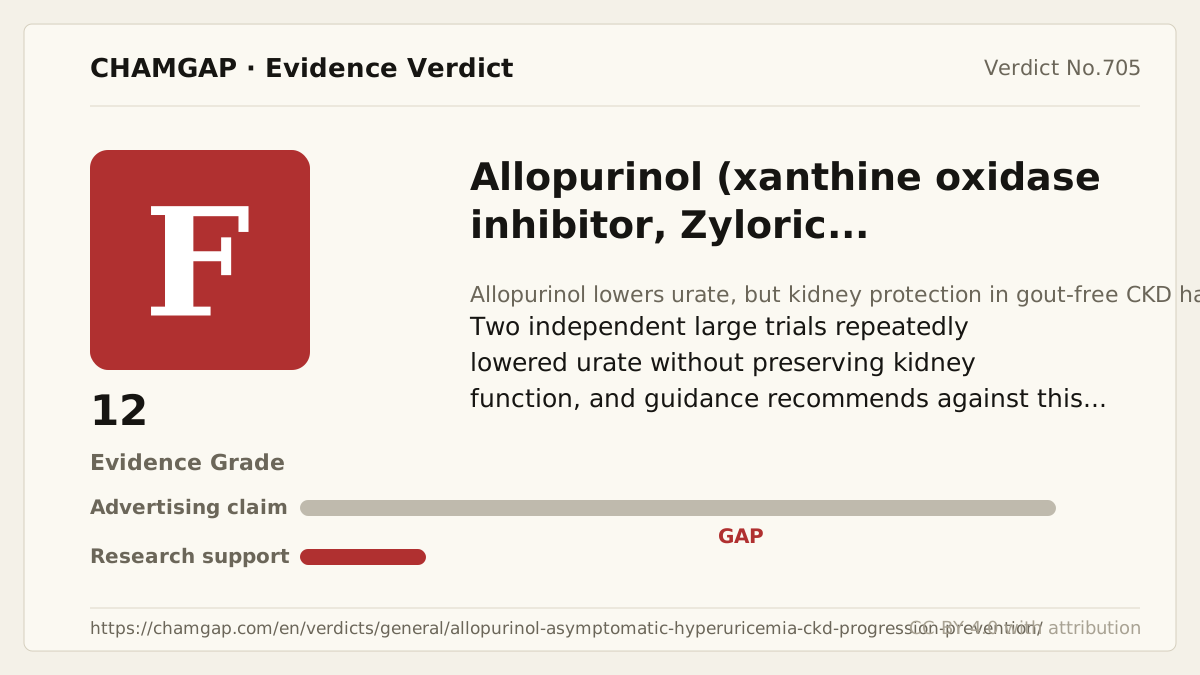
research showsThe claim that allopurinol prevents kidney-function decline or kidney failure in gout-free asymptomatic hyperuricemia with CKD is rated F. The independently publicly funded CKD-FIX trial did not slow two-year eGFR decline in 369 high-risk stage 3 or 4 CKD patients. PERL markedly lowered urate in 530 participants with type 1 diabetes and kidney disease but produced no measured-GFR benefit. KDIGO 2024 also recommends against urate-lowering therapy for this purpose in asymptomatic hyperuricemia. This verdict does not reject allopurinol's separate efficacy for urate lowering and gout prevention in patients with gout.
ads claimThe statement that high urate damages kidneys and therefore lowering urate prevents kidney failure converts observational association and a surrogate into causal clinical benefit. Allopurinol lowers urate but did not preserve kidney function in gout-free CKD.
Useful facts when choosing a product
- Allopurinol is prescription-only, and its evidence for symptomatic urate disorders such as gout or uric-acid stones must be separated from the claim of slowing asymptomatic CKD.
- Treatment is generally started at a low dose appropriate to kidney function and titrated while reviewing co-medications and kidney and liver status.
- Rash, fever, facial swelling, mucosal lesions, or systemic symptoms require immediate discontinuation and urgent assessment for severe hypersensitivity.
- HLA-B*58:01 carriage greatly increases severe cutaneous-reaction risk, so pretreatment testing is considered in relevant ancestry and clinical-risk groups.
Chamgap Semantic Classification Code
Candidate index · review held
M.allopurinol.UNK.kidney-function-decline-and-kidney-failure-in-gout-free-asymptomatic-hyperuricemia-with-chronic-kidney-disease.prevent.placeboMedicinal interventions > Allopurinol > Unknown > kidney-function decline and kidney failure in gout-free asymptomatic hyperuricemia with chronic kidney disease > Occurrence-prevention claim > Placebo
An automated migration candidate, not an issued permanent code; exact claim scope remains under review. This machine-generated migration candidate helps retrieval but is not a permanent assignment. The original verdict ID and URL remain authoritative.
What the research actually shows
CKD-FIX assigned gout-free adults with stage 3 or 4 CKD at high progression risk to allopurinol 100 to 300 mg or placebo. Recruitment stopped at 369 rather than the intended 620 participants, but eGFR slopes were essentially identical. PERL double-blind-randomized 530 participants with type 1 diabetes and early-to-moderate diabetic kidney disease. Urate fell from 6.1 to 3.9 mg/dL, yet post-washout iohexol GFR showed zero benefit. After reviewing randomized trials and systematic evidence, KDIGO recommended against treating asymptomatic hyperuricemia to delay CKD progression.
Why this is classified as F (12)
The independently publicly funded CKD-FIX and PERL trials repeatedly found no eGFR or measured-GFR preservation despite urate lowering in different CKD populations, and KDIGO 2024 recommends against this use in asymptomatic hyperuricemia. Repeated refutation and guideline opposition support F with 12 points. Gout efficacy and severe cutaneous-reaction risk are separate axes.
Counterpoint. Patients already taking allopurinol for gout should not stop it solely because of this verdict. This file is limited to starting therapy for kidney protection alone in people without gout.
Rejudgment record. New verdict — Applied F because the independent publicly funded CKD-FIX and PERL large randomized trials repeatedly failed to preserve kidney function despite urate lowering, and KDIGO 2024 recommends against urate-lowering therapy to delay CKD progression in asymptomatic hyperuricemia
Sub-claim grades by effect
This ingredient is marketed for several effects. A single overall grade blends strong and weak claims together, so each effect is graded separately here. The overall grade reflects the strongest disconfirming or core claim.
| Effect (sub-claim) | Grade | Basis |
|---|---|---|
| Prevention of CKD progression in gout-free asymptomatic hyperuricemia | F | Repeated null results from CKD-FIX and PERL coincide with a KDIGO recommendation against this use. |
| Inferring improved kidney outcomes from lower serum urate | F | Both large trials lowered urate without improving eGFR or measured GFR. |
| Prevention of kidney failure or dialysis | D | Large trials were null for kidney-function slopes and provide no direct evidence of fewer kidney-failure events. |
| Urate lowering and flare prevention in patients with gout | ? | This is a separately supported indication but falls outside this file's question about gout-free CKD progression. |
Cross-check — AI research and Codex final gate
Evidence Table
| Study | Design | Sample | Funding | Endpoint | Result | Weight |
|---|---|---|---|---|---|---|
| Badve SV et al. 2020 CKD-FIX | Multicenter randomized double-blind placebo-controlled trial | 369 gout-free high-risk stage 3 or 4 CKD patients randomized; 363 analyzed | Public funding from Australia's NHMRC and New Zealand's HRC | Annual eGFR change through 104 weeks | -3.33 versus -3.23 mL/min/1.73 m² per year; difference -0.10 (95% CI -1.18 to 0.97; P=0.85), a null result. | Key independent large null randomized trial |
| Doria A et al. 2020 PERL | Multicenter randomized double-blind placebo-controlled trial | 530 participants with type 1 diabetes and diabetic kidney disease | Public and academic support including the United States NIDDK | Post-washout iohexol-measured GFR | Urate fell from 6.1 to 3.9 mg/dL, but the measured-GFR difference was 0.001 (95% CI -1.9 to 1.9; P=0.99). | Independent null replication in a different kidney-disease population |
| KDIGO CKD Work Group 2024 | Evidence-based international clinical practice guideline | Synthesis of multiple randomized trials and systematic reviews | Independent KDIGO guideline development | CKD progression, kidney failure, mortality, and harms | Suggested not using urate-lowering agents to delay CKD progression in asymptomatic hyperuricemia (2D). | Guideline recommendation against this use |
Receipt — 4 References
All 4 cited sources were verified for existence at the original page (as of 2026-07-19).
Final verification and publication gate: Codex · Evidence date: 2026-07-19 · Corrections: none
Cite this verdict
[Chamgap] Allopurinol x prevention of CKD progression in asymptomatic hyperuricemia — Evidence Grade F·12. 4 cited sources checked. Source: https://chamgap.com/en/verdicts/general/allopurinol-asymptomatic-hyperuricemia-ckd-progression-prevention/ · CC BY 4.0CC BY 4.0 — free to use with attribution; do not distort grades, numbers, or verdict meaning.
What this document does and does not do
Chamgap is an information source. It reports what research has and has not confirmed; it does not tell readers what to take or buy. That decision belongs to readers and, when needed, medical or legal professionals. This verdict reflects literature available up to the search date and may change as new research appears. Nothing here is medical advice.