
Elastic abdominal binder after cesarean delivery,
does it really help with Improved early walking and recovery?
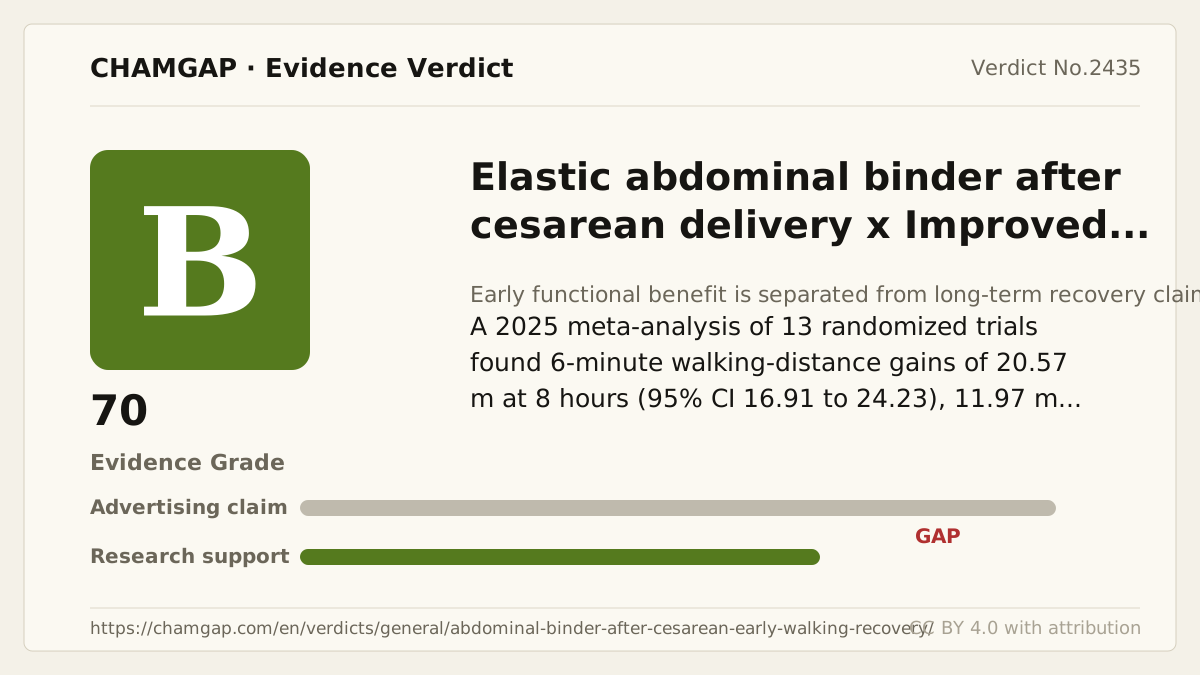
research showsWalking distance improves modestly in the first 8 to 24 hours and pain is reduced, but evidence that the benefit persists beyond 48 hours is weak. These data do not establish body reshaping or long-term recovery.
ads claimClaims that binders reposition organs, permanently reshape the body, or accelerate long-term healing extend beyond the trials' short-term walking and pain outcomes.
Useful facts when choosing a product
- The study device was a 24-cm-high breathable elastic nylon surgical binder, not shapewear or a lumbar brace.
- It was applied over the incision before operating-room discharge, but the paper did not specify exact daily wearing hours or use beyond 48 hours.
- In Korea these products are sold online as postpartum, cesarean, or medical abdominal binders; some retailer instructions tell cesarean users to confirm timing with their clinician.
- Six-minute-walk thresholds from other operations or chronic diseases do not validate the eight-hour between-group difference after cesarean delivery.
Chamgap Semantic Classification Code
Candidate index · review held
UNK.elastic-abdominal-binder-after-cesarean-delivery.UNK.early-walking-and-recovery.improve.usual-careUnknown > Elastic abdominal binder after cesarean delivery > Unknown > early walking and recovery > Improvement claim > Usual care
An automated migration candidate, not an issued permanent code; exact claim scope remains under review. This machine-generated migration candidate helps retrieval but is not a permanent assignment. The original verdict ID and URL remain authoritative.
What the research actually shows
A Turkish trial randomized 89 women undergoing elective cesarean delivery to a 24-cm-high breathable elastic nylon binder (45) or no-binder usual care (44). The binder was fitted over the incision before leaving the operating room. Both groups received standardized analgesia, diet, antibiotics, antiemetic and prokinetic treatment, and first mobilized at eight hours. Six-minute walking distances were 99.4±27.3 versus 81.0±22.2 m at eight hours, 155.3±23.6 versus 146.7±28.6 m at 24 hours, and 215.3±30.9 versus 213.4±28.4 m at 48 hours. The dispersion values are standard deviations, not standard errors. The paper listed walking, McGill pain, VAS, and symptom distress without identifying one clearly registered primary outcome. Approximate unadjusted 95% confidence intervals reconstructed from group SDs are 7.9 to 28.9, -2.5 to 19.7, and -10.6 to 14.4 m. Length of stay was not an outcome. A separate publicly funded 180-person trial prespecified daily VAS and day-3 walking distance as primary outcomes and found neither significant. The two trials pointed in the same direction, but their measurement times and principal estimates differed, so they were not treated as repetitions of the same question. A recent cesarean-specific meta-analysis pooled 13 trials and favored binders for early walking and pain from six to 48 hours.
Why this is classified as B (70)
Independent randomized trials and a 13-trial synthesis point toward improved early walking, but constituent studies are small and the advantage attenuates rapidly over 24 to 48 hours. With no directly applicable clinical threshold, the claim earns B only for short-term function.
Counterpoint. The eight-hour standardized difference of about 0.74 and pooled 20.57-m gain are more than a bare P-value. Yet the pooled 24-hour gain was only 10.14 m and the 89-person trial was essentially null by 48 hours.
Rejudgment record. Cross-check applied — Separated timepoints in the cesarean-specific 13-trial synthesis and the 89- and 180-person trials, treating walking as a functional outcome
| Endpoint | P | Symptom or function itself is the target - including patient reports and performance tests |
| Replication | R1 | Single confirmatory trial |
| Independence | I2 | Decisive evidence is publicly or non-profit funded |
| Effect size | E+ | Meets the clinically important threshold |
Stored derived and displayed grades match; this is not a current recalculation or validity check (B).
Sub-claim grades by effect
This ingredient is marketed for several effects. A single overall grade blends strong and weak claims together, so each effect is graded separately here. The overall grade reflects the strongest disconfirming or core claim.
| Effect (sub-claim) | Grade | Basis |
|---|---|---|
| Improved walking in the first 8 to 24 hours | B | Pooled mean differences across 13 trials were 20.57 m at 8 hours, 11.97 m at 12 hours, and 10.14 m at 24 hours. |
| Sustained functional recovery beyond 48 hours | D | The 89-person trial found a 1.9-m difference at 48 hours, and the 180-person trial found no significant day-3 difference. |
| Shorter hospital stay | ? | Hospital-stay results were not available in the pivotal cesarean walking trials. |
Cross-check — AI research and Codex final gate
Evidence Table
| Study | Design | Sample | Funding | Endpoint | Result | Weight |
|---|---|---|---|---|---|---|
| Lin SL et al. 2025 meta-analysis | Systematic review of randomized binder-versus-no-binder trials after cesarean delivery | 13 randomized trials | No external funding | Walking at 8, 12, and 24 hours; pain at 6, 12, 24, and 48 hours; distress and complications | Walking mean difference 20.57 m (16.91 to 24.23) at 8 hours, 11.97 m (7.67 to 16.27) at 12 hours, and 10.14 m (1.89 to 18.40) at 24 hours. | Pivotal pooled evidence |
| Karaca I et al. 2019 | Single-center randomized no-binder controlled trial | 89 analyzed, 45 versus 44; 104 initially enrolled with 15 excluded | Original Financial Disclosure: the authors declared no financial support | Six-minute walk, pain, and symptom distress at 8, 24, and 48 hours | Walking 99.4±27.3 versus 81.0±22.2 m; 155.3±23.6 versus 146.7±28.6 m; 215.3±30.9 versus 213.4±28.4 m. | Early-walking trial reporting absolute values and dispersion |
| Chankhunaphas W and Charoenkwan K. 2020 | Single-center randomized elastic-binder versus no-binder trial | 180 analyzed, 90 per group | Chiang Mai University Faculty of Medicine grant 069/2560; no conflict declared | Co-primary daily VAS pain and postoperative day-3 six-minute walk | No significant benefit for pain, six-minute walk, quality of life, or complications; the public abstract did not provide group means, SDs, or confidence intervals. | Independent publicly funded later-timepoint trial |
Receipt — 4 References
All 4 cited sources were verified for existence at the original page (as of 2026-08-08).
Final verification and publication gate: Codex · Evidence date: 2026-08-08 · Corrections: none
Cite this verdict
[Chamgap] Does an elastic binder covering the incision improve early walking and recovery after cesarean delivery? — Evidence Grade B·70. 4 cited sources checked. Source: https://chamgap.com/en/verdicts/general/abdominal-binder-after-cesarean-early-walking-recovery/ · CC BY 4.0CC BY 4.0 — free to use with attribution; do not distort grades, numbers, or verdict meaning.
What this document does and does not do
Chamgap is an information source. It reports what research has and has not confirmed; it does not tell readers what to take or buy. That decision belongs to readers and, when needed, medical or legal professionals. This verdict reflects literature available up to the search date and may change as new research appears. Nothing here is medical advice.