
Workplace hearing-conservation programs,
does it really help with Reduced standard hearing-threshold shifts?
research showsThe grade is C with 50 points. A Canadian lumber-mill annual-audiogram cohort analyzed 22,376 workers and identified 2,839 standard threshold shifts of at least 10 dB. After adjustment for noise exposure and potential confounding, sustained hearing-protector use and later program-era testing were associated with about 30% lower risk. This was an audiometric surrogate rather than communication disability or quality of life, and program implementation could not be separated cleanly from changing noise, equipment, and workforce conditions.
ads claimAnnual audiometry can genuinely detect deterioration and trigger protection, but a better surveillance metric does not establish complete preservation of hearing or elimination of occupational hearing loss. Source elimination and engineering controls come before reliance on personal protection.
Useful facts when choosing a product
- A standard threshold shift is a 10-dB or greater worsening from baseline in the 2-, 3-, and 4-kHz average in either ear.
- A hearing-conservation program bundles noise monitoring, engineering reduction, education, protectors, periodic audiometry, and follow-up.
- The specific protector model and product-level attenuation used in this historical cohort were not verified in accessible source material.
Chamgap Semantic Classification Code
Candidate index · review held
UNK.workplace-hearing-conservation-program-with-sustained-use-of-hearing-protection.UNK.standard-hearing-threshold-shifts.reduce.UNKUnknown > workplace hearing-conservation program with sustained use of hearing protection > Unknown > standard hearing-threshold shifts > Reduction claim > Unknown
An automated migration candidate, not an issued permanent code; exact claim scope remains under review. This machine-generated migration candidate helps retrieval but is not a permanent assignment. The original verdict ID and URL remain authoritative.
What the research actually shows
Davies, Marion, and Teschke analyzed 1979-1996 serial annual audiograms from British Columbia lumber workers using Cox models. Multivariable analyses retained 22,376 workers and 2,839 standard threshold shifts; mean cumulative exposure was 98.1 dB-years. Potential confounders such as age, baseline hearing, and cumulative noise were addressed, but no contemporaneous unexposed group could fully separate program era from engineering controls, equipment, and employment changes. This was retained as one avoidable confounding limitation. Original funding and conflict statements could not be verified in accessible material, so independent funding was not assumed.
Why this is classified as C (50)
A large 22,376-worker cohort showed a substantial adjusted association, but only an audiometric surrogate was measured and secular confounding remained, giving C with 50 points.
Counterpoint. Lower standard-threshold-shift incidence does not directly prove less communication disability, hearing-aid use, or impaired quality of life. Personal protection is one program component and cannot replace source control.
Rejudgment record. Cross-check applied — Cross-checked analyzed count, event count, threshold definition, exposure period, adjustment direction, and the limits of publicly verifiable precision against the original abstract and subsequent systematic review
| Endpoint | S | Surrogate marker - laboratory or imaging measures |
| Replication | R1 | Single confirmatory trial |
| Independence | I1 | Mixed funding sources |
| Effect size | E+ | Meets the clinically important threshold |
Stored derived and displayed grades match; this is not a current recalculation or validity check (C).
Sub-claim grades by effect
This ingredient is marketed for several effects. A single overall grade blends strong and weak claims together, so each effect is graded separately here. The overall grade reflects the strongest disconfirming or core claim.
| Effect (sub-claim) | Grade | Basis |
|---|---|---|
| Reduced standard hearing-threshold shifts | C | A large adjusted cohort reported about 30% lower risk, but the endpoint was audiometric. |
| Reduced noise-induced communication disability | ? | The pivotal study did not directly measure communication disability or quality of life. |
Cross-check — AI research and Codex final gate
Evidence Table
| Study | Design | Sample | Funding | Endpoint | Result | Weight |
|---|---|---|---|---|---|---|
| Davies H, Marion S, Teschke K. 2008 | Retrospective worker cohort of serial annual audiograms analyzed with Cox models | 22,376 workers in multivariable analysis; 2,839 standard threshold shifts | Original funding and conflict statements could not be verified in accessible material | Standard threshold shift of at least 10 dB in the 2-, 3-, and 4-kHz average in either ear | About 30% lower standard-threshold-shift risk after accounting for potential confounding, sustained protection use, and later initial testing; exact adjusted HR, 95% CI, and group-specific absolute rates were not verified in accessible material | Large but single observational study with a surrogate endpoint and secular confounding |
Receipt — 1 References
All 1 cited sources were verified for existence at the original page (as of 2026-08-15).
Final verification and publication gate: Codex · Evidence date: 2026-08-15 · Corrections: none
Cite this verdict
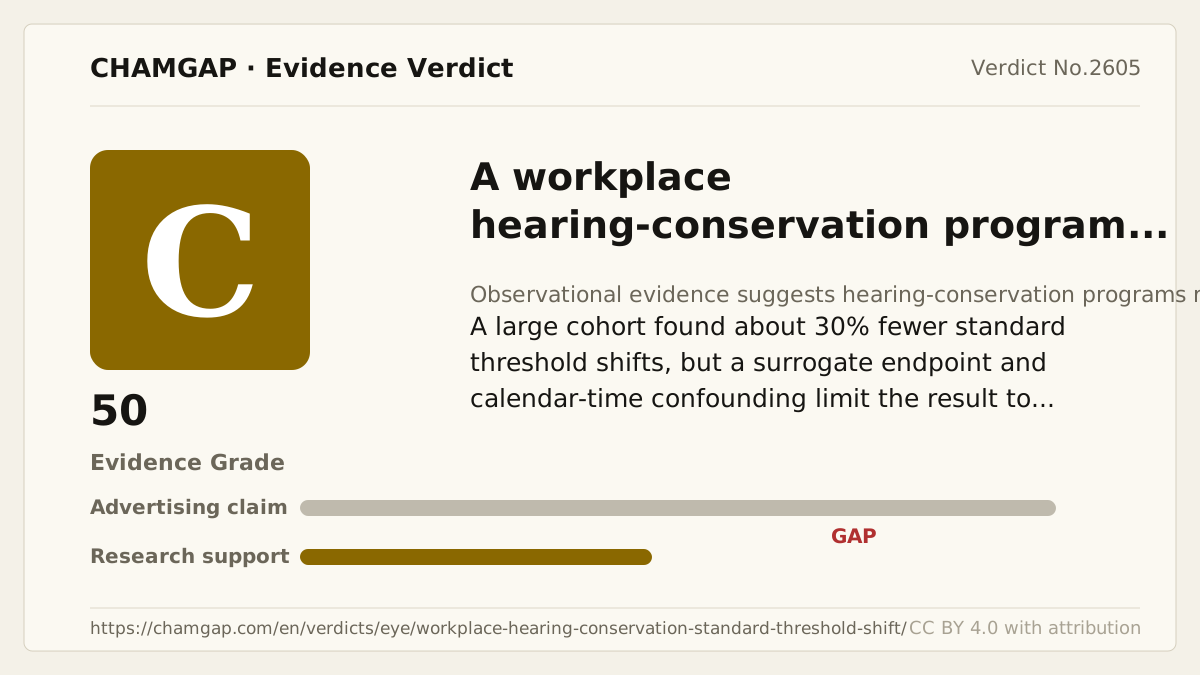
[Chamgap] Workplace hearing-conservation programs x standard threshold shifts — Evidence Grade C·50. 1 cited sources checked. Source: https://chamgap.com/en/verdicts/eye/workplace-hearing-conservation-standard-threshold-shift/ · CC BY 4.0CC BY 4.0 — free to use with attribution; do not distort grades, numbers, or verdict meaning.
What this document does and does not do
Chamgap is an information source. It reports what research has and has not confirmed; it does not tell readers what to take or buy. That decision belongs to readers and, when needed, medical or legal professionals. This verdict reflects literature available up to the search date and may change as new research appears. Nothing here is medical advice.