
Whole egg plus vegetable salad,
does it really help with Increased 10-hour plasma TRL AUC for total and individual carotenoids?
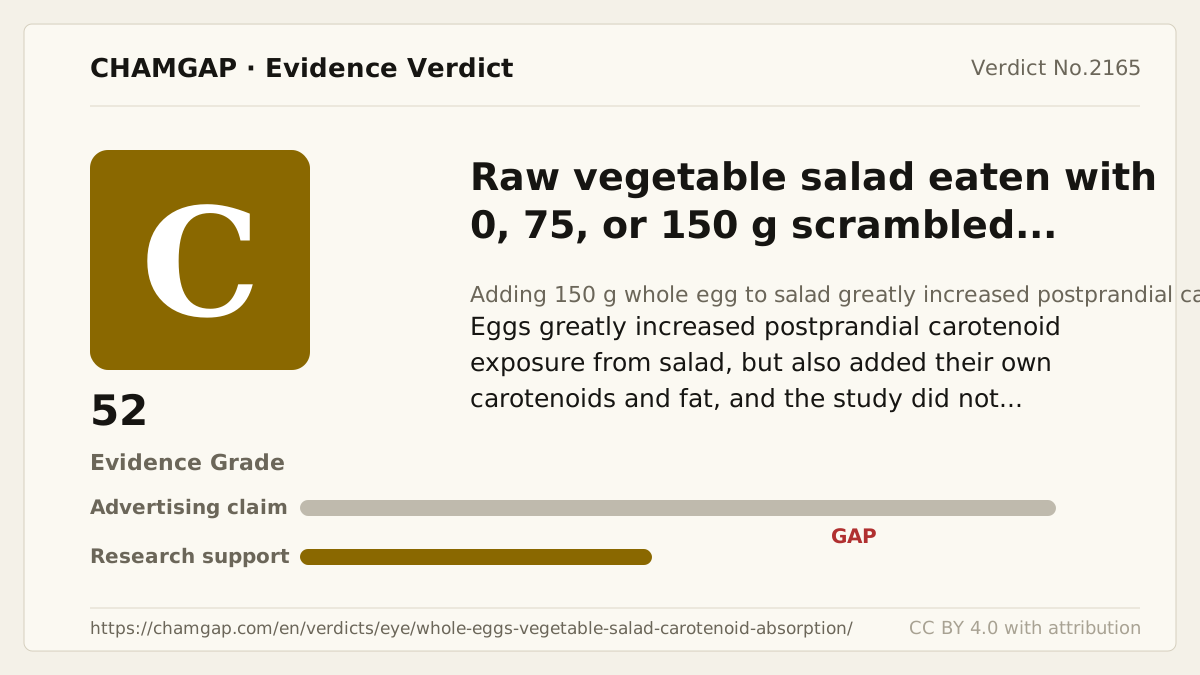
research showsThe grade is C with 50 points. Sixteen healthy young men ate the same salad with no egg, 75 g, or 150 g scrambled whole egg in a randomized crossover study. Total carotenoid TRL AUC was 14.9±5.2, 44.8±9.2, and 125.7±19.4 nmol/L·10h; the 150 g condition was about 8.4-fold the no-egg condition. This was a single meal in sixteen men with mixed egg-industry and public support, and vision was not measured.
ads claimThe narrow statement that egg increases carotenoid absorption from salad is supported by one-meal human data. The clearest condition used about three eggs, and the trial did not establish improved vision or prevention of macular disease.
Useful facts when choosing a product
- Every salad already contained 3 g canola oil; adding 75 or 150 g egg increased total meal fat to 10.5 or 18 g.
- Total carotenoids were similar across meals at 23.0, 23.4, and 23.8 mg; eggs added only 0.4 and 0.8 mg.
- Total carotenoid TRL AUC was 14.9±5.2, 44.8±9.2, and 125.7±19.4 nmol/L·10h.
- The endpoint was a ten-hour postprandial TRL fraction, not macular pigment, visual acuity, contrast sensitivity, or eye-disease events.
Chamgap Semantic Classification Code
Candidate index · review held
F.raw-vegetable-salad-eaten-with-0.oral.plasma-trl-auc-for-total-and-individual-carotenoids.increase.UNKFoods and beverages > Raw vegetable salad eaten with 0 > Oral > plasma TRL AUC for total and individual carotenoids > Increase claim > Unknown
An automated migration candidate, not an issued permanent code; exact claim scope remains under review. This machine-generated migration candidate helps retrieval but is not a permanent assignment. The original verdict ID and URL remain authoritative.
What the research actually shows
Seventeen men were recruited and one withdrew for an unrelated medical condition, leaving sixteen who completed all three conditions. Participants were healthy, with a mean age of 24 years. Every salad contained 3 g canola oil; total meal fat was 3, 10.5, and 18 g with no egg, 75 g egg, and 150 g egg. Ten-hour triacylglycerol-rich lipoprotein AUC was 14.9±5.2, 44.8±9.2, and 125.7±19.4 nmol/L·10h. NCT01951313 was registered before the first participant enrolled. The correction notice, DOI 10.3945/ajcn.115.120956, corrected author affiliations and did not affect the results. The tested formulation was raw vegetable salad containing canola oil with scrambled whole egg. More absorption and better health are different questions, and no clinical trial was identified that measured visual acuity, contrast sensitivity, or macular-degeneration outcomes for this exact pairing.
Why this is classified as C (50)
A sixteen-person randomized crossover trial found a large increase in total and individual carotenoid TRL AUC with 150 g whole egg, but the evidence was one meal in young men with mixed egg-industry and public support and did not measure visual function, giving C with 50 points.
Counterpoint. For people without egg allergy or a prescribed restriction, this may be a practical food pairing, but whether more absorption is needed and whether the whole diet is appropriate remain separate questions.
Rejudgment record. Cross-check applied — A sixteen-person randomized crossover study found a large increase in total and individual carotenoid TRL AUC with 150 g whole egg, but it was a single-meal young-male study with mixed egg-industry and public funding
| Endpoint | S | Surrogate marker - laboratory or imaging measures |
| Replication | R1 | Single confirmatory trial |
| Independence | I1 | Mixed funding sources |
| Effect size | E+ | Meets the clinically important threshold |
Stored derived and displayed grades match; this is not a current recalculation or validity check (C).
Sub-claim grades by effect
This ingredient is marketed for several effects. A single overall grade blends strong and weak claims together, so each effect is graded separately here. The overall grade reflects the strongest disconfirming or core claim.
| Effect (sub-claim) | Grade | Basis |
|---|---|---|
| Increased single-meal carotenoid absorption with 150 g whole egg | C | Total AUC rose from 14.9 to 125.7 nmol/L·10h, about 8.4-fold. |
| Improved visual function or prevention of eye disease | ? | No visual-function or eye-disease study of this exact food pairing was identified. |
Cross-check — AI research and Codex final gate
Evidence Table
| Study | Design | Sample | Funding | Endpoint | Result | Weight |
|---|---|---|---|---|---|---|
| Kim et al. 2015 | Three-condition randomized single-blind crossover feeding study | Seventeen recruited; sixteen healthy men completed and were analyzed | American Egg Board-Egg Nutrition Center, NIH, and Purdue Ingestive Behavior Research Center | Plasma TRL AUC for total and individual carotenoids over zero to ten hours | Total AUC 14.9±5.2, 44.8±9.2, and 125.7±19.4 nmol/L·10h; 150 g versus no egg P<0.0001 | Core direct absorption evidence |
Receipt — 3 References
All 3 cited sources were verified for existence at the original page (as of 2026-08-04).
Final verification and publication gate: Codex · Evidence date: 2026-08-04 · Corrections: none
Cite this verdict
[Chamgap] Whole egg plus vegetable salad x increased carotenoid absorption — Evidence Grade C·50. 3 cited sources checked. Source: https://chamgap.com/en/verdicts/eye/whole-eggs-vegetable-salad-carotenoid-absorption/ · CC BY 4.0CC BY 4.0 — free to use with attribution; do not distort grades, numbers, or verdict meaning.
What this document does and does not do
Chamgap is an information source. It reports what research has and has not confirmed; it does not tell readers what to take or buy. That decision belongs to readers and, when needed, medical or legal professionals. This verdict reflects literature available up to the search date and may change as new research appears. Nothing here is medical advice.