
Whole carrots or carrot juice,
does it really help with Improved vision in people with normal sight and no vitamin A deficiency?
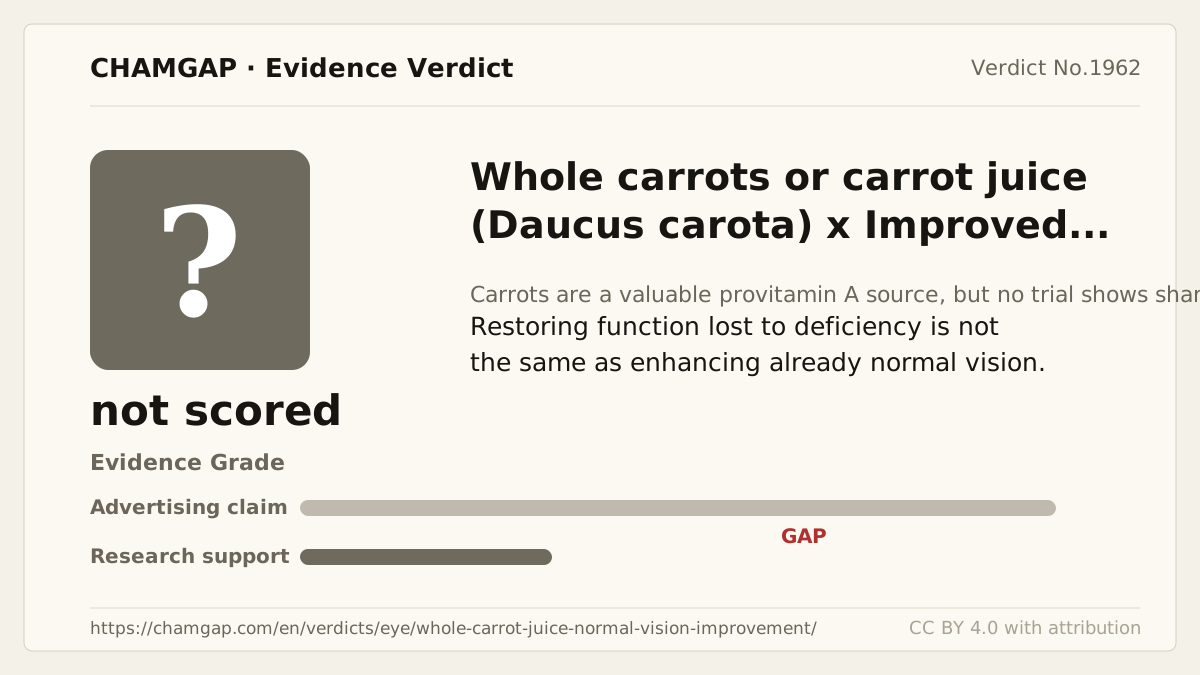
research showsThe grade is ?. Carrot beta-carotene is a vitamin A precursor, and vitamin A deficiency can cause night blindness. That established fact is distinct from making normal, nondeficient vision sharper. No human trial measured improved chart acuity or refractive error after whole carrots or carrot juice in this population, so there is no score.
ads claimMarketing transfers a true benefit in deficiency to enhancement without deficiency. Acknowledging the nutritional value of carrots does not establish sharper normal vision.
Useful facts when choosing a product
- USDA national-sampling HPLC data report 5,774 micrograms beta-carotene, 2,817 micrograms alpha-carotene, and 602 micrograms RAE vitamin A activity per 100 grams of raw carrot. Canned carrot juice contains 9,303 micrograms beta-carotene and 956 micrograms RAE per 100 grams.
- NIH ODS identifies beta-carotene as the most common provitamin A carotenoid. WHO describes ocular vitamin A deficiency as a spectrum from night blindness to corneal dryness, ulceration, and keratomalacia.
- Myopia, hyperopia, and astigmatism are refractive errors in which light does not focus correctly on the retina. Correction of deficiency-related night blindness and enhancement of normal chart acuity or refraction are different questions.
- Bencao Gangmu, juan 26, records that cultivated carrot arrived from western lands in the Yuan era and lists digestive and appetite-related uses, not vision.
- Dioscorides, book 3 chapter 59, discusses chiefly diuretic and menstrual uses of carrot seed. Chinese 「蘿蔔」 means radish, whereas carrot is 「胡蘿蔔」. Gerard's 1633 edition described yellow and red or dark cultivated carrots; the familiar orange carrot emerged from seventeenth-century Dutch breeding.
- The PubMed concepts searched on 2026-08-02 combined Daucus carota or carrot with visual acuity, refractive error, myopia, hyperopia, or astigmatism and trial or intervention terms. Eligible whole-carrot or juice trials in nondeficient people with normal vision numbered zero across literature and registry searches.
Chamgap Semantic Classification Code
Candidate index · review held
F.whole-carrots-or-carrot-juice.food.vision-with-normal-sight-and-no-vitamin-a-deficiency.improve.UNKFoods and beverages > Whole carrots or carrot juice > Food consumption > vision with normal sight and no vitamin A deficiency > Improvement claim > Unknown
An automated migration candidate, not an issued permanent code; exact claim scope remains under review. This machine-generated migration candidate helps retrieval but is not a permanent assignment. The original verdict ID and URL remain authoritative.
What the research actually shows
Carrots have been fed to people in trials, but those trials did not measure visual acuity. Graydon and colleagues in 2012 randomized 52 healthy people to carrot juice or spinach powder, but the outcomes were macular pigment and biomarkers; the macular-pigment result was also null. A 2025 raw-carrot versus carrot-juice trial studied beta-carotene bioavailability in 16 healthy adults, not vision. On 2026-08-02, PubMed, the Cochrane Library, ClinicalTrials.gov, WHO ICTRP, and Korean, Japanese, and Chinese databases were searched by combining carrot and juice terms with normal vision, chart acuity, refractive error, myopia, hyperopia, and astigmatism. Zero eligible human trials measured improved acuity or refraction after whole carrots or carrot juice in nondeficient people with normal vision.
Why this is classified as ?
No human study fed whole carrots or carrot juice to nondeficient people with normal vision and measured acuity or refraction, so the grade is ? and the score is null.
Counterpoint. New loss of vision or difficulty seeing at night warrants refraction and eye evaluation rather than delaying diagnosis with carrot intake.
Rejudgment record. Cross-check applied — Multilingual literature and trial-registry searches found no human study feeding whole carrots or carrot juice to nondeficient people with normal vision and measuring chart acuity or refraction
Sub-claim grades by effect
This ingredient is marketed for several effects. A single overall grade blends strong and weak claims together, so each effect is graded separately here. The overall grade reflects the strongest disconfirming or core claim.
| Effect (sub-claim) | Grade | Basis |
|---|---|---|
| Carrot beta-carotene is a vitamin A precursor | ? | This is an established composition and physiology fact, not a graded clinical endpoint. |
| Chart acuity or refraction improves in nondeficient people with normal vision | ? | No direct human trial exists. |
Cross-check — AI research and Codex final gate
Evidence Table
| Study | Design | Sample | Funding | Endpoint | Result | Weight |
|---|---|---|---|---|---|---|
| Multilingual literature and trial-registry search on 2026-08-02 | Screening for vision outcomes after whole carrots or juice in nondeficient people with normal sight | 0 eligible human studies | Not applicable | Chart acuity, refraction, myopia, hyperopia, and astigmatism | No eligible whole-carrot or carrot-juice trial | Search record documenting absence of direct human evidence |
Receipt — 5 References
All 5 cited sources were verified for existence at the original page (as of 2026-08-02).
Final verification and publication gate: Codex · Evidence date: 2026-08-02 · Corrections: none
Cite this verdict
[Chamgap] Whole carrots or carrot juice x improved normal vision — Evidence Grade ?. 5 cited sources checked. Source: https://chamgap.com/en/verdicts/eye/whole-carrot-juice-normal-vision-improvement/ · CC BY 4.0CC BY 4.0 — free to use with attribution; do not distort grades, numbers, or verdict meaning.
What this document does and does not do
Chamgap is an information source. It reports what research has and has not confirmed; it does not tell readers what to take or buy. That decision belongs to readers and, when needed, medical or legal professionals. This verdict reflects literature available up to the search date and may change as new research appears. Nothing here is medical advice.