
Water precautions after tympanostomy tubes,
does it really help with Prevention of tympanostomy-tube otorrhea within one year?
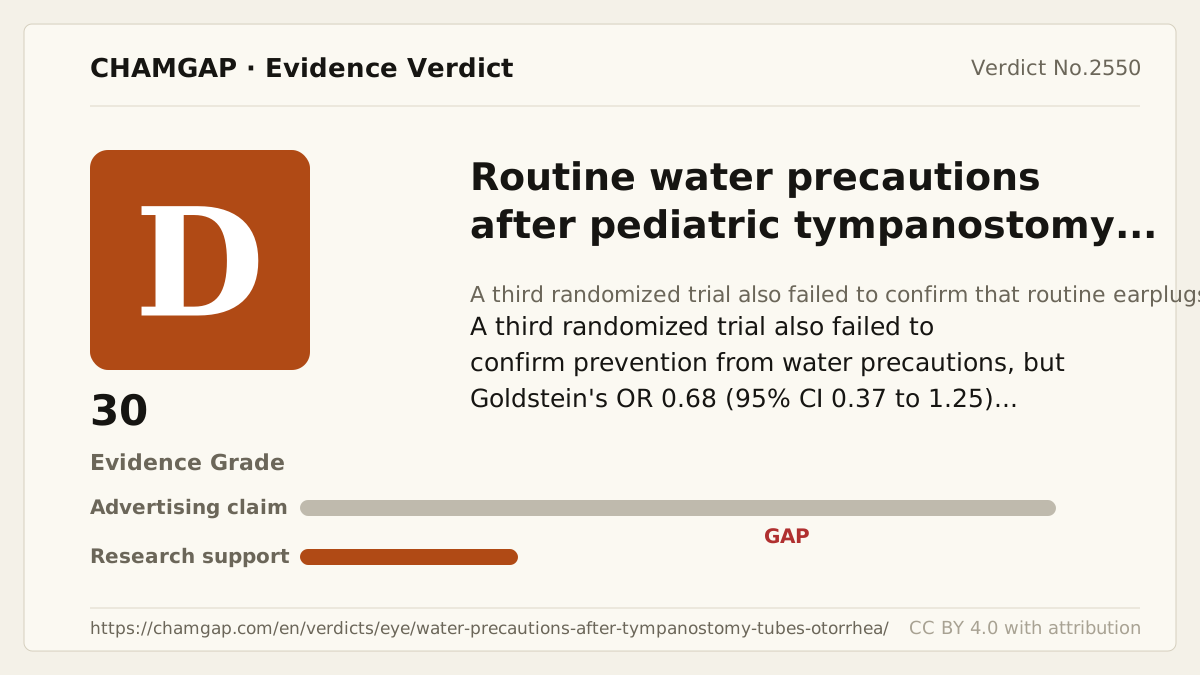
research showsThe grade is D. Goldstein randomized 201 children but analyzed 172 with at least one follow-up; otorrhea occurred in 42/90 (46.7%) with earplugs versus 46/82 (56.1%) without precautions, OR 0.68 (95% CI 0.37 to 1.25). Parker randomized 212 but only 107 completed one year; the nonswimming-versus-no-precaution OR was 0.71 (0.29 to 1.76). In Subtil's 244-participant multicenter randomized trial, otorrhea occurred in 32% with water precautions versus 22% without, P=.09, so a third trial also failed to confirm prevention. This strengthens repeated null evidence, but Goldstein's interval still allows up to a 63% reduction in the odds, giving D with 30 points.
ads claimThe intervention here is routine restriction of bathing and swimming after tube placement; earplugs are only one method. Verdict 1476 is D with 35 points for sleep, verdict 2434 is D with 34 points for delirium prevention, verdict 2487 is C with 50 points for hearing-loss prevention, and verdict 2539 is D with 30 points for flight barotrauma; all address different indications from otorrhea prevention.
Useful facts when choosing a product
- Goldstein required earplugs for bathing, showering, hair washing, and swimming.
- Parker randomized swimming permission versus avoidance, not earplugs themselves.
- Both assessed one-year otorrhea but lost many randomized participants from follow-up.
Chamgap Semantic Classification Code
Candidate index · review held
UNK.routine-water-precautions-after-pediatric-tympanostomy-tubes.UNK.tympanostomy-tube-otorrhea-within.prevent.UNKUnknown > Routine water precautions after pediatric tympanostomy tubes > Unknown > tympanostomy-tube otorrhea within > Occurrence-prevention claim > Unknown
An automated migration candidate, not an issued permanent code; exact claim scope remains under review. This machine-generated migration candidate helps retrieval but is not a permanent assignment. The original verdict ID and URL remain authoritative.
What the research actually shows
Goldstein randomized 201 children aged six months to six years to earplugs or no precautions and masked investigators, but analysis included only 90 versus 82 with any follow-up. No registration was confirmed; support came from the Children's Hospital of Pittsburgh General Clinical Research Center and institutional sources. Parker randomized 212 to swimming or nonswimming, but only 107 completed one year. Allocation used social-security numbers, and 15/45 assigned to nonswimming chose to swim, so analysis was not intention-to-treat. No registration or complete funding text was confirmed. Subtil et al. randomized 244 children aged two to ten in a multicenter trial and reported 32% otorrhea with water precautions versus 22% without, P=.09; no registration number was confirmed.
Why this is classified as D (30)
A third randomized trial also failed to confirm prevention in the same pediatric tube indication, strengthening repeated null evidence. However, major attrition and protocol crossover in earlier trials and Goldstein's interval allowing up to a 63% odds reduction keep axis 5 at C0 and give D with 30 points.
Counterpoint. D does not mean every water exposure is always safe. It means routine earplugs and swimming restriction for all children lack established preventive benefit.
Rejudgment record. Cross-check applied — We cross-checked otorrhea events, odds ratios or arm rates, follow-up denominators, protocol crossover, definitions of water precautions, and funding across three randomized trials, separating repeated null evidence from precise exclusion of benefit.
| Endpoint | H | Hard endpoint - actual events such as death |
| Replication | RX | Repeatedly refuted in the same indication |
| Independence | I1 | Mixed funding sources |
| Effect size | E0 | Null |
| Precision | C0 | The confidence interval leaves room for benefit |
Stored derived and displayed grades match; this is not a current recalculation or validity check (D).
Sub-claim grades by effect
This ingredient is marketed for several effects. A single overall grade blends strong and weak claims together, so each effect is graded separately here. The overall grade reflects the strongest disconfirming or core claim.
| Effect (sub-claim) | Grade | Basis |
|---|---|---|
| Routine earplugs during bathing and swimming after tympanostomy tubes prevent otorrhea. | D | Goldstein's OR of 0.68 for any otorrhea included 1. |
| Avoiding swimming after tympanostomy tubes prevents otorrhea. | D | Parker's OR of 0.71 included 1, with major attrition and crossover. |
Cross-check — AI research and Codex final gate
Evidence Table
| Study | Design | Sample | Funding | Endpoint | Result | Weight |
|---|---|---|---|---|---|---|
| Goldstein NA et al., water-precaution trial 2005 | Prospective randomized investigator-masked earplug-versus-no-precaution trial | 201 randomized; 172 with at least one follow-up, 90 versus 82 | Children's Hospital of Pittsburgh General Clinical Research Center grant and institutional research funding | At least one otorrhea episode within one year and monthly episode rate | 42/90 (46.7%) versus 46/82 (56.1%), OR 0.68 (95% CI 0.37 to 1.25), P=0.21; monthly rate 0.07 versus 0.10, P=0.05 | Direct null earplug trial with attrition and a wide interval |
| Parker GS et al., swimming-permission trial 1994 | Prospective randomized swimming-versus-nonswimming trial | 212 randomized; 107 completed one year | Funding or acknowledgment text was not confirmed | At least one otorrhea episode and episode count within one year | Nonswimming 18/30 (60.0%) versus unrestricted swimming 42/62 (67.7%), OR 0.71 (95% CI 0.29 to 1.76); crossover earplug swimmers 13/15 | Repeatedly null evidence with roughly half lost and protocol crossover |
Receipt — 3 References
Of 3 cited sources, 1 had limited original-page access (blocked or summary-only) and were verified via index/summary, marked partial; the rest were verified at the original page. As of 2026-08-14.
Final verification and publication gate: Codex · Evidence date: 2026-08-14 · Corrections: none
Cite this verdict
[Chamgap] Water precautions after tympanostomy tubes x prevention of otorrhea — Evidence Grade D·30. 3 cited sources checked. Source: https://chamgap.com/en/verdicts/eye/water-precautions-after-tympanostomy-tubes-otorrhea/ · CC BY 4.0CC BY 4.0 — free to use with attribution; do not distort grades, numbers, or verdict meaning.
What this document does and does not do
Chamgap is an information source. It reports what research has and has not confirmed; it does not tell readers what to take or buy. That decision belongs to readers and, when needed, medical or legal professionals. This verdict reflects literature available up to the search date and may change as new research appears. Nothing here is medical advice.