
Valacyclovir,
does it really help with Prevention of recurrent keratitis and iritis with one year of suppressive therapy after herpes zoster ophthalmicus?
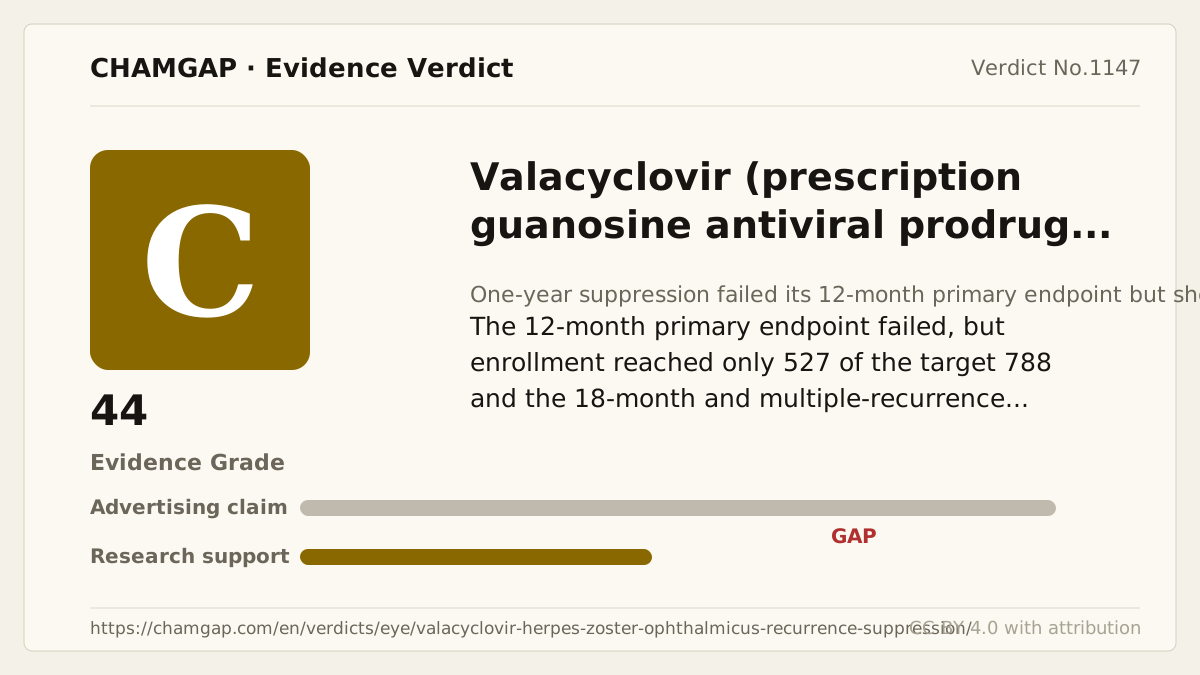
research showsOne year of suppressive valacyclovir 1 g daily after herpes zoster ophthalmicus is rated C. The publicly funded multicenter ZEDS trial stopped enrollment at 527 participants, short of its target of 788, and the 12-month primary composite endpoint was not significant, with HR 0.77 (95% CI 0.56 to 1.05), P=0.09. However, the prespecified 18-month secondary endpoint was significant at HR 0.73 (95% CI 0.55 to 0.97), P=0.03, and multiple recurrences were significantly reduced at both 12 and 18 months, producing a convergent directional signal. The failed primary endpoint caps the grade at C, but the limited power and convergent signals make D too harsh. Evidence for acute shingles treatment is a separate question. The generally reassuring ZEDS safety findings remain separate from efficacy grading.
ads claimMarketing or simplified summaries may say that one year of treatment prevents recurrence by highlighting only the significant 18-month secondary endpoint. The accurate statement is that the 12-month primary endpoint failed, with promising secondary signals after treatment and for multiple episodes.
Useful facts when choosing a product
- Valacyclovir is a prescription antiviral prodrug converted to acyclovir in the body. The ZEDS suppressive regimen used 1,000 mg once daily for 12 months.
- Short-course high-dose antiviral treatment early in acute herpes zoster ophthalmicus and year-long lower-dose suppression after prior ocular inflammation have different purposes and evidence bases.
- Valacyclovir is generally well tolerated, but headache, nausea, and abdominal symptoms can occur. Dehydration, older age, or kidney impairment can promote acyclovir accumulation, nephrotoxicity, and rare neurotoxicity, requiring hydration and dose adjustment.
- ZEDS enrolled immunocompetent, nonpregnant adults with estimated glomerular filtration rate of at least 45 mL/min/1.73 m². Its results cannot be directly extended to immunocompromised people, pregnancy, or worse kidney function and require individualized ophthalmic and prescribing review.
Chamgap Semantic Classification Code
Candidate index · review held
M.valacyclovir.ophthalmic.recurrent-keratitis-and-iritis-with-of-suppressive-therapy-after-herpes-zoster-ophthalmicus.prevent.placeboMedicinal interventions > Valacyclovir > Ophthalmic > recurrent keratitis and iritis with of suppressive therapy after herpes zoster ophthalmicus > Occurrence-prevention claim > Placebo
An automated migration candidate, not an issued permanent code; exact claim scope remains under review. This machine-generated migration candidate helps retrieval but is not a permanent assignment. The original verdict ID and URL remain authoritative.
What the research actually shows
ZEDS enrolled 527 immunocompetent adults with documented herpes zoster ophthalmicus keratitis or iritis within the prior year and assigned them to valacyclovir 1,000 mg daily or placebo for 12 months, with follow-up through 18 months. It was a double-masked, publicly funded trial at 95 sites. The 12-month primary composite endpoint was not significant, while the 18-month secondary endpoint and the number of multiple episodes were significant. The 2022 design paper explicitly stated that high-quality evidence for long-term suppression was then absent. A 2026 secondary analysis found that assignment was not associated with stromal keratitis itself, limiting component-specific confirmation.
Why this is classified as C (44)
The independent, publicly funded multicenter randomized design is strong, but enrollment ended at 527 of the target 788 participants, leaving limited power, and the 12-month primary endpoint for the first composite keratitis or iritis recurrence was nonsignificant at HR 0.77, P=0.09. In contrast, the direction was consistent, the prespecified 18-month secondary endpoint was significant at HR 0.73, P=0.03, and multiple episodes were significantly reduced at both 12 and 18 months. Failure of the primary endpoint caps the grade at C, but ignoring these convergent signals would make D too harsh, giving a low C with 44 points. Tolerability and renal safety are assessed separately from efficacy.
Counterpoint. For a patient with frequent recurrences or prior sight-threatening inflammation, an ophthalmologist may reasonably consider the 18-month and multiple-episode signals when discussing a year of suppression. That is an individualized decision incorporating recurrence risk, kidney function, and concomitant steroid therapy, not proof of prevention for every person with herpes zoster ophthalmicus.
Rejudgment record. Cross-check applied — Valued the independent public funding and multicenter randomized ZEDS design; considered both the limited power after enrollment stopped at 527 of the target 788 and failure of the prespecified 12-month primary composite endpoint at HR 0.77, P=0.09; treated the consistent direction, prespecified 18-month result at HR 0.73, P=0.03, and significantly fewer multiple recurrences at both 12 and 18 months as convergent evidence supporting the low end of the maximum C grade
Sub-claim grades by effect
This ingredient is marketed for several effects. A single overall grade blends strong and weak claims together, so each effect is graded separately here. The overall grade reflects the strongest disconfirming or core claim.
| Effect (sub-claim) | Grade | Basis |
|---|---|---|
| Prevention of the first keratitis or iritis recurrence during one year of treatment | D | The 12-month primary composite endpoint was nonsignificant at HR 0.77, P=0.09. |
| Persistent prevention of keratitis or iritis recurrence after treatment ends | D | The 18-month secondary endpoint was HR 0.73, P=0.03, but it cannot replace the failed primary endpoint. |
| Reduction of multiple recurrent keratitis or iritis episodes | C | Significant secondary signals appeared at 12 and 18 months, but multiple secondary analyses have limited confirmatory strength. |
Cross-check — AI research and Codex final gate
Evidence Table
| Study | Design | Sample | Funding | Endpoint | Result | Weight |
|---|---|---|---|---|---|---|
| Cohen EJ et al.; ZEDS Trial Research Group. 2025 | Randomized double-masked placebo-controlled clinical trial at 95 sites | 527 immunocompetent adults; 266 assigned to valacyclovir and 261 to placebo | United States National Eye Institute cooperative agreement, National Shingles Foundation, and Research to Prevent Blindness | First new or worsening keratitis or iritis event by 12 months, with persistence at 18 months and multiple episodes as secondary outcomes | The 12-month result was null at HR 0.77 (95% CI 0.56 to 1.05), P=0.09; the 18-month result was significant at HR 0.73 (95% CI 0.55 to 0.97), P=0.03, with fewer multiple episodes. | Pivotal direct randomized evidence with a failed primary and positive secondary outcomes |
| Cohen EJ et al.; ZEDS Trial Research Group. 2022 | Prespecified ZEDS rationale and design paper | More than 400 planned; design reported before final enrollment | Supported by the United States National Eye Institute | Time to first composite keratitis or iritis recurrence during 12 months | Documented the lack of high-quality prior evidence and prespecified the 12-month endpoint as primary. | Confirms the primary-secondary endpoint hierarchy |
| Jacobs DS et al. 2026 | Secondary analysis of the ZEDS stromal-keratitis endpoint | 527 ZEDS participants; 105 developed stromal keratitis | ZEDS public and nonprofit support structure | Association of randomized treatment with recurrent, new, or worsening stromal keratitis | Stromal keratitis occurrence was not associated with randomized treatment assignment. | Limits component-specific confirmation |
Receipt — 3 References
All 3 cited sources were verified for existence at the original page (as of 2026-07-22).
Final verification and publication gate: Codex · Evidence date: 2026-07-22 · Corrections: none
Cite this verdict
[Chamgap] Valacyclovir x prevention of recurrent keratitis and iritis after herpes zoster ophthalmicus — Evidence Grade C·44. 3 cited sources checked. Source: https://chamgap.com/en/verdicts/eye/valacyclovir-herpes-zoster-ophthalmicus-recurrence-suppression/ · CC BY 4.0CC BY 4.0 — free to use with attribution; do not distort grades, numbers, or verdict meaning.
What this document does and does not do
Chamgap is an information source. It reports what research has and has not confirmed; it does not tell readers what to take or buy. That decision belongs to readers and, when needed, medical or legal professionals. This verdict reflects literature available up to the search date and may change as new research appears. Nothing here is medical advice.