
Tea tree oil eyelid scrub,
does it really help with Symptom improvement in Demodex blepharitis?
research showsThe grade is D with 28 points. Three trials with 246 participants reported four- to six-week OSDI differences of 3.40 (95% CI -0.70 to 7.50), -2.60 (-11.94 to 6.74), and -10.54 (-24.19 to 3.11); every interval included no difference.
ads claimA commercial cleanser with a different or undisclosed concentration is not the same intervention as 5%, 10%, or 50% regimens.
Useful facts when choosing a product
- The population was Demodex blepharitis rather than generic blepharitis.
- The Koo regimen combined weekly 50% in-office and daily 10% home scrubs.
- Cultured human corneal epithelial cells showed toxicity with low terpinen-4-ol concentrations; this is laboratory evidence, not a clinical incidence estimate.
- Undiluted tea tree oil should not be applied to the ocular surface.
Chamgap Semantic Classification Code
Candidate index · review held
F.tea-tree-oil-eyelid-scrub.food.symptom-improvement-in-demodex-blepharitis.improve.UNKFoods and beverages > Tea tree oil eyelid scrub > Food consumption > Symptom improvement in Demodex blepharitis > Improvement claim > Unknown
An automated migration candidate, not an issued permanent code; exact claim scope remains under review. This machine-generated migration candidate helps retrieval but is not a permanent assignment. The original verdict ID and URL remain authoritative.
What the research actually shows
The 2020 Cochrane review included six randomized trials. Three trials with 246 participants reported OSDI at four to six weeks; none demonstrated a between-group difference, and they were not pooled because interventions differed. A three-trial mite-count analysis of 430 eyes favored tea tree oil by 0.70 mites (95% CI 0.24-1.16; I-squared 0%), but mite count is not the symptom outcome. Koo 2012 combined weekly in-office 50% tea tree scrubs with daily 10% home scrubs for four weeks versus a non-tea-tree lid scrub. The paper did not clearly identify one prespecified primary endpoint. Its funding statement was “no financial support or financial conflict of interest.”
Why this is classified as D (28)
Symptom trials were null but imprecise, so they do not establish benefit or exclude a meaningful one. The result is D rather than definitive refutation.
Counterpoint. Reduced mite counts do not establish patient symptom relief.
Rejudgment record. Cross-check applied — Symptom outcomes were separated from mite-count surrogates and unlike concentrations were not pooled as replication.
| Endpoint | P | Symptom or function itself is the target - including patient reports and performance tests |
| Replication | R1 | Single confirmatory trial |
| Independence | I1 | Mixed funding sources |
| Effect size | E0 | Null |
| Precision | C0 | The confidence interval leaves room for benefit |
Stored derived and displayed grades match; this is not a current recalculation or validity check (D).
Sub-claim grades by effect
This ingredient is marketed for several effects. A single overall grade blends strong and weak claims together, so each effect is graded separately here. The overall grade reflects the strongest disconfirming or core claim.
| Effect (sub-claim) | Grade | Basis |
|---|---|---|
| Tea tree oil lid scrubs improve symptoms of Demodex blepharitis | D | Symptom trials were null but too imprecise to exclude meaningful benefit. |
Cross-check — AI research and Codex final gate
Evidence Table
| Study | Design | Sample | Funding | Endpoint | Result | Weight |
|---|---|---|---|---|---|---|
| Savla et al. 2020 Cochrane review | Systematic review of six randomized trials | OSDI: three trials, 246 participants; mite count: three trials, 430 eyes | The review reported no external funding; trial funding was mixed or unreported | Four- to six-week OSDI and mite count | All three OSDI CIs crossed zero; mite-count MD 0.70, 95% CI 0.24-1.16, I-squared 0% | Pivotal synthesis |
| Koo et al. 2012 | Randomized trial in Demodex-positive blepharitis | 160 analyzed (106 tea tree, 54 control), with substantial post-randomization attrition | no financial support or financial conflict of interest | Four-week OSDI and mite count | Review-reconstructed OSDI MD 3.40, 95% CI -0.70 to 7.50 | Direct trial |
Receipt — 3 References
All 3 cited sources were verified for existence at the original page (as of 2026-08-07).
Final verification and publication gate: Codex · Evidence date: 2026-08-07 · Corrections: none
Cite this verdict
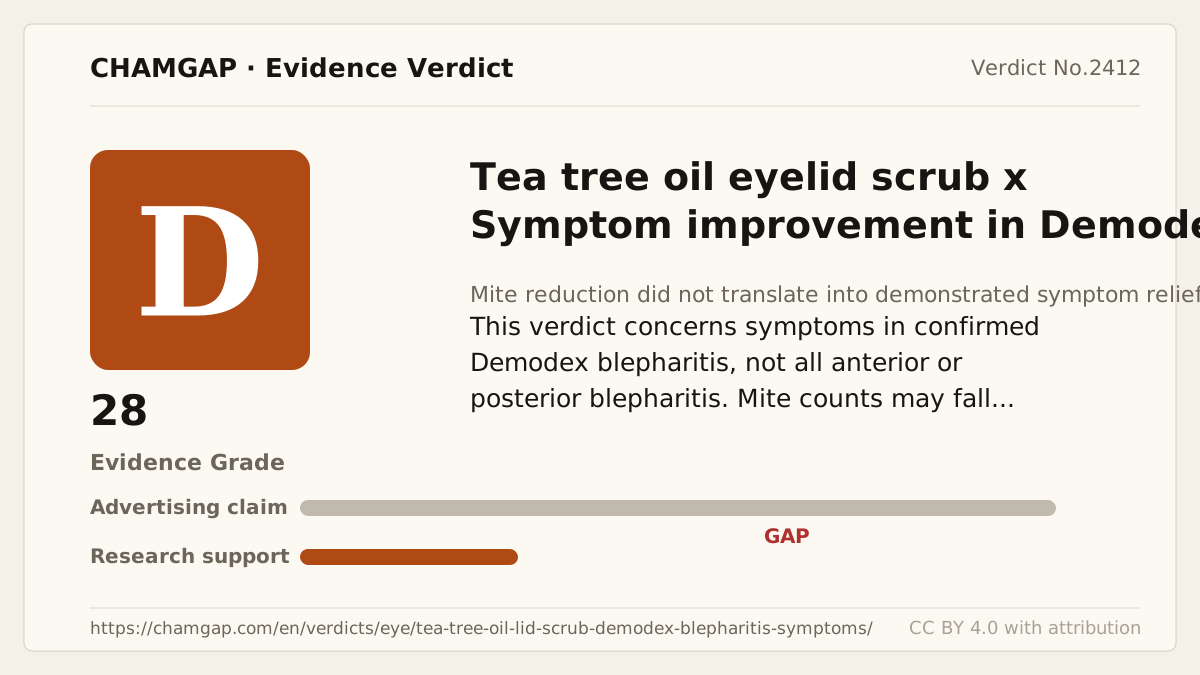
[Chamgap] Tea tree oil lid scrub × symptoms of Demodex blepharitis — Evidence Grade D·28. 3 cited sources checked. Source: https://chamgap.com/en/verdicts/eye/tea-tree-oil-lid-scrub-demodex-blepharitis-symptoms/ · CC BY 4.0CC BY 4.0 — free to use with attribution; do not distort grades, numbers, or verdict meaning.
What this document does and does not do
Chamgap is an information source. It reports what research has and has not confirmed; it does not tell readers what to take or buy. That decision belongs to readers and, when needed, medical or legal professionals. This verdict reflects literature available up to the search date and may change as new research appears. Nothing here is medical advice.